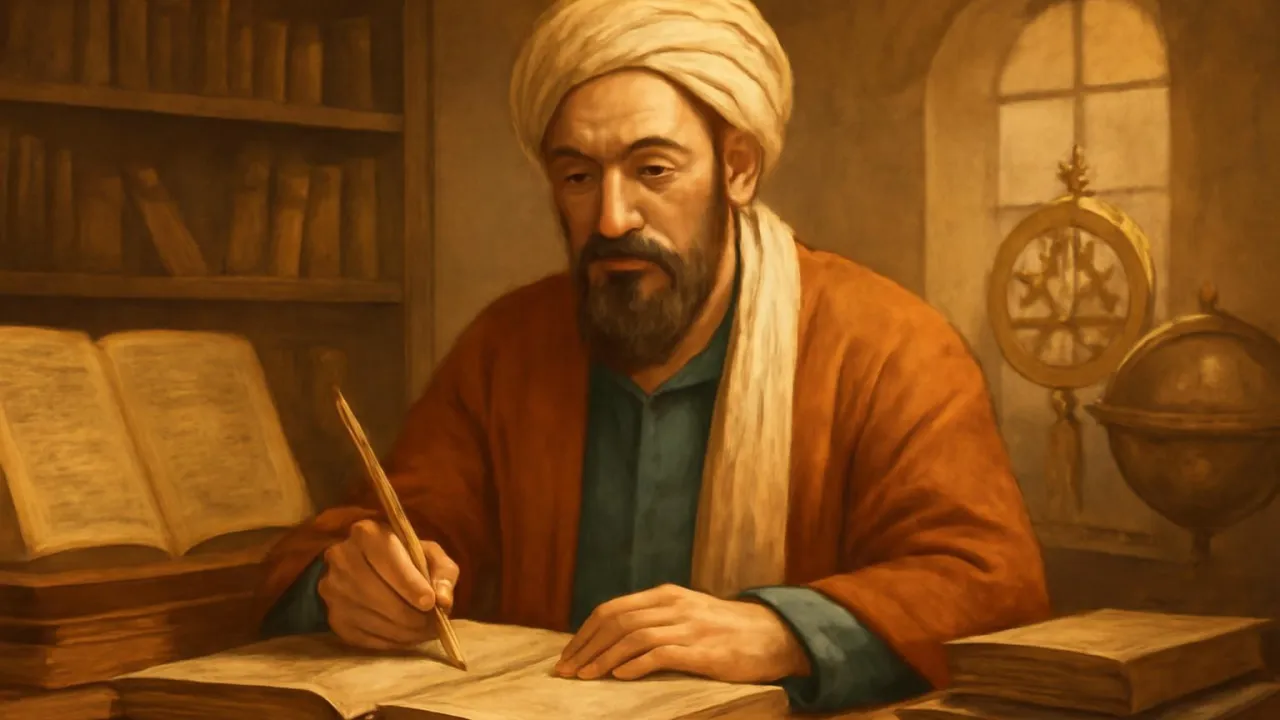
Ibn Sina’s book was a medical guide for doctors for over 600 years!
✨ Word Sparks (Grade 2 Glossary)
Tap 🔊 to hear
medicine
Ways to help people get healthy
curious
Wanting to learn or know more
practice
Doing something again and again to get better
🪝
How did a curious boy become a famous doctor and thinker?
1
Curious About the World
Ibn Sina asked many questions about nature and health. He read many books to find answers. He loved learning about how the body works.
2
Hard Work and Practice
He studied very carefully and helped many sick people. He worked day and night to understand plants and cures. His hard work made him a great doctor.
3
A Doctor Who Changed Medicine
Ibn Sina wrote a big book called The Canon of . It taught doctors how to treat illnesses well. His book was used for hundreds of years around the world.
Ibn Sina’s Canon of Medicine was a key medical textbook for over 600 years!
✨ Word Sparks (Grade 3 Glossary)
Tap 🔊 to hear
hypothesis
A smart guess to test and learn
perseverance
Never giving up, even when it's hard
philosophy
Big ideas about life and knowledge
🪝
What made Ibn Sina one of history’s greatest scientists and doctors?
1
A Mind Full of Questions
Ibn Sina was curious about how the human body works and why people get sick. He used careful observation and a strong to learn new things. His helped him study many subjects deeply. He believed knowledge could heal and help others.
2
Mastering Medicine and Philosophy
He studied medicine, , and science with great care and discipline. Ibn Sina wrote The Canon of Medicine, a detailed book that explained diseases and treatments. His work combined scientific facts with philosophical ideas about life. This helped doctors understand both body and mind.
3
Overcoming Challenges
Ibn Sina faced many challenges, like limited books and tools in his time. He used his intelligence and creativity to solve problems. His allowed him to become a leading scholar despite difficulties. His ideas changed how medicine was practiced.
4
A Lasting Legacy
The Canon of Medicine became a medical textbook for centuries across Europe and Asia. Ibn Sina’s work influenced science, , and medicine worldwide. His dedication to sportsmanship in learning inspired many future scientists. His legacy shows how curiosity and hard work can change the world.
Ibn Sina’s Canon of Medicine was a global medical textbook for over six centuries!
✨ Word Sparks (Grade 4 Glossary)
Tap 🔊 to hear
diagnose
To find out what makes someone sick
innovation
A new idea or way to do something
legacy
Something important left behind for others
🪝
How did Ibn Sina’s work change medicine and science around the world?
1
Learning in a Time of Change
Ibn Sina lived during the Islamic Golden Age, a time full of scientific discovery and learning. He studied many subjects, including medicine, philosophy, and astronomy, in Persia’s rich culture. His work built on earlier Greek and Arabic knowledge, blending ideas to create new understanding. This historical context helped him develop his famous medical texts.
2
A Turning Point in Medicine
The Canon of Medicine was Ibn Sina’s signature work, organizing medical knowledge clearly and logically. It introduced new ideas about diagnosing and treating illnesses, emphasizing careful observation and experimentation. His method helped doctors improve patient care and understand diseases better than before. This book became a turning point in medical history.
3
Innovations and Techniques
Ibn Sina described many medicines and surgical techniques that were advanced for his time. He explained how to use herbs and minerals to treat different illnesses safely. His work combined science and philosophy to explain the human body’s functions. These influenced doctors and scientists for centuries.
4
Global Impact and Legacy
The Canon of Medicine was translated into Latin and used in European universities for hundreds of years. Ibn Sina’s ideas spread across Asia, Europe, and Africa, shaping medical education worldwide. His dedication to knowledge and learning inspired generations of scientists and doctors. Today, he is remembered as a pioneer who bridged cultures and advanced human health.
2. How did Ibn Sina’s work spread around the world?
🤯 Mind-Blowing Fact • Grade 5
Ibn Sina wrote nearly 450 works, influencing medicine and philosophy worldwide for centuries!
✨ Word Sparks (Grade 5 Glossary)
Tap 🔊 to hear
empirical
Learning by watching and testing carefully
interdisciplinary
Using many subjects to learn and solve problems
metaphysical
Ideas about things beyond the physical world
🪝
What made Ibn Sina a revolutionary figure in medicine and philosophy for centuries?
1
Early Life and Intellectual Growth
Ibn Sina, born in 980 in Persia, displayed exceptional intelligence and curiosity from a young age. He mastered many subjects, including logic, natural sciences, and medicine, by reading extensively and questioning established ideas. His early education combined Islamic teachings with Greek philosophy, forming a strong foundation for his future work. This approach shaped his unique perspective on health and knowledge.
2
Scientific and Medical Contributions
Ibn Sina’s most famous work, The Canon of Medicine, systematically compiled medical knowledge from various cultures and his own discoveries. It described diseases, symptoms, and treatments with remarkable precision, emphasizing observation and experimentation. He introduced concepts such as contagious diseases and the importance of hygiene, which were revolutionary at the time. His writings also integrated philosophy, explaining the human body as a complex system influenced by both physical and factors.
3
Quantitative Achievements and Influence
Over his lifetime, Ibn Sina authored nearly 450 works, with around 240 surviving today, covering medicine, astronomy, mathematics, and philosophy. The Canon of Medicine remained the standard medical textbook in Europe and the Islamic world for over 600 years, influencing scholars like Thomas Aquinas and later Renaissance scientists. His methodical approach to diagnosis and treatment laid groundwork for modern clinical medicine and pharmacology.
4
Historical Legacy and Global Reach
Ibn Sina’s work bridged cultural and scientific traditions, blending Greek, Persian, and Islamic knowledge into a coherent system. His medical texts were translated into Latin, Hebrew, and other languages, spreading across Europe, Asia, and Africa. Universities used his Canon as a primary teaching text well into the 17th century. His legacy is not only in medicine but also in philosophy, where his ideas on metaphysics and ethics continue to be studied.
5
Inspiration and Enduring Lessons
Ibn Sina’s life teaches us the power of curiosity, perseverance, and learning. His ability to combine science, philosophy, and medicine shows how different fields can work together to solve complex problems. He inspires students and scientists to keep asking questions and to seek knowledge that benefits all humanity. His story reminds us that great discoveries often come from blending ideas across cultures and disciplines.