Hypatia
The Brilliant Mathematician of Ancient Alexandria
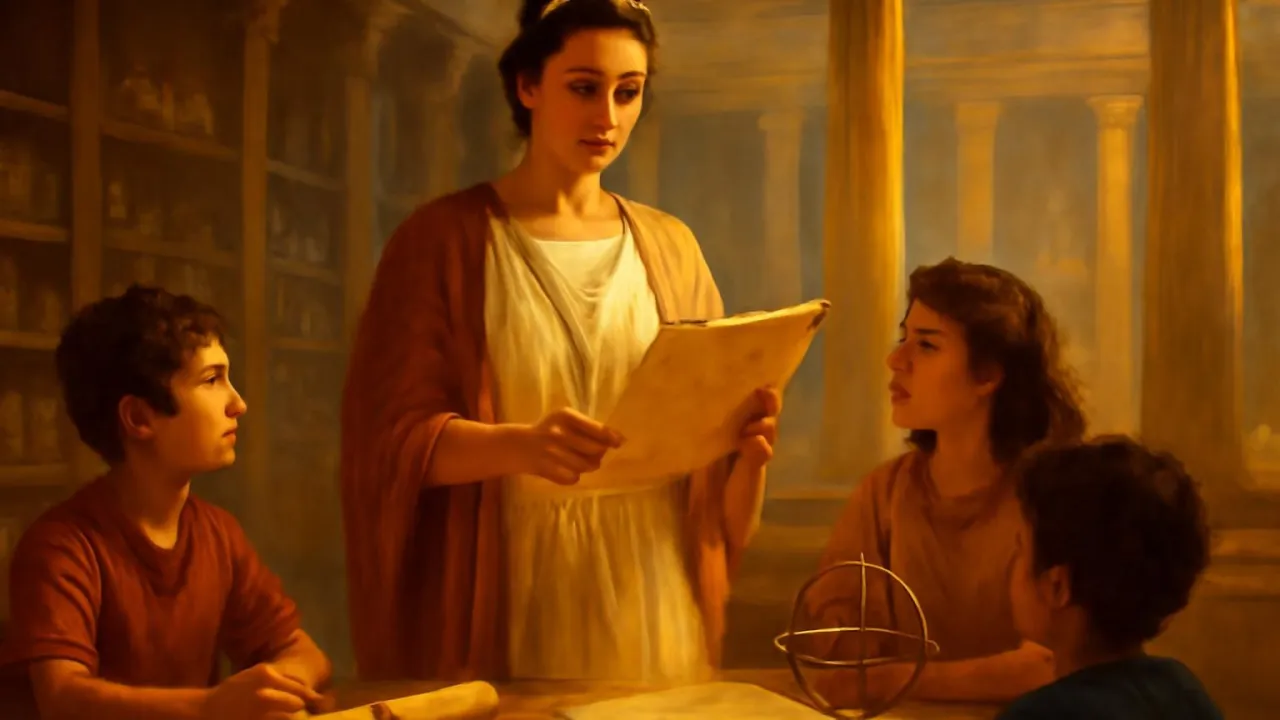
Hypatia taught in a giant library filled with scrolls!
What if you could solve big puzzles with numbers and stars?
1 A Girl with Big Questions
Hypatia loved to ask questions. She liked to count and draw. She wanted to know how things worked.
2 Learning in a Busy City
She lived in Alexandria, a busy city. She learned with her father. They read many old books together.
3 Teaching and Sharing Ideas
Hypatia taught to many people. She drew shapes and made tools. She helped others learn new things.
1. What did Hypatia love to do?
2. Where did Hypatia teach?
Hypatia was one of the first famous women teachers in science!
What would you discover if you could ask any question?
1 A Curious Mind at Home
Imagine sitting beside your parent and looking at the stars together. Thatâs how Hypatia learned, always asking questions about numbers and the world. She and her father explored math and the sky every day.
2 Practice Makes a Great Teacher
Hypatia practiced drawing shapes and making with special . She worked hard to solve tricky puzzles and understand how things fit together. Her city, Alexandria, was full of books and people who loved to learn.
3 Sharing Her Love of Learning
When she grew up, Hypatia taught math and to students from many places. She explained ideas clearly and helped others feel excited about learning. People traveled far to hear her lessons and ask her questions.
1. Who did Hypatia learn with at home?
2. Why did people come to hear Hypatia?
Hypatia improved the astrolabe, a tool for studying stars and planets!
Imagine drawing perfect circles and exploring the skyâwhat secrets would you find?
1 Growing Up with Curiosity
As a young girl in Alexandria, Hypatia was surrounded by books and ideas. Her father, Theon, was a respected mathematician who taught her about numbers and the stars. Hypatia loved solving puzzles and asking deep questions about how the world worked. She quickly became known for her sharp mind and eagerness to learn.
2 Mastering Math and Astronomy
Hypatia learned to use special tools, like the , to study the sky. She practiced drawing perfect circles and measuring with great care. Her skills in mathematics and astronomy grew stronger every year. People admired her for her careful work and clear explanations.
3 Teaching at the Great Library
When Hypatia became an adult, she taught at the famous Library of Alexandria. Students from many lands came to hear her lessons on mathematics, astronomy, and . She made difficult ideas easier to understand and encouraged everyone to keep asking questions.
4 Overcoming Challenges
Even though it was rare for women to teach, Hypatia never gave up. She faced challenges but stood strong, believing that learning was for everyone. Her courage and wisdom inspired many people in her city. Today, Hypatia is remembered as one of the greatest teachers of her time.
1. What tool did Hypatia help improve?
2. Why was Hypatia's teaching special?
Hypatiaâs lessons helped shape science and math for hundreds of years after her life!
What would it feel like to teach science in one of the worldâs oldest libraries?
1 A Childhood of Learning and Wonder
Growing up in bustling Alexandria, Hypatia was surrounded by scholars, scrolls, and the lively exchange of ideas. Her father, Theon, was not only her parent but also her mentor, teaching her advanced mathematics and astronomy from a young age. Hypatiaâs curiosity led her to study , philosophy, and the movement of the stars. She quickly gained a reputation for her sharp mind and her ability to solve challenging problems.
2 Mastering Ancient Tools and Techniques
As she grew older, Hypatia became skilled at using and improving scientific tools, such as the astrolabe and the . She used these instruments to measure the positions of stars and study the properties of liquids. Her careful experiments and clear explanations made her a respected expert in mathematics and astronomy. Hypatiaâs work helped other scientists make important discoveries for years to come.
3 A Trailblazing Teacher in Alexandria
Hypatia taught at the famous Library of Alexandria, where scholars from many countries gathered to share knowledge. Her lectures covered mathematics, astronomy, and philosophy, and she welcomed students from all backgrounds. Even though women rarely taught in public, Hypatiaâs wisdom and kindness earned her great respect. She believed that learning should be open to everyone, no matter who they were.
4 Legacy and Inspiration Across Centuries
Despite facing challenges in a time of change and unrest, Hypatia remained dedicated to teaching and discovery. Her courage and brilliance inspired generations of scientists and thinkers. Today, Hypatia is honored as one of the worldâs first great female mathematicians and a symbol of knowledge and . Her story continues to encourage people to ask questions and seek understanding.
1. Which tool did Hypatia use to study liquids?
2. Why is Hypatia remembered today?
A crater on the moon is named after Hypatia to honor her scientific legacy.
How did a woman in ancient Alexandria become one of historyâs most influential scientists and teachers?
1 A Spark of Curiosity in Ancient Alexandria
In the vibrant city of Alexandria, Hypatia grew up surrounded by scholars, scrolls, and the spirit of discovery. Her father, Theon, was a renowned mathematician and philosopher who taught her advanced mathematics, astronomy, and classical philosophy from a young age. Hypatiaâs early education included geometry, algebra, and the study of celestial movements, which fueled her desire to understand the universe. She quickly developed a reputation for her curiosity, sharp reasoning, and ability to solve complex problems that challenged even experienced scholars.
2 Mastery of Science and Mathematical Innovation
Hypatia became an expert in using and refining scientific instruments such as the astrolabe, which helped astronomers measure the positions of stars and planets. She also improved the hydrometer, a device used to determine the density of liquids, making it more accurate for scientific experiments. Her work in mathematics included writing commentaries on the works of earlier mathematicians like Diophantus and Apollonius, clarifying difficult concepts for her students. Hypatiaâs contributions to geometry, algebra, and astronomy advanced scientific understanding in the ancient world and laid the groundwork for future discoveries.
3 Teaching at the Heart of Knowledge
As a respected scholar, Hypatia taught at the Library of Alexandria and its nearby lecture halls, where students traveled from distant regions to attend her classes. Her lessons covered mathematics, astronomy, and philosophy, and she was known for her clear explanations and willingness to answer challenging questions. Despite living in a time when women were rarely allowed to teach, Hypatiaâs wisdom, patience, and fairness earned her the admiration of students and fellow scholars alike. She believed that knowledge should be shared freely and that education was a path to understanding and peace.
4 Challenges, Courage, and Enduring Legacy
Hypatia lived during a period of political and religious turmoil in Alexandria, which made her work both important and dangerous. She faced prejudice and threats because she was a woman and a respected , but she continued to teach and write with courage and resilience. Her commitment to reason, scientific inquiry, and open dialogue made her a symbol of intellectual freedom. After her tragic death, her life became a legend, inspiring later generations to value education, critical thinking, and perseverance in the face of adversity.
5 Inspiration for Future Scientists and Thinkers
Today, Hypatia is celebrated as one of the first great female mathematicians and scientists in recorded history. Her story encourages people of all backgrounds to pursue learning, ask bold questions, and stand up for the importance of knowledge. Statues, books, and even craters on the moon have been named in her honor, reflecting her lasting impact on science and culture. Hypatiaâs reminds us that curiosity, courage, and the love of learning can change the world, no matter where or when you live.
1. How did Hypatia help future scientists?
2. Why is Hypatiaâs life still important today?