1. What heats the underground water inside hot springs and geysers?
2. What is the name of Yellowstone's famous geyser that erupts many times every day?
🤯 Mind-Blowing Fact • Grade 2
Tiny heat-loving microbes living inside Yellowstone's hot springs helped scientists invent the DNA copying tool used in medical labs worldwide!
✨ Word Sparks (Grade 2 Glossary)
Tap 🔊 to hear
thermophile
Tiny living organism that thrives in high heat.
plumbing
Underground network of cracks and rock tubes.
mineral
Natural solid crystal dissolved and carried in water.
🪝
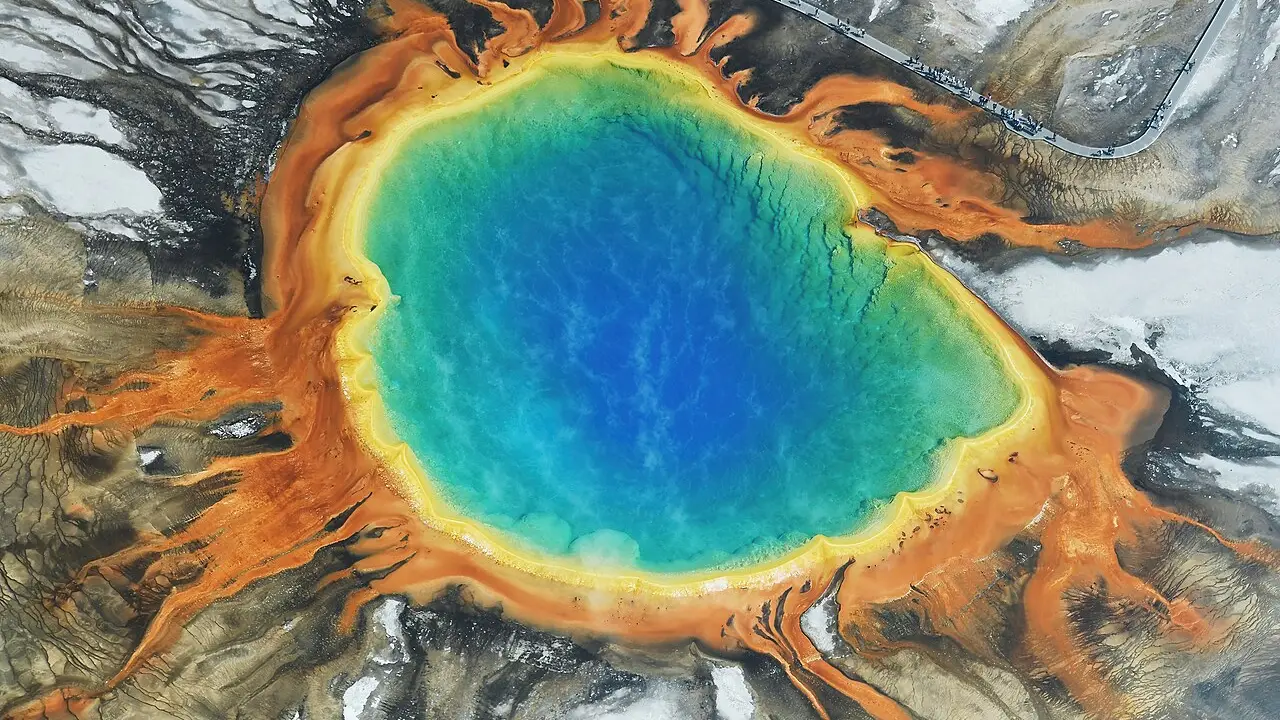
Why are some hot springs painted in bright rainbow rings of orange, yellow, and emerald green?
1
Why Geysers Are Picky
Hot springs bubble up on every continent, yet geysers are super rare—only about 1,000 exist on Earth! Every geyser needs three special ingredients: plenty of water, strong underground heat, and narrow rock tubes strong enough to hold high steam pressure.
2
Rainbow Microbe Mats
Peer at Yellowstone's Grand Prismatic Spring, and its center glows deep blue while its edges shine yellow and orange! Tiny heat-loving microbes called live in the warm water, creating natural rainbow bands according to water temperature.
3
Warm Springs Without Volcanoes
Not every hot spring sits near a volcano! In Bath County, Virginia, rainwater sinks miles down along deep rock folds, warms up naturally, and rises into soothing warm springs.
1. What creates the bright yellow and orange rainbow rings around hot springs like Grand Prismatic Spring?
2. How many geysers exist on the entire planet?
🤯 Mind-Blowing Fact • Grade 3
Yellowstone's Steamboat Geyser—the tallest active geyser on Earth—can blast boiling water more than 300 feet (90 meters) into the air, taller than the Statue of Liberty!
✨ Word Sparks (Grade 3 Glossary)
Tap 🔊 to hear
superheated
Liquid heated past boiling point under high pressure.
geyserite
Hard silica mineral crust lining geyser vents.
groundwater
Rain and snowmelt stored inside underground rock cracks.
🪝
How can underground water heat WELL past 100 °C without boiling—until all of a sudden it blasts into the sky?
1
Plumbing Makes the Difference
Both hot springs and geysers run on geothermal energy—heat from inside Earth. In an ordinary hot spring, wide underground cracks let hot water rise freely to the surface, circulate, and cool safely without building pressure.
2
Trapped Under Heavy Water
A geyser's underground tubes are twisted and pinched narrow! Cooler water near the top presses down heavily on water deep below, stopping it from boiling even above 100 °C—a state scientists call water.
3
Flash-Boiling Eruption!
Once a few steam bubbles finally push some top water out of the vent, pressure below drops in a flash! Gallons of water instantly turn to expanding steam, rocketing a towering fountain 30 to 90 meters into the air.
4
Self-Sealing Silica Pipes
Hot water dissolves silica from volcanic rock and coats the geyser's narrow tubes with smooth stone called , sealing leaky cracks so the geyser stays pressure-tight!
1. Why doesn't a regular hot spring shoot high into the air like a geyser?
2. Which geyser in Yellowstone holds the world record as Earth's tallest active geyser?
🤯 Mind-Blowing Fact • Grade 4
Iceland gets its word 'geyser' from the Great Geysir, and today Iceland uses natural geothermal hot water to heat nearly 9 out of every 10 homes across the island!
✨ Word Sparks (Grade 4 Glossary)
Tap 🔊 to hear
travertine
Step-like limestone mineral rock built by hot springs.
geothermal gradient
Steady rise in temperature deeper inside Earth's crust.
sinter
Silica mineral crust deposited around volcanic hot springs.
🪝
Where did the word 'geyser' come from—and how does Virginia have natural warm springs hundreds of miles from any volcano?
1
From Iceland's Geysir to Five Global Fields
Every geyser on Earth borrows its name from 'Geysir,' a famous spouting spring in southwestern Iceland whose Old Norse name means 'to gush'! Because geysers require an exact trio of abundant groundwater, shallow magmatic heat, and silica-rich rhyolite rock to seal narrow plumbing conduits, major geyser fields cluster in just five places on Earth: Yellowstone (USA), Iceland, Kamchatka (Russia), Taupo (New Zealand), and El Tatio high in Chile's Andes.
2
Sinter vs. Travertine Terraces
Dissolved minerals shape dramatically different geothermal landscapes depending on bedrock! Where superheated water dissolves silica from volcanic rhyolite, cooling splashes build pearly-grey mounds and cones of siliceous (geyserite) around Old Faithful. Where hot water rises through limestone—like Yellowstone's Mammoth Hot Springs—it dissolves calcium carbonate and deposits gleaming white stair-step waterfalls of !
3
Virginia's Non-Volcanic Geothermal Springs
You don't always need a magma chamber to make a warm spring! In Virginia's Alleghany Highlands (Warm Springs and Hot Springs), rainwater seeps roughly a kilometer deep through folded sedimentary quartzite and limestone. Earth's normal —which warms about 25 °C per kilometer of depth—heats the water naturally before faults channel it rapidly back up around 35 to 40 °C!
4
Clean Geothermal Power
Countries like Iceland and parts of the western United States tap underground geothermal steam to heat homes and spin turbines for clean, round-the-clock electricity.
1. How are the warm springs in Bath County, Virginia heated without any nearby volcano?
2. What rock builds the gleaming white stair-step terraces at Mammoth Hot Springs when hot water flows through limestone?
🤯 Mind-Blowing Fact • Grade 5
Subsurface seismic mapping beneath Old Faithful revealed an underground cavern holding billions of bubbles that slosh like a rhythmic heartbeat before launching 30,000 liters of boiling water per eruption!
✨ Word Sparks (Grade 5 Glossary)
Tap 🔊 to hear
hydrostatic pressure
Downward pressure exerted by the weight of water.
fumarole
Volcanic vent emitting superheated steam and gases only.
mudpot
Acidic hot spring that dissolves rock into bubbling clay.
🪝
How did underground video cameras reveal a secret sideways 'bubble trap' that keeps Old Faithful erupting like clockwork—and how did a hot-spring microbe revolutionize genetics?
1
Thermodynamics of Episodic Geyser Eruptions
At sea level, pure water boils at 100 °C; at Yellowstone's high elevation (~2,240 meters), lower atmospheric pressure drops surface boiling to ~93 °C. Deeper inside a geyser's conduit, however, from the overlying water column raises the boiling point substantially—exceeding 170 °C just 100 meters down! Using miniature heat-shielded video cameras and seismic arrays around Old Faithful, geophysicists discovered its conduit isn't a straight vertical pipe: roughly 15 meters down sits an angled side cavern that acts as a 'bubble trap,' accumulating compressible steam pockets like a rechargeable spring.
2
Decompression Cascade and Recharge
Once trapped steam oscillates and spills water out the surface vent, drops throughout the column in milliseconds. A downward-propagating boiling wave flashes superheated water into steam—which expands over 1,500 times in volume—propelling a supersonic two-phase jet skyward until the reservoir empties and cool meteoric groundwater recharges the fracture network for the next 90-minute cycle.
3
Amorphous Silica vs. Acid-Sulfate Mudpots
Chemistry governs hydrothermal landforms. Neutral-chloride waters circulating deep through rhyolitic ash-flow tuffs dissolve silica and precipitate impervious opaline geyserite linings capable of withstanding explosive pressures. Conversely, where rising `H2S` gas oxidizes near the surface into sulfuric acid (`H2SO4`) with scarce groundwater, acid dissolves surrounding rock into bubbling clay cauldrons called and hissing steam vents called .
4
Thermus aquaticus and the PCR Revolution
In 1966, microbiologist Thomas Brock discovered Thermus aquaticus thriving at 70 °C inside Yellowstone's Mushroom Spring. Its heat-proof enzyme—Taq polymerase—enabled Polymerase Chain Reaction (PCR), earning a Nobel Prize and powering modern medical diagnostics, forensics, and ancient DNA research!
5
Astrobiological Analogs
Because silica sinter preserves fossilized microbial mats over billions of years, NASA rovers specifically hunt ancient hot-spring silica deposits—like Columbia Hills on Mars—for potential biosignatures of early planetary life.