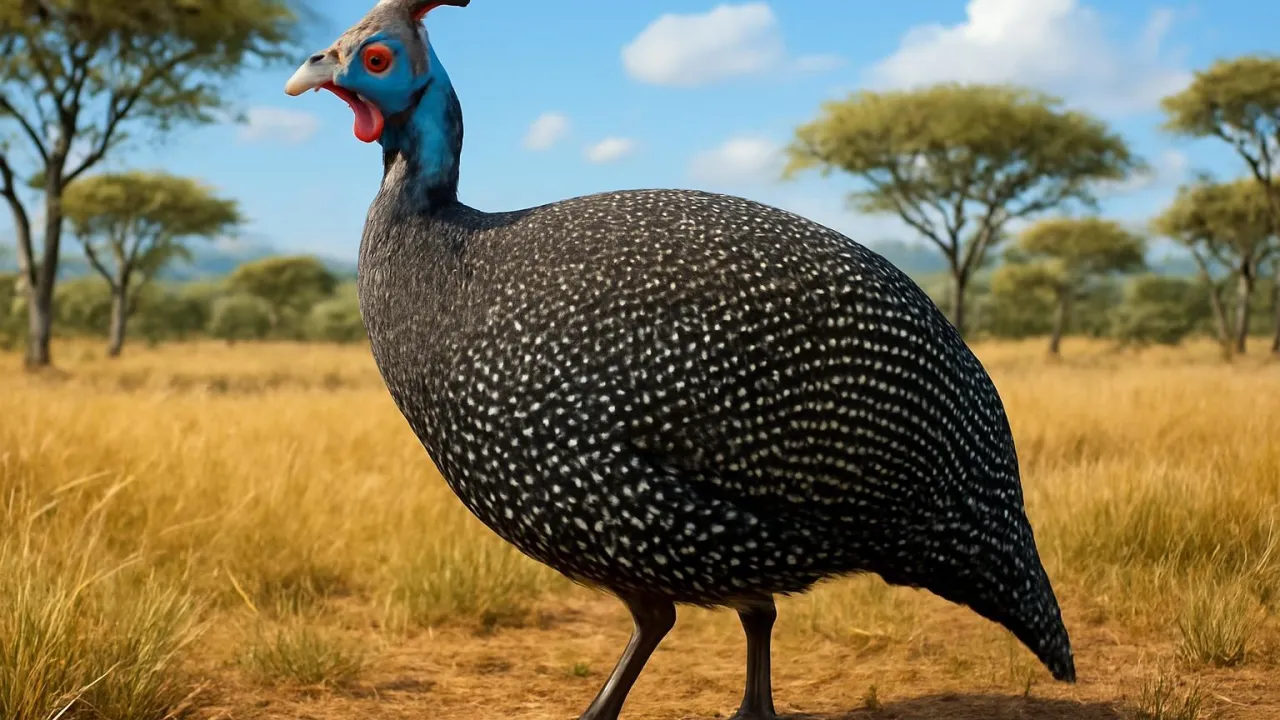
Helmeted guineafowl can run up to 15 miles per hour to escape predators!
✨ Word Sparks (Grade 2 Glossary)
Tap 🔊 to hear
savanna
A grassy place with few trees
beak
A bird's hard mouth part
predator
An animal that hunts others
🪝
Have you ever seen a bird with a bony helmet on its head?
1
Helmet and Body
The helmeted guineafowl has a hard bony helmet on its head. Its feathers are dark gray with many white spots. It looks like a polka dot ball when it moves. This helmet helps protect its head from bumps.
2
Where It Lives
This bird lives in open woodlands and in Africa. It likes places with tall grass and trees. Guineafowl often walk on the ground to find food. They can also fly short distances to escape danger.
3
What It Eats
Helmeted guineafowl eat seeds, insects, and small animals like worms. They use their strong to peck at food on the ground. These birds help farmers by eating pests. Their loud calls warn others about nearby danger.
The helmeted guineafowl’s spotted feathers help it blend perfectly into tall grass!
✨ Word Sparks (Grade 3 Glossary)
Tap 🔊 to hear
camouflage
Colors that help hide an animal
ecosystem
All living things in one place
adaptation
A body change that helps survive
🪝
Did you know the helmeted guineafowl wears a bony helmet to stay safe?
1
Unique Helmet and Spots
The helmeted guineafowl has a hard, bony casque on its head that protects it. Its body feathers are dark gray with many white spots, which help with in tall grass. This spotted pattern makes it harder for predators to see it clearly. The helmet also helps the bird push through bushes safely.
2
Habitat and Behavior
These birds live mainly in African savannas and open woodlands where they find food easily. They walk on the ground to search for seeds, insects, and small animals, using their strong beaks to peck. When threatened, they run fast or fly short distances to escape predators. Their loud calls serve as warnings to others nearby.
3
Role in the Ecosystem
Helmeted guineafowl help control insect populations by eating bugs that can harm plants. Their feeding habits contribute to spreading seeds, aiding plant growth. They are prey for larger animals, making them part of the food web. Their presence supports a balanced in their habitat.
4
Adaptations for Survival
The bird’s strong legs allow it to run quickly to avoid danger, while its spotted feathers provide . The bony helmet protects its head when moving through thick bushes. Loud calls warn the flock about predators, increasing their chances to escape. These help the guineafowl survive in the wild.
Helmeted guineafowl have adapted to live in farmlands, helping farmers by eating pests naturally!
✨ Word Sparks (Grade 4 Glossary)
Tap 🔊 to hear
symbiosis
Two living things helping each other
omnivore
An animal that eats plants and animals
vigilance
Being watchful for danger
🪝
How does the helmeted guineafowl’s bony helmet help it survive in Africa’s wild?
1
Physical Features and Protection
The helmeted guineafowl has a distinctive bony casque on its head, which protects it as it moves through dense bushes and thorny plants. Its dark feathers, covered with white spots, provide excellent camouflage in the grasslands, helping it avoid predators. This bird’s strong legs allow it to run swiftly, often reaching speeds up to 15 miles per hour. These physical features work together to increase its chances of survival.
2
Habitat and Geographic Range
Helmeted guineafowl primarily inhabit the savannas and open woodlands of Sub-Saharan Africa, where there is a mix of grass and scattered trees. They prefer areas with plenty of ground cover to hide from predators. Their range extends from Senegal in the west to Ethiopia in the east and down to South Africa. Human farming has affected some habitats, but these birds adapt well to farmlands.
3
Ecosystem Role and Food Web
As , helmeted guineafowl consume seeds, insects, and small animals, helping control pest populations that might damage crops. They also serve as prey for larger predators like jackals and birds of prey, making them an important part of the food web. Their feeding behavior helps disperse seeds, which supports plant growth and ecosystem health. This symbiotic relationship benefits both plants and animals.
4
Behavior and Communication
Helmeted guineafowl are social birds that live in groups called flocks, which helps protect them from predators through collective . They use loud, harsh calls to warn others about approaching danger, which increases the survival chances of the entire flock. These birds also use body language, such as raising their helmets and fluffing feathers, to communicate. Their ability to run fast and fly short distances aids quick escapes.
Helmeted guineafowl can run faster than a person walks and have a bony helmet on their heads!
✨ Word Sparks (Grade 5 Glossary)
Tap 🔊 to hear
casque
A hard bony helmet on a bird’s head
Galliformes
An order of heavy-bodied ground birds
seed dispersal
Spreading seeds to grow new plants
🪝
What makes the helmeted guineafowl a unique bird in Africa’s ecosystems and farms?
1
Scientific Classification and Physical Traits
The helmeted guineafowl, scientifically named Numida meleagris, belongs to the family Numididae within the order . It stands about 20 to 28 inches tall and weighs between 2.2 and 4.4 pounds. Its most distinctive feature is the bony on its head, which provides protection and aids in social signaling. The bird’s plumage is dark gray with numerous white spots, an adaptation for camouflage in its natural habitat.
2
Physiological Adaptations and Behavior
This bird’s strong legs enable it to run at speeds up to 15 miles per hour, allowing quick escapes from predators. Its short, rounded wings facilitate short bursts of flight but are not suited for long distances. The ’s bony structure protects the skull during fights or when pushing through dense vegetation. Helmeted guineafowl communicate through loud, harsh calls that alert flocks to danger, enhancing group survival.
3
Ecological Role and Conservation Status
Helmeted guineafowl play a vital role in controlling insect populations, consuming large numbers of agricultural pests. They contribute to , promoting plant diversity and ecosystem health. While not currently endangered, habitat loss and hunting pressure in some regions pose risks. However, their adaptability to farmlands has helped maintain stable populations across much of Sub-Saharan Africa.
4
Historical and Agricultural Importance
Humans have domesticated helmeted guineafowl for centuries, valuing them for pest control and meat production. Their natural behavior of foraging for insects reduces the need for chemical pesticides. In many African cultures, they hold symbolic significance and are part of traditional farming systems. This bird’s presence in agricultural landscapes supports sustainable farming practices.
5
Quantitative Comparisons and Interesting Facts
Helmeted guineafowl can run faster than many other ground birds, reaching speeds of 15 miles per hour, which is faster than the average human walking speed. They weigh roughly the same as a small cat but are much lighter than many other game birds. Their can grow up to 2 inches long and is made of solid bone. These birds thrive in temperatures ranging from 59 to 104 degrees Fahrenheit, showing great adaptability.