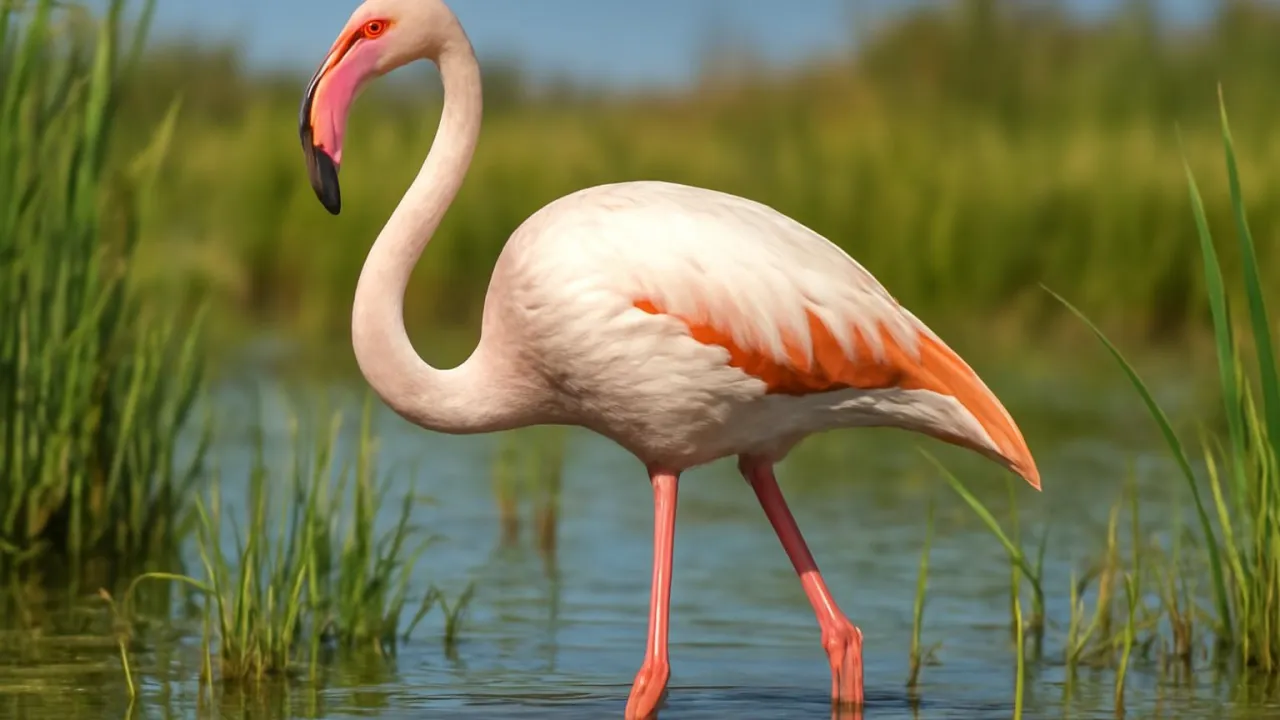
Greater flamingos can live up to 30 years in the wild!
✨ Word Sparks (Grade 2 Glossary)
Tap 🔊 to hear
wetlands
Land with water like lakes and swamps
filter
To separate tiny things from water or air
nest
A home birds build to lay eggs
🪝
Have you ever seen a bird that stands on one leg all day long?
1
Pink Color Comes from Food
Greater flamingos get their pink color from eating tiny shrimp and algae. They live in shallow lakes and . Their bright feathers help them blend with the pink water at sunset.
2
Long Legs and Neck
These birds have very long legs and necks to wade through water easily. They often stand on one leg to rest and keep warm. Their curved beak helps small food from the water.
3
Where They Live
Greater flamingos live in warm places like Africa and southern Europe. They build from mud near water. Baby flamingos are gray but turn pink as they grow.
Greater flamingos can filter up to 20 liters of water per hour to find food!
✨ Word Sparks (Grade 3 Glossary)
Tap 🔊 to hear
carotenoids
Pigments that give plants and animals color
adaptation
A change that helps animals survive better
camouflage
Colors or patterns that help hide animals
🪝
How does a flamingo’s curved beak help it eat in muddy water?
1
Pink Color and Diet
Greater flamingos get their pink color from in shrimp and algae they eat. These pigments color their feathers over time. Their diet is full of nutrients that help keep feathers bright. This is an example of to their food source.
2
Beak and Feeding
Their unique curved beak filters food from water and mud. Tiny hairs inside the beak trap shrimp and plankton. This filtering helps them gather enough nutrients. It is a special for feeding in shallow wetlands.
3
Habitat and Nesting
Greater flamingos live in salty or alkaline lakes in Africa, southern Europe, and Asia. They build mud nests in colonies to protect eggs from predators. These habitats provide food and safety. Their choice of habitat helps their survival.
4
Behavior and Camouflage
Flamingos often stand on one leg to conserve body heat and energy. Their pink feathers blend with the sunset sky and water, helping them from predators. This behavior and coloring help flamingos avoid danger. They also use loud calls to communicate in large groups.
1. What is one way flamingos protect themselves from predators?
2. How do flamingos catch tiny shrimp and plankton?
🤯 Mind-Blowing Fact • Grade 4
Greater flamingos can fly up to 37 miles per hour during long migrations between wetlands.
✨ Word Sparks (Grade 4 Glossary)
Tap 🔊 to hear
nutrients
Substances that help plants and animals grow
colonies
Groups of animals living closely together
pollution
Harmful waste that damages nature
🪝
How do greater flamingos’ habits affect their wetland ecosystems?
1
Diet and Ecosystem Role
Greater flamingos feed mainly on algae, small shrimp, and plankton, which helps control these populations in wetlands. Their feeding stirs up sediment, recycling that support other aquatic life. This makes them important players in their ecosystem’s food web. Their presence supports biodiversity in salty lakes.
2
Adaptations for Survival
Their specialized curved beak allows efficient filtering of tiny food from water, an adaptation to their wetland habitat. Standing on one leg conserves body heat in cool weather, showing behavioral adaptation. Their bright pink feathers also play a role in mating displays, attracting partners. These adaptations help flamingos survive and reproduce.
3
Geographic Distribution and Habitats
Greater flamingos are found across Africa, southern Europe, and parts of Asia in saline or alkaline lakes. They prefer shallow waters where food is abundant and build mud nests in to protect their young. Human activities like habitat loss and threaten some populations. Conservation efforts focus on protecting wetlands.
4
Interactions and Human Impact
Flamingos live in large that provide safety and social interaction. They communicate with loud calls and synchronized movements. Wetland degradation from farming and development reduces their habitat. Protecting these areas benefits flamingos and many other species. People study flamingos to understand wetland health better.
1. Why is the flamingo’s feeding important for wetlands?
2. How do human actions affect flamingos?
🤯 Mind-Blowing Fact • Grade 5
Greater flamingos filter up to 20 liters of water per hour, eating thousands of tiny shrimp daily!
✨ Word Sparks (Grade 5 Glossary)
Tap 🔊 to hear
lamellae
Tiny comb-like parts inside a bird’s beak
IUCN
Group that protects endangered animals
migration
Seasonal movement of animals to new places
🪝
What unique biological traits allow greater flamingos to thrive in harsh wetland environments?
1
Taxonomy and Scientific Classification
The greater flamingo, Phoenicopterus roseus, belongs to the family Phoenicopteridae, order Phoenicopteriformes. It is the largest species of flamingo and is closely related to other flamingo species found worldwide. Its classification helps scientists study evolutionary adaptations among wading birds. Understanding taxonomy reveals relationships within bird families.
2
Physiological Adaptations and Feeding Mechanics
Greater flamingos have specialized inside their curved beaks that act as filters to separate food from water. Their long legs and webbed feet enable wading in deep, saline waters where few predators venture. The carotenoid pigments in their diet metabolize to produce their vibrant pink feathers. These physiological traits allow survival in nutrient-poor, salty wetlands.
3
Conservation Status and Habitat Challenges
Although classified as Least Concern by the , greater flamingo populations face threats from wetland drainage, pollution, and human disturbance. Habitat loss reduces breeding sites and food availability, impacting reproductive success. Conservation programs focus on protecting key wetland habitats and monitoring populations to ensure long-term survival. Public education raises awareness about wetland importance.
4
Behavioral Ecology and Social Structure
Greater flamingos form large, dense colonies that enhance predator detection and social bonding. Their synchronized group displays during courtship increase mating success. Standing on one leg reduces heat loss by minimizing exposed surface area. Vocalizations coordinate group movements and maintain flock cohesion during . These behaviors optimize survival in dynamic wetland environments.
5
Quantitative Comparisons and Migration Patterns
Greater flamingos can reach heights of up to 1.5 meters and weigh between 2.5 to 4 kilograms. They migrate seasonally, flying at speeds up to 60 kilometers per hour over distances exceeding 1,000 kilometers. Their wingspan measures about 1.5 to 1.7 meters, allowing efficient long-distance flight. These quantitative traits facilitate adaptation to diverse wetland habitats across continents.