1. What happens when you gently breathe air inward through a harmonica?
2. About how big is a classic ten-hole harmonica?
🤯 Mind-Blowing Fact • Grade 2
Blowing into any three neighbor holes at once on a standard C harmonica always makes a pleasant, in-tune C major chord!
✨ Word Sparks (Grade 2 Glossary)
Tap 🔊 to hear
comb
Slotted middle body dividing air into channels
free reed
Thin metal strip swinging freely through slot
draw
Pull air inward through a harmonica hole
🪝
What hides inside a harmonica's ten little tunnels to make twenty different notes?
1
A Sandwich of Metal and Wood
Imagine sliding a campfire band right into your backpack! If you peek inside a harmonica, it looks like a neat three-layer sandwich with shiny steel covers on top and bottom.
2
Comb and Brass Tongues
The middle frame has ten air channels shaped like teeth on a hair . Bolted onto that comb sit two brass plates holding twenty paper-thin metal strips called .
3
Cupping Your Hands
Ten reeds buzz only when you blow out, and ten partner reeds buzz when you air in. Opening and closing cupped hands around the back makes the sound talk with a playful 'wah-wah' voice that delights every listener!
1. Why is the middle block of a harmonica called a comb?
2. How many brass reeds hide inside a standard ten-hole diatonic harmonica?
🤯 Mind-Blowing Fact • Grade 3
Matthias Hohner began building harmonicas at his kitchen table in Germany in 1857, and within decades his workshops were shipping millions every year!
✨ Word Sparks (Grade 3 Glossary)
Tap 🔊 to hear
riveted
Fastened tightly at one end with metal
pitch bend
Lowering a note smoothly using mouth shape
slide button
Spring button shifting harmonica notes up half-step
🪝
How can a musician make a stiff piece of brass cry and slide downward like a blues guitar?
1
Inspired by Asian Mouth Organs
In the 1820s, European clockmakers and instrument builders studied ancient Chinese sheng mouth organs that used tiny free reeds. Soon, German towns like Trossingen were crafting millions of pocket harmonicas tuned with clever chord layouts.
2
Free to Swing Without Hitting
Unlike a clarinet reed that beats against a mouthpiece, a harmonica's brass reed is at one end over a snug rectangular slot. Air pressure pushes the tip cleanly through the slot and back, chopping the airstream into bright sound waves.
3
Bending Notes for the Blues
Normally a ten-hole harmonica plays only one major scale, missing sharps and flats. Yet blues pioneers discovered that arching the tongue backward changes mouth resonance, forcing a reed to drop smoothly in pitch—a soulful trick called bending!
4
Diatonic vs. Chromatic
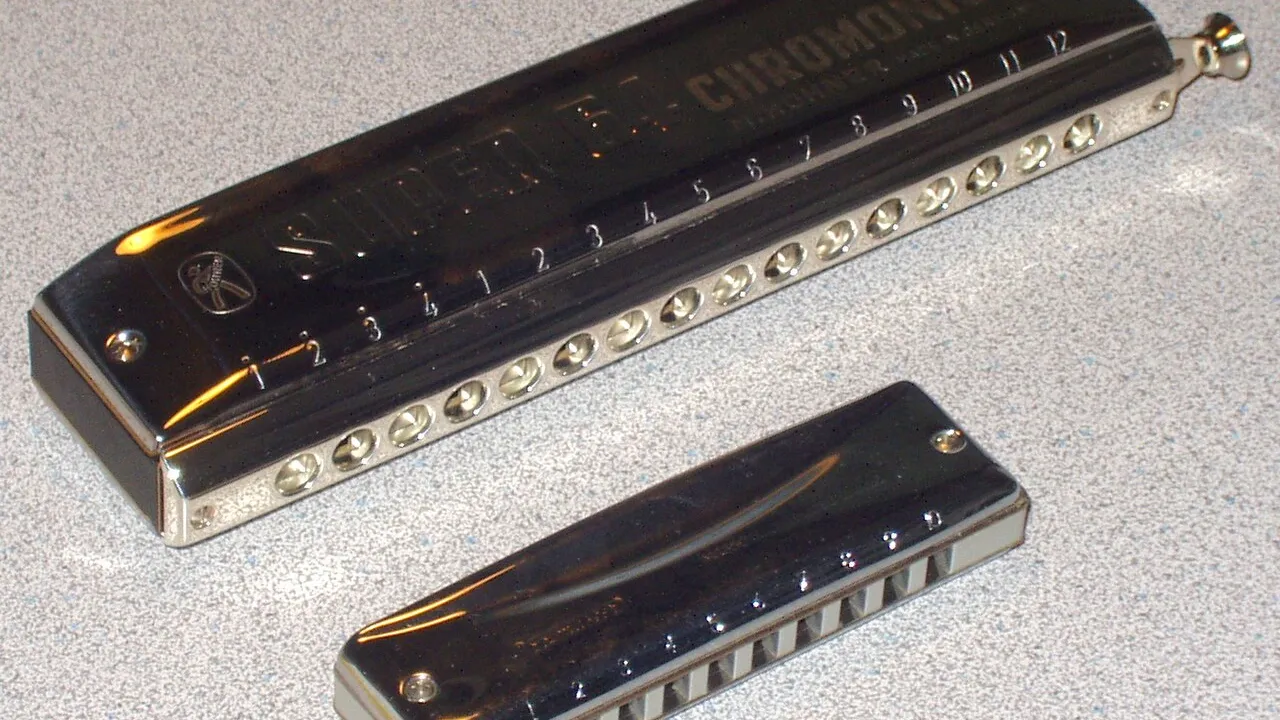
Jazz and classical soloists often play a chromatic harmonica, pressing a spring-loaded side button to slide into a second set of sharps and flats. Meanwhile, folk and rock singers clip a diatonic harmonica onto a wire neck rack so they can strum guitar and blow melodies at once!
1. Why is the brass tongue inside a harmonica called a 'free' reed?
2. What does pressing the side button on a chromatic harmonica do?
🤯 Mind-Blowing Fact • Grade 4
Chicago blues legend Little Walter cupped his ten-hole harmonica tightly against a taxi-dispatch 'bullet' microphone wired into a guitar amplifier, inventing the gritty 'Mississippi saxophone' sound!
Why does drawing air inward on a blues harmonica bend pitches so deeply when both reeds inside one chamber team up?
1
Richter's Clever Layout
Pick up a standard ten-hole C harmonica and examine its note chart: the lowest holes skip certain scale steps so exhaling always yields a C-E-G tonic chord while inhaling sounds a G-B-D-F dominant chord! Designed in nineteenth-century Bohemia by Joseph Richter, this tuning meant folk players could accompany dances effortlessly.
2
Two-Reed Acoustic Tug-of-War
For decades, makers assumed missing notes in the bottom octave were simply unavailable. Then African American blues innovators unlocked '' playing—performing in G on a C harp—and deep draw bends. Because each chamber shares one blow reed and one higher-pitched draw reed, tuning the vocal tract between their two frequencies couples both reeds together, slowing the draw reed and waking the blow reed to bend pitches down up to three !
3
Tongue Blocking and Chugging Trains
Covering three or four holes with the lips while blocking the left holes with the tip of the tongue lets a virtuoso slap rhythmic chords against crisp single-note melodies or split octaves, imitating chugging steam locomotives and lonesome train whistles across the American South.
4
Global Voices from Campfire to Symphony
From Sonny Boy Williamson and Little Walter electrifying Chicago blues through cupped microphones to Toots Thielemans, Stevie Wonder, and Larry Adler performing jazz ballads and orchestral concertos on sixteen-hole chromatic models, this four-inch marvel conquered nearly every musical genre on Earth.
1. Why did Joseph Richter skip two scale notes in the bottom octave of a ten-hole harmonica?
2. What physical surprise happens inside a hole during a deep blues draw bend?
🤯 Mind-Blowing Fact • Grade 5
Machining tolerances inside a concert harmonica are so tight—less than the thickness of a human hair—that makers scrape the tip of a reed to raise its pitch or scrape its base near the rivet to lower its pitch!
✨ Word Sparks (Grade 5 Glossary)
Tap 🔊 to hear
cantilevered
Anchored at one end while hanging free
overblow
Advanced technique popping reed above normal pitch
windsaver
Thin flap sealing unused chromatic reed slots
🪝
How do twenty cantilevered brass tongues spanning ten centimeters achieve full three-octave chromaticism through oral-cavity aerodynamics?
1
Aeromechanics of Closing vs. Opening Free Reeds
Out of a musician's tightly cupped palms erupts a wailing blue note that slides, shimmers, and resolves into a four-voice chord. Classified under Hornbostel-Sachs 412.132 (sets of free reeds with individual air ducts), the harmonica mounts brass or phosphor-bronze tongues over milled brass slots with tolerances narrower than fifty micrometers. Crucially, blow reeds mount inside the chamber (acting as 'closing' reeds pushed shut by lung pressure), whereas draw reeds mount on the outside face (acting as 'opening' reeds pulled inward during inhalation).
2
Dual-Reed Coupling in Richter Chambers
On a standard ten-hole diatonic model spanning three octaves (C4 at 261.6 hertz to C7 at 2,093 hertz), holes 1 through 6 place the draw reed higher in pitch than the paired blow reed, while holes 7 through 10 invert that relationship. Acoustic research reveals that pitch bending is never a solitary reed phenomenon: shaping the tongue and pharynx creates an oral resonance between the two paired frequencies, retarding the higher 'opening' reed while exciting the lower 'closing' reed in reverse so pitch glides continuously across the gap.
3
Overblows and Overdraws
Late-twentieth-century virtuosos like Howard Levy took reed physics even further. By choking the normal closing reed via precise vocal-tract impedance, a player forces the opposite reed to vibrate as an 'opening' reed ABOVE its natural frequency—unlocking missing chromatic notes called (holes 1–6) and overdraws (holes 7–10) so a ten-hole diatonic harp plays chromatically in all twelve keys!
4
Chromatic Valving, Tremolo, and Windsavers
Alternatively, twelve- and sixteen-hole solo-tuned chromatic harmonicas stack two complete harmonicas—such as C and C-sharp—behind a spring-loaded mouthpiece slide, utilizing thin PTFE check-valve flaps called to prevent air leakage across up to sixty-four independent reeds, while double-row tremolo harmonicas pair slightly detuned reeds for shimmering East Asian and European folk melodies.
5
Transcultural Evolution
Sparked by Christian Friedrich Ludwig Buschmann's 1821 Aura and Asian free-reed sheng imports, industrialized by Matthias Hohner in Trossingen, and reinvented from acoustic folk roots into amplified urban blues and symphonic concertos for Ralph Vaughan Williams and Heitor Villa-Lobos, the harmonica remains humanity's most widely produced acoustic instrument.