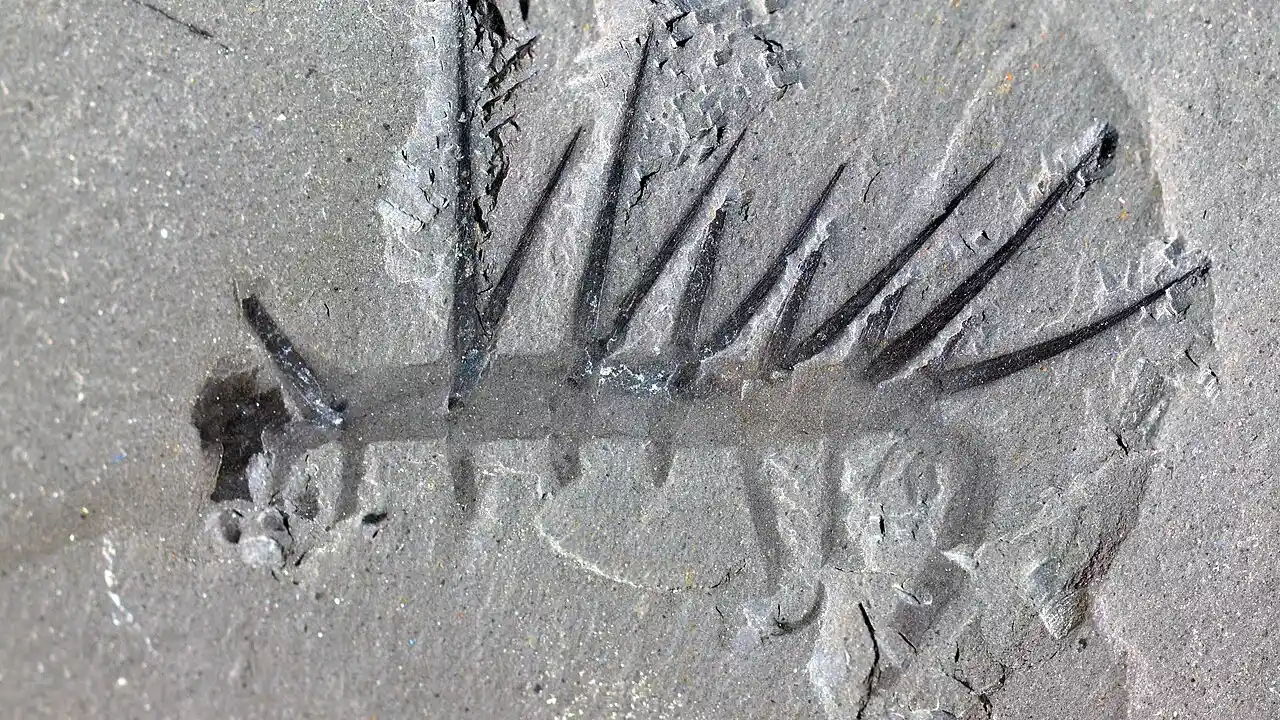
1. What were the seven pairs of stiff spikes on Hallucigenia actually used for?
2. Which living rainforest critter is a modern cousin of Hallucigenia?
🤯 Mind-Blowing Fact • Grade 2
What scientists thought for decades was Hallucigenia's balloon-shaped head turned out to be a stain of squished gut fluid pressed into rock!
✨ Word Sparks (Grade 2 Glossary)
Tap 🔊 to hear
magnifying
Making tiny things look bigger and clearer
lobopod
Soft-bodied ancient worm with stubby walking legs
velvet worm
Soft, many-legged land cousin living in forests
🪝
How did electron microscopes finally reveal which end of Hallucigenia was its head?
1
Weirdest Creature on the Seafloor
Zoom down with a glass onto a colorful Cambrian reef 508 million years ago! Clinging to a tall glass sponge crawls Hallucigenia, a thumb-sized worm armed with fourteen needle-sharp spines along its back and soft, stubby legs below.
2
Flipping It Right-Side Up
In 1977, paleontologist Simon Conway Morris named it Hallucigenia because flattened Canadian fossils looked bizarrely upside down—walking on stiff spines with seven wiggly tentacles along its back! In 1991, clearer Chinese fossils revealed a second row of soft legs, flipping Hallucigenia right-side up!
3
Swapping Tail for Head in 2015
Even then, scientists had its head and tail switched! A round dark blob at one end wasn't a big head—it was squeezed-out tummy goo! At the skinny front end sat two eyes and a toothed mouth.
Why did Hallucigenia carry needle-lined throat teeth AND three delicate tentacles behind its neck?
1
Small Body, Giant Defense
Measuring barely an inch or two long, Hallucigenia sparsa lived surrounded by hungry Cambrian predators like Anomalocaris and five-eyed Opabinia! Since it couldn't swim fast, it grew seven pairs of stiff, cone-in-cone armored spines arching up from its back like tiny javelins.
2
Claws Built Like Russian Nesting Dolls
Underneath its body, seven pairs of chubby, unjointed legs ended in curved claws that gripped porous sea sponges. Under high magnification, paleontologist Martin Smith noticed each claw held smaller stacked cones nested inside—the exact unique claw construction found today only in tropical velvet worms ()!
3
Neck Tentacles and Smiling Teeth
Right behind its narrow head sat three pairs of super-slender, clawless feeler tentacles that likely passed bits of food toward its mouth. scanning the head in 2015 revealed two simple dark eyes above a circular ring of plates—plus rows of needle teeth lining its throat!
4
Slurping Seafloor Meals
Its circular mouth worked like a suction plunger while throat needles ratcheted sponge juices forward and stopped food from slipping back out.
1. What nested structure inside Hallucigenia's claws linked it directly to modern velvet worms?
2. How did needle-like teeth inside Hallucigenia's throat help it eat?
🤯 Mind-Blowing Fact • Grade 4
Finding throat teeth in Hallucigenia helped unite velvet worms, microscopic water bears (tardigrades), and all insects and crabs onto one shared evolutionary branch called Ecdysozoa!
✨ Word Sparks (Grade 4 Glossary)
Tap 🔊 to hear
ocelli
Tiny simple eyes that sense light and shadow
pharyngeal
Located inside the muscular throat behind the mouth
Ecdysozoa
Supergroup of animals that molt their outer skin
🪝
How did a two-centimeter fossil teach scientists humility and link arthropods, tardigrades, and velvet worms?
1
From 'Worm' to 'Dreamlike Enigma'
Originally lumped into a catch-all bristle-worm genus by Burgess Shale discoverer Charles Doolittle Walcott in 1911, Hallucigenia sparsa became famous in 1977 when Simon Conway Morris gave it a brand-new name celebrating its surreal appearance! Flattened sideways in dark shale, one row of soft legs lay buried deeper inside the rock slab while seven pairs of rigid dorsal spines poked cleanly out—tricking researchers into standing the creature upside down on spike-stilts!
2
Two Major Scientific Corrections
Science thrives by testing and updating ideas! First, Lars Ramsköld and Hou Xianguang studied uncrushed Early Cambrian lobopodians (such as Microdictyon and Hallucigenia fortis from China's Chengjiang biota) in 1991 and excavated the hidden second row of clawed lobopods buried in Burgess rock—inverting Hallucigenia onto soft legs! Second, in 2015, Martin Smith and Jean-Bernard Caron used scanning electron microscopy to prove the bulbous stain at one end was decay fluid squeezed post-mortem from the anus, whereas the slender opposite tip housed paired pigment-cup and a toothed mouth!
3
Clues to the Ecdysozoan Ancestor
Finding both a radial circumoral mouth ring AND needle teeth inside a stem-onychophoran stunned evolutionary biologists! Those exact throat structures appear in cycloneuralian worms (like priapulids) and early radiodont arthropods—proving the shared ancestor of velvet worms, water bears (tardigrades), and arthropods possessed a toothed throat lost later by modern velvet worms.
4
Life Clinging to Vauxia Sponges
Many Burgess specimens rest directly atop branching Vauxia sponges, where curved claws anchored Hallucigenia securely while dorsal spines deterred passing predators.
1. Why did only one row of soft legs show up at first on flattened Burgess Shale slabs?
2. Why was finding a ring of mouth plates and throat teeth in Hallucigenia such a big breakthrough?
🤯 Mind-Blowing Fact • Grade 5
Hallucigenia's tiny nested 'cone-in-cone' claws held its next replacement claw already pre-packed inside—ready whenever the little worm molted its outer skin!
✨ Word Sparks (Grade 5 Glossary)
Tap 🔊 to hear
Panarthropoda
Clade uniting arthropods, tardigrades, and velvet worms
circumoral
Arranged in a complete circle around the mouth
sclerites
Hardened protective spines or plates on soft bodies
🪝
How did scanning electron backscatter imaging turn paleontology's most misunderstood worm into a keystone of panarthropod phylogeny?
1
A Century of Taphonomic Illusions
Collected by Charles Doolittle Walcott in 1911 as Canadia sparsa (assumed to be a polychaete annelid) and rechristened Hallucigenia sparsa by Simon Conway Morris in 1977 during the 'weird wonders' re-examination of the Burgess Shale, this one-to-five-centimeter organism endured two historic anatomical inversions! Oblique lateral compaction hid one ventrolateral row of non-sclerotized lobopods inside shale part/counterpart splits while exposing rigid phosphatic dorsal spines—prompting Conway Morris's iconic upside-down stilt-walker hypothesis until Chinese Chengjiang lobopodians and micro-preparation by Lars Ramsköld inverted its dorsoventral axis in 1991.
2
Electron Microscopy Reverses Anterior and Posterior
Even right-side up, dark spheroidal stains at one extremity misled researchers into reconstructing a bulbous head for another twenty-four years. In 2015, Martin R. Smith and Jean-Bernard Caron examined dozens of Royal Ontario Museum specimens under variable-pressure scanning electron microscopy (SEM), mapping elemental carbon and iron distributions. The dark 'head' blob lacked cuticular edges—representing extruded post-mortem gut decay fluid—whereas the slender opposite neck bore paired simple ocelli, a radial ring of cuticular lamellae, and an elongated foregut lined with acicular (needle-shaped) denticles!
High-magnification ultrastructure of Hallucigenia's paired terminal leg claws and dorsal spines revealed stacked internal lamellae ('cone-in-cone' construction). Because modern Onychophora (terrestrial velvet worms) uniquely construct jaws and claws from nested cuticular cones ready for future molts, Hallucigenia locked securely onto the stem-onychophoran branch of alongside Luolishaniidae and Collinsium.
4
Ancestral Blueprint of Ecdysozoa
Modern velvet worms lack radial oral cones and pharyngeal teeth, sparking decades of debate over whether Anomalocaris's radial mouth evolved independently from cycloneuralian worms (priapulids, kinorhynchs). Discovering both plates and pharyngeal denticles inside stem-onychophoran Hallucigenia proved this feeding apparatus characterized the Last Common Ancestor of all Ecdysozoa—later simplified independently in crown velvet worms and tardigrades!
5
Cambrian Benthic Ecology
Equipped with three anterior pairs of slender tentaculiform appendages for sensory manipulation, seven pairs of clawed walking lobopods, and fourteen protective dorsal spines up to a centimeter tall, Hallucigenia browsed epibenthic Vauxia sponge gardens across Middle Cambrian shelves from Laurentia to South China.