2. How does rock salt help towns during snowy winters?
🤯 Mind-Blowing Fact • Grade 2
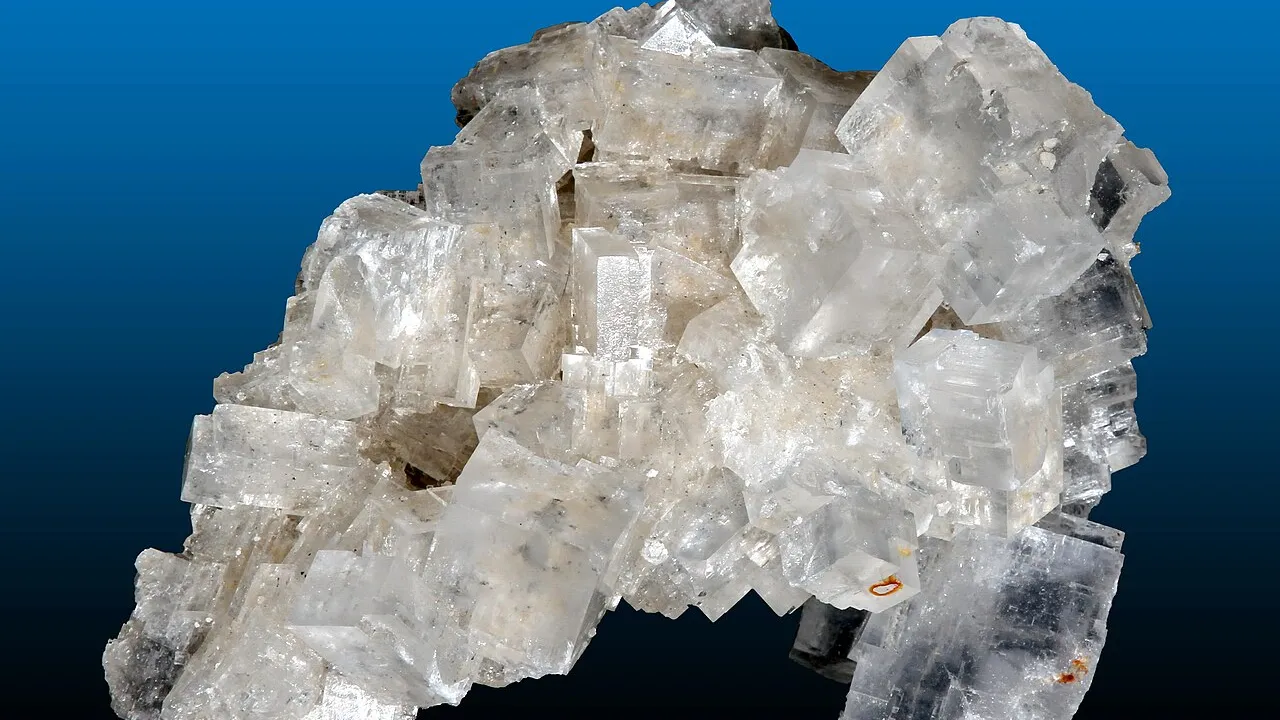
If you tap a big chunk of halite with a rock hammer, it breaks cleanly into smaller baby cubes!
✨ Word Sparks (Grade 2 Glossary)
Tap 🔊 to hear
Crystallize
To harden into neat, repeating crystal shapes
Geologist
A scientist who studies rocks and minerals
Evaporate
When liquid water dries into invisible gas
🪝
How can an ancient ocean turn into solid crystal blocks underground?
1
A Mineral You Eat
Imagine holding a clear, glassy rock that tastes just like salty pretzels! You eat tiny pieces of this mineral almost every day. call natural rock salt halite, and it grows in neat square cubes.
2
Left Behind by Water
Millions of years ago, shallow salty seas covered big parts of the land. When hot sun dried up the water, the salt could not float into the sky. Instead, it crystallized into thick white beds that later got buried under mud and stone.
3
Colors and Uses
Pure halite is clear or white, but tiny trapped minerals can turn it pink, blue, or orange. Today, workers collect halite to season food, make soap, and keep icy winter sidewalks safe for walking.
1. Why did salt stay behind when ancient seas dried up?
2. What happens when you break a large piece of halite?
🤯 Mind-Blowing Fact • Grade 3
In Saltville, Virginia, ancient underground salt deposits attracted Ice Age woolly mammoths and mastodons that came to lick the salty springs!
✨ Word Sparks (Grade 3 Glossary)
Tap 🔊 to hear
Evaporite
A mineral left after salty water evaporates
Brine
Water packed with lots of dissolved salt
Luster
How light shines off a mineral surface
🪝
Why do every single one of halite's crystals grow with square corners?
1
Built from Two Elements
Peer through a magnifying glass at table salt, and you will spot tiny glittering boxes. Halite is made of two chemical elements—sodium and chlorine—locked together in a tidy checkerboard pattern. Because its atoms line up at right angles, halite always forms cubic crystals.
2
Born in Evaporite Basins
Halite belongs to a special group of minerals called . When salty lakes like Utah's Great Salt Lake or shallow inland seas lose water through evaporation, the remaining becomes super-salty. Soon, halite crystals precipitate and sink to the bottom in gleaming crusts.
3
Testing Halite's Properties
Earth scientists identify halite without ever needing to lick a dusty rock! It has a glassy , a white streak, and a Mohs hardness of 2.5—meaning your fingernail can barely scratch it, while a copper penny scratches it easily.
4
More Than Kitchen Seasoning
Surprisingly, less than ten percent of mined halite ends up in salt shakers. Factories use huge amounts to manufacture paper, plastics, glass, and clean drinking water, while highway crews spread millions of tons to de-ice winter roads.
1. Which two elements join together in a checkerboard pattern to make halite?
2. With a Mohs hardness of 2.5, which everyday object can easily scratch halite?
🤯 Mind-Blowing Fact • Grade 4
Beneath Detroit, Michigan, a colossal salt mine stretches more than 1,100 feet underground across 1,500 acres—left behind by a 400-million-year-old tropical sea!
✨ Word Sparks (Grade 4 Glossary)
Tap 🔊 to hear
Cleavage
Smooth flat planes where a mineral splits
Salt Dome
An underground pillar of rising rock salt
Hopper Crystal
A cube crystal with stair-stepped sunken sides
🪝
How can solid rock salt slowly rise upward through heavier stone like a giant underground lava lamp?
1
Atomic Geometry You Can See
Crunch down on a flake of sea salt, and you are tasting Earth history! Halite, known chemically as sodium chloride (NaCl), is the only rock-forming mineral humans regularly eat. Inside every crystal, positively charged sodium ions and negatively charged chloride ions alternate in a three-dimensional cubic lattice. Because of this internal arrangement, halite exhibits perfect cubic , splitting cleanly along three directions that meet at exact 90-degree angles.
2
Evaporating Seas and Hopper Crystals
Halite forms in arid basins where water evaporates faster than rivers or rain can refill it. Once seawater evaporates to roughly one-tenth of its original volume, sodium chloride precipitates rapidly. When edges of a crystal grow faster than the centers of its faces, halite creates stair-stepped hollow pyramids called . Over millions of years, sediment buries these salt beds hundreds of meters underground, including thick deposits beneath the Great Lakes and southwestern Virginia.
3
Rising Salt Domes
Even though rock salt is a solid, deep underground pressure makes it behave almost like stiff putty. Because halite is less dense than surrounding sandstone and shale, buried salt layers slowly bulge upward over geologic time, forming towering pillars called . Geologists map these domes carefully because rising salt bends nearby rock layers into natural traps that hold valuable oil and natural gas.
4
Essential to Industry and Life
Every human body relies on sodium and chloride ions from halite to carry nerve signals and balance fluids. Beyond nutrition, chemical plants split halite brine with electricity to produce chlorine and sodium hydroxide—building blocks used in water purification, medicines, and soaps.
1. Why does buried halite sometimes push upward through overlying rock layers to form salt domes?
2. What causes a halite hopper crystal to have stair-stepped, sunken faces?
🤯 Mind-Blowing Fact • Grade 5
Microbiologists have revived living salt-loving microbes trapped inside tiny brine pockets within halite crystals that formed more than 250 million years ago!
✨ Word Sparks (Grade 5 Glossary)
Tap 🔊 to hear
Halokinesis
Slow underground movement and rising of rock salt
Halophile
A microbe that thrives in extreme salt
Solution Mining
Dissolving underground salt with water to pump upward
🪝
What happened six million years ago when the entire Mediterranean Sea nearly dried up into a mile-thick desert of halite?
1
Ionic Bonds and Isometric Symmetry
Step onto Bolivia's Salar de Uyuni after a desert rain, and a blindingly flat crust of crystalline salt mirrors the sky from horizon to horizon. That crust is composed largely of halite (NaCl), the flagship mineral of the halide group. At the atomic scale, sodium transfers one outer electron to chlorine, locking Na+ and Cl- ions into an isometric face-centered cubic lattice. This uniform bond strength in three perpendicular axes explains halite's unmistakable diagnostic traits: isometric crystal habit, three directions of perfect 90-degree cleavage, a low specific gravity of 2.16, and high solubility in polar water molecules.
2
The Evaporite Sequence and Giant Salt Giants
Marine seawater contains roughly 35 grams of dissolved salts per liter, nearly 78 percent of which is sodium chloride. When tectonic shifts isolate an ocean basin in an arid climate, dissolved minerals precipitate in a predictable sequence according to solubility: first calcite and dolomite, then gypsum at about 20 percent remaining volume, and finally halite at roughly 10 percent volume. Around 5.96 million years ago during the Messinian Salinity Crisis, the Strait of Gibraltar closed, evaporating much of the Mediterranean Sea and depositing more than a million cubic kilometers of halite and gypsum across the abyssal seafloor.
3
Halokinesis and Subsurface Engineering
Once buried beneath denser clastic sediments, thick evaporite beds undergo —gravity-driven plastic flow without fracturing. Rising diapirs and salt domes deform overlying strata into structural traps prized by energy geologists. Because deep salt formations are remarkably impermeable to groundwater and self-seal small fractures under pressure, engineers also excavate caverns inside salt domes to store strategic energy reserves, compressed air, and hydrogen fuel.
4
Color Centers and Microbial Time Capsules
Although pure halite is colorless and transparent, natural specimens often glow rose-pink from halophilic (salt-loving) archaea trapped in microscopic fluid inclusions, or deep sapphire-blue where natural radiation knocks electrons out of place inside the crystal lattice. Paleoclimatologists drill ancient halite cores and analyze those tiny brine droplets to measure prehistoric ocean temperatures and atmospheric gases.
5
Global Extraction and Environmental Balance
Modern society extracts roughly 290 million metric tons of halite annually through room-and-pillar mining, solar evaporation ponds, and —pumping freshwater down boreholes to dissolve salt and bring saturated brine to the surface. Meanwhile, environmental scientists study freshwater salinization from winter road salt, testing beet-juice brines and precision spreaders to keep highways safe while protecting streams and aquifers.