1. Why does snipping your hair with scissors never hurt?
2. Which spot on your body has ZERO hair follicles?
🤯 Mind-Blowing Fact • Grade 2
Your scalp holds over one hundred thousand hair follicles, and each hair grows about half an inch every month!
✨ Word Sparks (Grade 2 Glossary)
Tap 🔊 to hear
scalp
the skin covering the top of your head
keratin
tough natural protein forming hair and nails
coil
a springy spiral curl of hair
🪝
What makes one kid's hair grow pin-straight while another kid's hair springs into bouncy curls?
1
Inside the Hair Factory
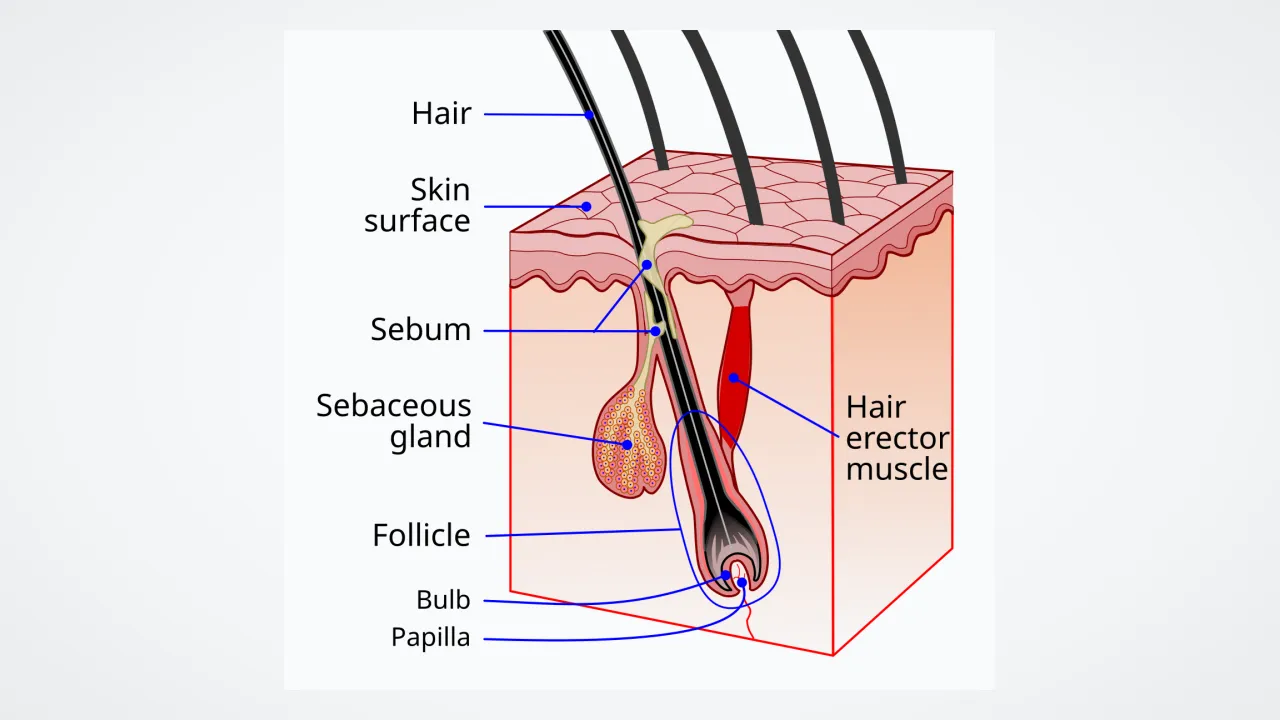
Look closely at the fine peach fuzz on your arm! Underneath every visible hair hides a tunnel-shaped pocket in the dermis called a hair follicle. Tiny blood vessels at the bottom feed fast-growing cells that stack together into tough .
2
Round, Oval, or Flat
Did you know your follicle's shape decides your hairstyle? Perfectly round follicles push out straight hair, oval follicles create gentle waves, and flat ribbon-shaped follicles grow tight curls and !
3
Built-In Shine and Sensors
Each follicle has a tiny oil gland that coats hair so it stays soft and water-resistant, plus touch nerves that feel a mosquito land before it bites!
1. What determines whether hair grows straight, wavy, or curly?
2. What helper sits next to each hair follicle to keep hair soft and shiny?
🤯 Mind-Blowing Fact • Grade 3
If you added up the tiny bit of growth from all 100,000 scalp follicles in one single day, your head builds over 100 feet (30 meters) of combined hair fiber every 24 hours!
✨ Word Sparks (Grade 3 Glossary)
Tap 🔊 to hear
sebum
natural waxy oil keeping hair and skin supple
arrector pili
tiny muscle pulling hair upright into goosebumps
dermal papilla
blood-rich nipple at follicle base feeding growth
🪝
Why do your eyelashes stay short and neat while the hair on your head can grow down to your waist?
1
The Bulb and Dermal Papilla
Blow softly across the back of your forearm and feel tiny hairs sway! Every strand anchors inside a downward pocket called a hair follicle. At its swollen base—the hair bulb—a cluster of capillaries called the delivers oxygen and nutrients to some of the fastest-dividing cells in your body.
2
Grow, Rest, Shed, Repeat
Why don't eyebrows grow three feet long? Every follicle follows a timed three-step clock! Scalp follicles stay in their active growing phase for two to seven years before resting, while eyebrow and eyelash follicles grow for only thirty to forty-five days before resting and shedding.
3
Sebum and Goosebump Muscles
Opening into each follicle neck is a sebaceous gland that secretes , a waxy oil that waterproofs skin and hair. Slanted beside it sits the tiny muscle, which contracts in cold air to fluff fur in mammals—leaving humans with goosebumps!
4
Fifty to One Hundred Daily Sheds
Because neighboring follicles run on staggered schedules, losing fifty to one hundred resting scalp hairs daily is completely normal as fresh strands push up behind them.
1. Why can scalp hair grow much longer than eyelashes?
2. What causes goosebumps to pop up on your arms when you feel chilly?
🤯 Mind-Blowing Fact • Grade 4
A single healthy strand of human scalp hair spun by a follicle is strong enough to hold up an apple weighing 3.5 ounces (100 grams)—meaning a full head of hair could theoretically support two elephants!
✨ Word Sparks (Grade 4 Glossary)
Tap 🔊 to hear
anagen
active growth phase of a hair follicle
telogen
resting phase before an old hair sheds
cortex
thick middle hair layer holding pigment and strength
🪝
How can hair follicles help scraped skin heal itself faster than hairless skin?
1
Anatomy of the Pilosebaceous Unit
Run a fingertip lightly over just the tips of your arm hairs without touching skin—you still feel it instantly! That hair-trigger sensitivity comes from basket-like nerve endings wrapped around each hair follicle. Anatomists call the follicle, its sebaceous oil gland, and its smooth arrector pili muscle a pilosebaceous unit, and humans carry roughly five million of them across the body.
2
Three Concentric Layers of Keratin
Inside the deep hair bulb, matrix stem cells divide rapidly around the nutrient-rich dermal papilla, while neighboring melanocytes inject melanin granules for color. Rising cells harden via keratinization into three nested cylinders: an inner spongy medulla, a thick middle that gives hair ninety percent of its strength and elasticity, and an outer cuticle of overlapping transparent scales arranged like roof shingles.
3
Anagen, Catagen, and Telogen Cycles
Each follicle cycles independently through three biological seasons: (years of active growth at roughly one centimeter per month on the scalp), catagen (a brief two-week transition as the lower bulb shrinks), and (a three-month resting phase before a new hair nudges the old club hair out).
4
Hidden Stem-Cell Rescue Crew
Tucked halfway up every follicle sits a special niche called the bulge, packed with epidermal stem cells. When you scrape your knee, bulge stem cells march upward out of surviving follicles to rebuild fresh outer skin!
1. How do hair follicles assist when you scrape off the top layer of skin on your knee?
2. Which layer of a hair strand looks like overlapping roof shingles under a microscope?
🤯 Mind-Blowing Fact • Grade 5
Hair matrix cells at the bottom of your follicles divide so rapidly—roughly once every 23 to 24 hours—that scientists can trace months of a person's nutrition and mineral history centimeter by centimeter along a single strand!
✨ Word Sparks (Grade 5 Glossary)
Tap 🔊 to hear
disulfide bond
strong sulfur bridge locking keratin chains together
vellus hair
fine soft peach-fuzz hair covering most skin
multipotent
stem cell able to build several related tissues
🪝
Why are hair follicles the only mammalian organs capable of completely tearing down and regenerating their lower half throughout life?
1
Mini-Organs Born Before Birth
By the twenty-second week of fetal development, a human baby has already formed every single one of its roughly five million hair follicles—never adding a brand-new follicle after birth! Extending as tubular invaginations of the epidermis deep into the dermis and subcutis, follicles transition from fine, unpigmented covering children's cheeks to thicker, pigmented terminal hairs on the scalp, eyebrows, and lashes.
2
Disulfide Bridges and Follicular Asymmetry
Inside the germinative matrix at the base of anagen follicles, epithelial cells divide every twenty-four hours—second in speed only to bone marrow. As daughter cells ascend, they cross-link alpha-keratin helices using strong covalent between cysteine amino acids. In symmetrical, vertical follicles, keratin packs evenly to produce straight shafts; in curved, asymmetrical follicles, uneven keratin distribution along the inner and outer bends coils strands into helical curls.
3
Lifelong Organ Regeneration
Unlike nearly any other human structure, each follicle undergoes cyclical organ remodeling: during catagen, programmed cell death dismantles the lower two-thirds of the follicle, bringing the dermal papilla close to stem cells residing in the bulge niche. Chemical crosstalk—via Wnt and BMP signaling—later reawakens bulge stem cells to regenerate a brand-new hair bulb for the next anagen cycle.
4
Mechanosensory Collar and Immune Privilege
Low-threshold lanceolate nerve endings collar the follicle isthmus, firing microseconds after air currents deflect a hair shaft by mere micrometers, while specialized signaling shields growing bulbs with localized immune privilege. Each scalp follicle also harbors its own specialized microbiome and rich capillary plexus, making hair roots sensitive biological barometers of systemic nutrition and endocrine balance.
5
Unlocking Regenerative Medicine
In 1990, cell biologists George Cotsarelis, Tung-Tien Sun, and Robert Lavker pinpointed slow-cycling stem cells inside the hair follicle bulge—a milestone discovery now guiding regenerative skin grafts and alopecia therapies.