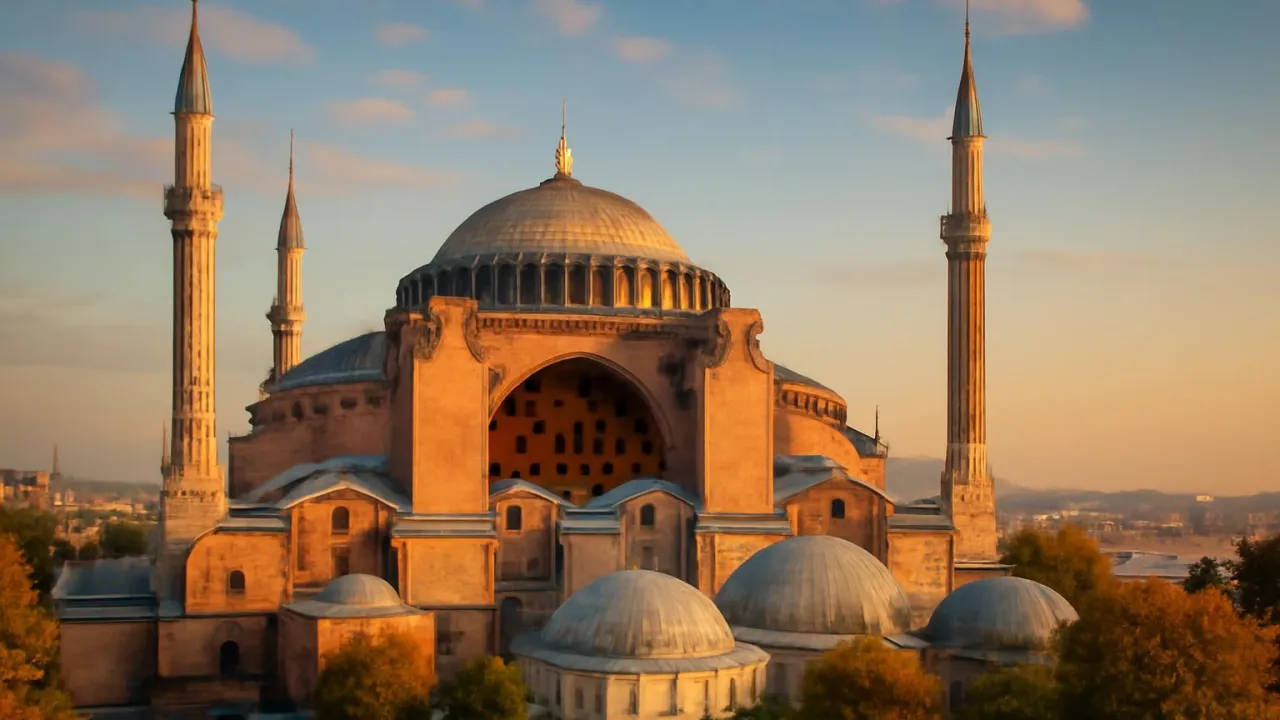
Hagia Sophia’s dome was the world’s biggest for almost 1,000 years!
✨ Word Sparks (Grade 2 Glossary)
Tap 🔊 to hear
tiles
Flat pieces used to cover roofs or walls
history
Stories about things that happened long ago
visitor
A person who goes to see a place
🪝
What would it sound like to sing under a giant golden dome?
1
A Dome That Dazzles
Hagia Sophia’s roof is a huge dome, shining with gold . When the sun shines, the dome glows and sparkles. People come from all over to see its bright beauty. The dome is so high that it almost touches the sky.
2
Echoes and Whispers
Inside, every sound bounces off the walls and dome. If you sing, your voice echoes and fills the hall. The building’s round shape helps sound travel far. It feels like the music floats in the air.
3
A Place of Wonder
walk on smooth stone floors and look at colorful mosaics. They see pictures made from tiny glass pieces. Hagia Sophia is famous for its art and . Many people visit to learn about its past.
If you whisper at one end of the dome, someone far away can hear you!
✨ Word Sparks (Grade 3 Glossary)
Tap 🔊 to hear
acoustics
How sound moves and echoes in a space
arch
A curved building piece that holds weight
resonance
When sound vibrates and gets stronger
🪝
What secrets might a whisper carry beneath a dome as wide as a playground?
1
A Dome That Touches the Sky
The Hagia Sophia’s dome rises high above the city, shimmering in sunlight. Its round shape and golden mosaics dazzle all who enter. The dome’s diameter stretches wider than a basketball court. People have admired its beauty for almost 1,500 years.
2
Echoes and Acoustics
Inside, the dome creates amazing , making even a whisper sound magical. Sound waves bounce and vibrate across the curved surfaces. This special lets music and voices fill the huge hall. Visitors love to hear their echoes swirl in the air.
3
Building with Arches and Bricks
Engineers used bricks and hidden to hold up the heavy dome. The arches spread the dome’s weight to strong columns below. This clever design keeps the building standing through earthquakes and time. Hagia Sophia is a monument to ancient engineering.
4
A Place for Art and History
Colorful mosaics cover the walls and ceilings, sparkling in the light. Each mosaic tells a story from long ago, using tiny pieces of glass. People from around the world visit to see its art and history. Hagia Sophia is a symbol of Istanbul’s rich past.
Hagia Sophia’s dome is so well designed that it survived dozens of earthquakes over 15 centuries!
✨ Word Sparks (Grade 4 Glossary)
Tap 🔊 to hear
pendentive
A curved support for a round dome
Byzantine
A powerful empire from long ago
heritage
Important history and culture from the past
🪝
Imagine your voice echoing through a hall so grand it once amazed emperors and sultans alike.
1
A Dome That Changed History
The Hagia Sophia’s massive dome, built in 537 CE, was an engineering marvel of the Empire. Its shimmering mosaics and golden tiles reflected sunlight, making the vast hall glow with color. The dome’s diameter reaches 102 feet, and its height soars to 180 feet above the floor. For centuries, it was the largest enclosed space in the world, inspiring awe in all who entered.
2
Engineering Wonders: Arches and Pendentives
Architects Anthemius and Isidore used a clever system of arches and to support the dome’s enormous weight. Pendentives are curved triangles that help the round dome rest on square walls below. Hidden brick arches distribute the force evenly to strong marble columns. This design allowed Hagia Sophia to withstand earthquakes and stand for nearly 1,500 years.
3
Acoustics: The Magic of Resonance
The building’s shape creates unique acoustics, letting sound waves travel and bounce in surprising ways. Even a soft whisper can be heard across the hall due to resonance and vibration. When choirs sing, their voices blend and echo, filling the space with music. Musicians and scientists still study Hagia Sophia’s acoustics to learn how ancient builders shaped sound.
4
A Landmark for Many Cultures
Hagia Sophia has served as a cathedral, mosque, and museum, reflecting Istanbul’s rich cultural history. Its mosaics show scenes from Christian and Islamic traditions, making it a symbol of unity. Millions of visitors come each year to admire its art, architecture, and engineering. Today, Hagia Sophia stands as a monument to human creativity and shared .
1. How does Hagia Sophia’s dome stay balanced on square walls?
2. Why do scientists study Hagia Sophia’s acoustics?
🤯 Mind-Blowing Fact • Grade 5
Hagia Sophia’s dome is so acoustically perfect that researchers have digitally recreated its ancient sounds for modern listeners.
✨ Word Sparks (Grade 5 Glossary)
Tap 🔊 to hear
piers
Huge columns that hold up heavy buildings
reverberation
When sound bounces around for a long time
UNESCO
A group that protects world treasures
🪝
What if you could design a building where a single whisper could travel across a sea of marble and gold?
1
The Dome That Redefined Architecture
When Hagia Sophia was completed in 537 CE, its central dome astonished the world with its unprecedented scale and engineering. Measuring 102 feet (31 meters) in diameter and rising 180 feet (55 meters) above the marble floor, the dome seemed to float above the vast nave, supported by a series of hidden arches and massive columns. Byzantine architects Anthemius of Tralles and Isidore of Miletus pioneered the use of pendentives—curved triangular supports that allowed the circular dome to rest securely atop a square base. This innovation enabled the creation of a vast, open interior space that influenced architectural design for centuries.
2
Engineering Marvels: Arches, Pendentives, and Earthquake Resistance
The structural genius of Hagia Sophia lies in its sophisticated system of arches and pendentives, which transfer the dome’s immense weight to four colossal . These piers, made of brick and stone, anchor the building and absorb seismic shocks, allowing Hagia Sophia to survive dozens of major earthquakes over 1,500 years. The dome’s shallow curvature and lightweight brick construction reduce stress, while buttresses added over time further reinforce the structure. This combination of ancient engineering techniques makes Hagia Sophia one of the most resilient monuments in history.
3
Acoustics: The Science of Whispering Walls
Hagia Sophia’s unique geometry creates extraordinary acoustics, where sound waves reflect and resonate throughout the enormous space. The dome’s curved surfaces and marble walls amplify even the softest sounds, enabling a whisper at one end to be heard across the hall. Scientists have studied its acoustic properties, discovering that the building’s shape and materials create long times and multiple echoes. These effects once enhanced religious chants and music, enveloping worshippers in a sea of harmonious sound.
4
Mosaics and Cultural Legacy
Inside, thousands of glittering mosaics made from colored glass and gold leaf depict religious scenes and geometric patterns. Over the centuries, Hagia Sophia has served as a cathedral, mosque, and museum, reflecting the cultural and religious changes of Istanbul. Its mosaics and calligraphy blend Christian and Islamic artistry, making the building a symbol of cultural exchange and coexistence. Today, millions of visitors from around the world come to experience its art, architecture, and spiritual atmosphere.
5
A Global Icon of Human Achievement
Hagia Sophia’s architectural innovations shaped the design of countless churches and mosques across Europe and Asia. Its combination of engineering brilliance, artistic mastery, and historical significance earned it World Heritage status and global recognition. The building’s enduring presence reminds us of humanity’s capacity for creativity, resilience, and cultural dialogue. As both a monument and a living space, Hagia Sophia continues to inspire architects, scientists, and visitors alike. Its story is a testament to the power of imagination and the spirit of discovery.