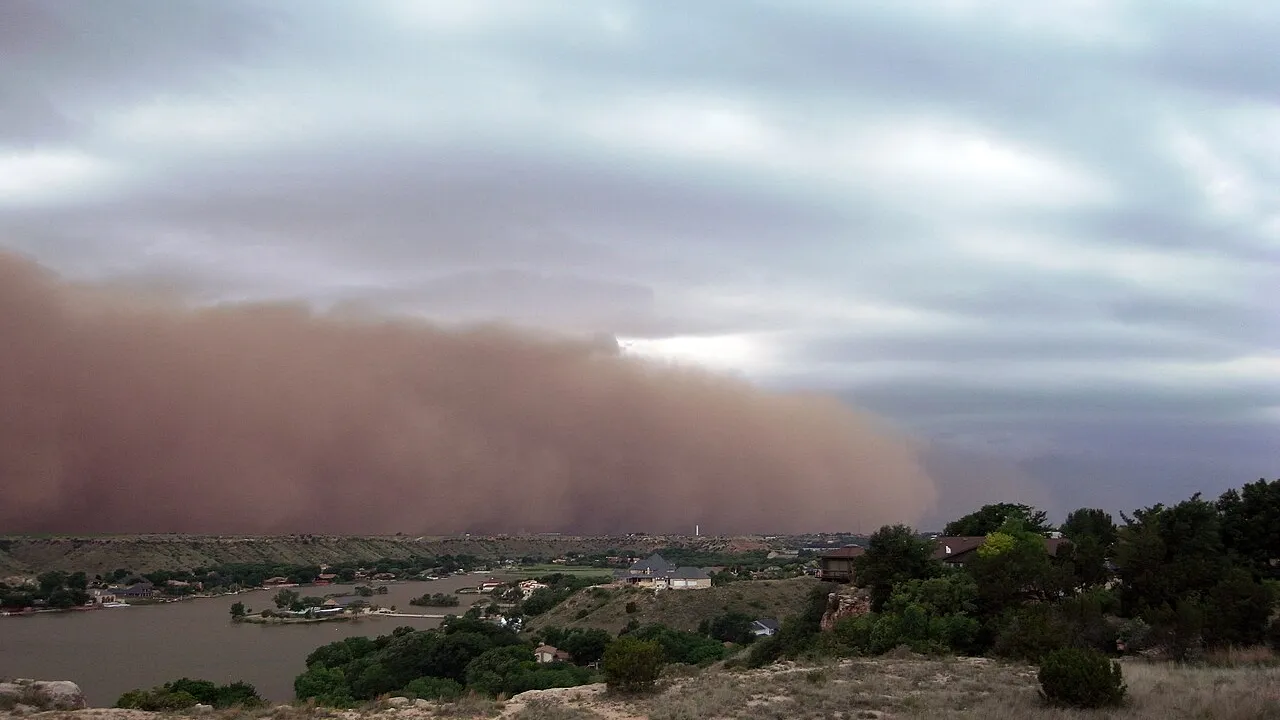
1. What kicks up all the sand and dust inside a haboob?
2. What is the safest choice when a thick haboob rolls across a town?
🤯 Mind-Blowing Fact • Grade 2
A single large haboob in the Sahara or Sonoran Desert can stretch more than sixty miles wide from end to end!
✨ Word Sparks (Grade 2 Glossary)
Tap 🔊 to hear
horizon
Line where the sky meets the ground
evaporate
Change from liquid drops into invisible gas
billow
Swell outward in big rolling clouds
🪝
How can a thunderstorm that never drops rain on your town still bury your street in dust?
1
Day Turns Into Dusk
Imagine a bright afternoon in Phoenix, Arizona, when a towering copper-colored cloud suddenly fills the . Within minutes, swirling dust blocks out the sun and turns daytime as dark as dusk. A desert haboob has arrived!
2
How Thunderstorms Build a Haboob
High inside a desert thunderstorm, falling rain in hot, dry air before reaching the ground. Evaporation chills the air, making it heavy so it slams downward and blasts outward in every direction like pancake batter.
3
Sand Below, Dust Above
Heavy grains of coarse sand stay low in the first few feet of wind, while powdery silt and clay thousands of feet high. Most haboobs pass in less than an hour, leaving behind a dusty coat on roofs and cars.
1. Why does air plunge downward so fast beneath a dry desert thunderstorm?
2. Where do the heaviest grains of coarse sand travel during a storm?
🤯 Mind-Blowing Fact • Grade 3
Fine mineral dust lofted into the upper air by Sahara haboobs can drift clear across the Atlantic Ocean and fertilize rainforest plants in the Amazon!
✨ Word Sparks (Grade 3 Glossary)
Tap 🔊 to hear
downdraft
Strong current of cool air sinking downward
visibility
How far ahead you can clearly see
silt
Powdery soil finer than grains of sand
🪝
Why do meteorologists around the world use an Arabic word for Arizona's biggest dust storms?
1
A Global Desert Phenomenon
For centuries, people living in Sudan along the edge of the Sahara Desert watched giant walls of summer dust roll across Khartoum and called them haboobs. In the 1920s and 1970s, weather scientists realized that identical thunderstorm-driven dust walls sweep across the American Southwest, Australia, the Middle East, and Central Asia.
2
The Outflow Boundary Plow
Every haboob begins with a collapsing thunderstorm . Cold, dense air crashes onto the desert floor and races outward at thirty-five to sixty miles per hour. This leading edge—called an outflow boundary or gust front—acts like an invisible snowplow, wedging underneath warm desert air and tossing millions of tons of skyward.
3
Sandstorm vs. Dust Storm
People often call haboobs sandstorms, yet fine and clay actually form the towering mile-high cloud. True sand grains are heavier and bounce within a few feet of the earth, stinging ankles and polishing desert rocks.
4
Pull Aside, Stay Alive
inside a haboob can drop to zero in seconds. Highway signs in Arizona teach motorists a smart rhyme—Pull Aside, Stay Alive—reminding drivers to park off pavement and turn off lights so trailing cars do not follow them.
1. How does a thunderstorm's gust front lift dust so high into the sky?
2. How can dust lifted over the Sahara Desert help plants thousands of miles away?
🤯 Mind-Blowing Fact • Grade 4
On July 5, 2011, a monster haboob over Phoenix, Arizona, grew nearly one hundred miles wide and towered more than 5,000 feet above downtown skyscrapers!
✨ Word Sparks (Grade 4 Glossary)
Tap 🔊 to hear
virga
Streaks of rain evaporating before reaching ground
turbulent
Rough, swirling, and wildly churning motion
stewardship
Careful protection of land and natural resources
🪝
What happens inside a summer monsoon cloud to unleash a mile-high gravity current of desert dust?
1
Virga and Evaporative Cooling
Picture July monsoon season in the Sonoran Desert of Arizona. Towering cumulonimbus clouds build over distant mountain ridges, releasing curtains of rain called into parched lower air. As raindrops evaporate before hitting the ground, they absorb heat from the surrounding air. That rapid evaporative cooling creates a heavy pocket of cold air that plummets Earthward as a powerful microburst or downdraft.
2
Anatomy of a Gravity Current
When that dense downdraft strikes the flat desert basin, it spreads horizontally at speeds up to fifty miles per hour as an atmospheric gravity current. eddies curl backward along its nose, giving a haboob its unmistakable cauliflower-shaped wall towering 3,000 to 5,000 feet tall. Ahead of the wall, skies may look calm and sunny; thirty seconds after the gust front passes, fierce winds drop temperatures by fifteen degrees and cut visibility below a quarter mile.
3
Forecasting Dust Warnings
The National Weather Service issues Dust Storm Warnings using Doppler radar, satellite channels, and roadside visibility sensors. Just as Tornado Warnings trigger wireless emergency alerts on phones, Dust Storm Warnings give families, pilots, and highway crews vital minutes to seek shelter before the wall arrives.
4
Soil Stewardship Matters
Healthy desert crusts made of tiny lichens, mosses, and packed pebbles naturally hold soil down. Protecting native plants and using smart farming cover crops helps communities reduce how much loose dust enters passing gust fronts.
1. What weather term describes streaks of rain that evaporate in dry air before touching the ground?
2. How do native desert plants and biological soil crusts reduce haboob severity?
🤯 Mind-Blowing Fact • Grade 5
Microscopic silicate dust inside a haboob is mostly lifted not by wind alone, but by bouncing sand grains acting like tiny hammers in a process called saltation bombardment!
✨ Word Sparks (Grade 5 Glossary)
Tap 🔊 to hear
aerosol
Tiny solid or liquid particle floating in air
micrometer
One millionth of a meter in length
phytoplankton
Microscopic ocean plants that make oxygen
🪝
How do fluid dynamics, Doppler radar echoes, and satellite infrared sensors track a 100-kilometer wall of airborne mineral dust?
1
Physics of a Density Current
In mesoscale meteorology, a haboob is a textbook atmospheric density current—a cold, dense air mass advancing rapidly into warmer, less dense ambient air. During arid summer thunderstorms, sub-cloud relative humidity often sits below twenty percent. Hydrometeors—raindrops, graupel, and hail—sublimate and evaporate as they descend, extracting latent heat from the surrounding air parcel. This diabatic cooling increases air density, accelerating negative buoyancy into a fierce downdraft that splashes outward across the desert floor at 15 to 30 meters per second.
2
Saltation Bombardment and Aerosol Lofting
Oddly enough, wind shear alone struggles to lift microscopic clay particles under 10 directly off smooth soil because cohesive inter-particle forces bind tiny grains tightly together. Instead, haboobs rely on saltation bombardment: larger quartz sand grains measuring 70 to 500 micrometers hop horizontally across the surface and slam into soil aggregates like tiny cannonballs, ejecting plumes of fine silt and clay into turbulent Kelvin-Helmholtz billows extending 1,500 to 3,000 meters aloft.
3
Remote Sensing From Ground and Orbit
Operational meteorologists track haboobs even at night using Dual-Polarization Doppler radar and GOES-R Dust RGB satellite imagery. Radar beams detect non-spherical dust and biological debris along the thin fine-line of the advancing gust front, while infrared satellite channels measure thermal contrast between lofty cool dust tops and scorching desert ground.
4
Air Quality and Aviation Impacts
Inside an intense haboob, concentrations of coarse particulate matter (PM10) spike dozens of times above clean-air standards, temporarily grounding commercial aircraft because abrasive silicate dust can erode jet turbine blades and clog pitot tubes.
5
Earth System Connections
Despite short-term hazards, haboobs play a vital planetary role in biogeochemical cycling. Iron- and phosphorus-rich swept from North Africa, Arabia, and Australia settle onto distant oceans and tropical forests, fueling marine blooms that absorb atmospheric carbon dioxide and produce oxygen.