1. Why are every fifth string on a guzheng colored green or red?
2. What poetic nickname do Chinese musicians give the slanted row of guzheng bridges?
🤯 Mind-Blowing Fact • Grade 2
The ancient Chinese guzheng is the grand ancestor of zithers across Asia, including Japan's koto, Korea's gayageum, and Vietnam's dan tranh!
✨ Word Sparks (Grade 2 Glossary)
Tap 🔊 to hear
octave
Eight scale steps from one note to its double.
ancestor
An early family member that later ones come from.
melody
A sequence of notes that makes a tune.
🪝
How can a musician paint rushing rivers and singing birds using twenty-one strings?
1
Two Thousand Years of Shimmer
Swoosh—ring—ripple! With one graceful sweep of the hand, twenty-one strings sparkle like a silver waterfall! People in China have played the guzheng for more than two thousand five hundred years, and its name simply means 'ancient zither.'
2
Wild-Geese Bridges and Colored Guides
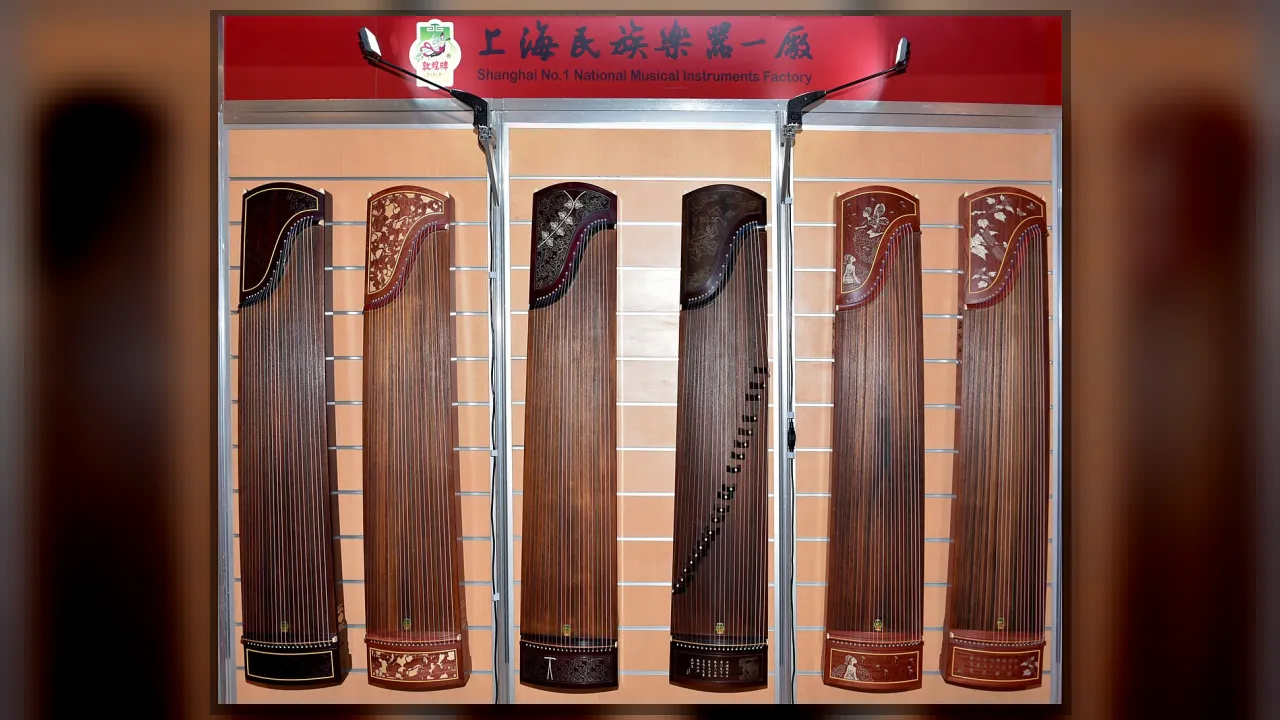
Resting on two wooden stands, its curved paulownia wood board holds twenty-one nylon-wrapped steel strings across four full . Twenty-one movable wooden bridges slant across the middle like a flock of flying geese, while green strings mark every octave.
3
Right Hand Plucks, Left Hand Bends
Musicians tape smooth picks onto four fingers of each hand to pluck sparkling pentatonic melodies. While the right hand plucks on one side of the bridges, the left hand presses strings on the other side to bend notes smoothly!
1. What does the Chinese name 'guzheng' literally mean in English?
2. Which Asian instruments descended from the ancient Chinese guzheng?
🤯 Mind-Blowing Fact • Grade 3
Early guzhengs unearthed from ancient tombs had only five or twelve silk strings before growing to sixteen in the Tang Dynasty and twenty-one in the 1960s!
✨ Word Sparks (Grade 3 Glossary)
Tap 🔊 to hear
yanzi
Movable V-shaped wooden bridges on a guzheng.
tension
How tightly a stretched string is pulled.
tremolo
Rocking a pick rapidly to sustain one note.
🪝
Why does tuning twenty-one strings to a five-note scale let every sweeping waterfall run sound harmonious?
1
Waterfalls, Lotus Blossoms, and Typhoons
Cascade—shimmer—hum! One sweeping glide across the guzheng sounds like moonlight dancing over ripples on a lake, while rapid thumb-and-finger rolls roar like an approaching typhoon. Originating during China's Warring States period over twenty-five centuries ago, the guzheng remains one of the world's most expressive plucked zithers.
2
Wutong Wood and Steel-Core Strings
Modern concert guzhengs measure about sixty-four inches long, pairing an arched wutong—Chinese paulownia—soundboard with carved hardwood frames. Twenty-one nylon-wrapped steel strings stretch across movable wooden bridges called , meaning wild-geese pillars, spanning four full octaves.
3
Pentatonic Waterfalls and Left-Hand Magic
Strings are tuned to a five-note pentatonic scale—do, re, mi, sol, la—with green or red strings marking every 'sol' note. Because clashing half-steps are left out of the open strings, sweeping right-hand glissandos always ring out in lush harmony!
4
Unlocking Missing Notes by Bending
What if a melody needs 'fa' or 'ti'? Pressing downward with the left hand to the left of a bridge increases string just enough to raise 'mi' to 'fa' or 'la' to 'ti,' adding weeping slides and rich vibrato.
1. Why do sweeping glissandos across all twenty-one guzheng strings sound naturally harmonious?
2. How does a guzheng musician play notes like 'fa' or 'ti' that aren't tuned into the open strings?
🤯 Mind-Blowing Fact • Grade 4
Hidden beneath a hinged wooden lid at the right end of a modern guzheng sit twenty-one metal piano-style tuning pins turned with a square wrench!
✨ Word Sparks (Grade 4 Glossary)
Tap 🔊 to hear
yaozhi
Rapid back-and-forth pick rocking for sustained melody.
arpeggio
Notes of a chord plucked one after another.
repertoire
Collection of musical pieces prepared for performance.
🪝
How did switching from twisted silk to nylon-wrapped steel transform an ancient scholar's zither into a four-octave concert giant?
1
Painting Landscapes in Sound
What would happen if a painter traded brushes and ink for twenty-one gleaming strings stretched over seasoned paulownia wood? In classical Chinese such as 'High Mountains and Flowing Water,' a guzheng soloist sweeps taped finger picks across right-hand strings while sculpting shimmering pitch bends on the left—conjuring mist-shrouded peaks, darting kingfishers, and thundering storm waves inside a concert hall.
2
Twenty-Five Centuries of Evolution
Archaeological finds from China's Warring States era (475–221 BCE) reveal early twelve-string bamboo and wood zithers that blossomed into thirteen- and sixteen-string silk instruments during the Qin and Tang dynasties. Travelling along trade and cultural routes, the Chinese zheng seeded an entire East Asian zither family, inspiring Japan's koto, Korea's gayageum, Mongolia's yatga, and Vietnam's dan tranh.
3
Acoustic Engineering of the 21-String Standard
In the early 1960s, instrument makers in Shanghai standardized the modern sixty-four-inch, twenty-one-string guzheng, spanning four full octaves from D2 to D6. Replacing delicate silk or bare brass wire with steel cores wrapped in smooth white nylon dramatically boosted volume, tuning stability, and bass depth while protecting players' fingertips during expressive left-hand slides.
4
Dual-Hand Virtuosity and Yaozhi Tremolo
Resting across two trestle stands, the arched wutong soundboard houses concealed tuning pins beneath a hinged right-hand lid. Contemporary performers tape tortoise-shell or composite yijia picks onto four fingers of both hands: they weave harp-like left-hand alongside rapid right-hand thumb-rocking tremolos that make plucked strings sing with violin-like sustain.
1. Why was inventing nylon-wrapped steel strings in the 1960s such a breakthrough for the guzheng?
2. How do modern guzheng soloists achieve long, singing violin-like notes on a plucked instrument?
🤯 Mind-Blowing Fact • Grade 5
Unlike the Japanese koto—whose thirteen strings all share the same thickness—a modern twenty-one-string guzheng uses twenty-one individually graduated string gauges from hair-thin treble steel to thick wound bass cords!
✨ Word Sparks (Grade 5 Glossary)
Tap 🔊 to hear
anhemitonic
A musical scale containing zero half-step intervals.
contrapuntal
Weaving two independent melodies together at once.
guazou
Sweeping glissando run across pentatonic guzheng strings.
🪝
How do arched paulownia acoustics, non-equal tension scaling, and bilateral eight-finger technique empower China's 2,500-year-old zither?
1
High Mountains and Flowing Water in Four Octaves
From a whisper-soft harmonic chime resembling temple jade to a ferocious two-handed storm portraying 'Fighting the Typhoon,' the Chinese guzheng commands one of the widest dynamic palettes in world organology. Stretching roughly one hundred sixty-three centimetres across twin wooden stands, the modern twenty-one-string board zither encompasses four full octaves from D2 (73.4 hertz) to D6 (1,174.7 hertz).
2
Millennia of Lineage and Pan-Asian Diffusion
Classified under Hornbostel-Sachs 312.22 as a movable-bridge half-tube board zither, the zheng appears in Qin-dynasty chronicles by historian Sima Qian and in fifth-century BCE tomb excavations from southern China. During the cosmopolitan Tang Dynasty (618–907 CE), thirteen-string silk zhengs anchored imperial ensembles and radiated outward across East Asia, giving rise to the Japanese koto, Korean gayageum, Mongolian yatga, and Vietnamese dan tranh.
3
Wutong Soundboard Physics and String Architecture
Acoustic projection relies on a steam-bent top plate of porous Paulownia elongata (wutong) paired with dense rosewood or red sandalwood structural rails and a flat resonant baseboard pierced by sculpted sound ports. Unlike the Japanese koto's uniform-gauge strings, modern guzheng strings graduate progressively from thin high-tension treble wire to thick copper-and-nylon-wound steel bass cords. Twenty-one notched rosewood bridges (yanzi) transmit vibrations into the arched crown while dividing each string into a plucked right-hand speaking segment and an unplucked left-hand sympathetic-and-bending zone.
4
Pentatonic Geometry and Micro-Inflection
Standard D-major pentatonic tuning—D, E, F-sharp, A, B repeated across four octaves, with green-dyed A strings serving as visual anchors—unlocks effortless sweeping glissandos (). Left of the yanzi bridges, regional schools cultivate distinct inflections: Henan players execute bold, wide vibratos, Chaozhou masters weave subtle modal pitch shifts by pressing 'mi' and 'la' strings toward 'fa' and 'ti,' and Shandong performers pair crisp thumb plucks with singing glides.
5
Twentieth-Century Reinvention and Polyphonic Technique
Following 1960s conservatory reforms led by craftsmen and virtuosos in Shanghai, players began taping Delrin or tortoise-shell yijia picks to both hands. Freed from purely left-hand ornament duties, modern soloists perform independent basslines, percussive rail slaps, and blazing yaozhi tremolos—even experimenting with multi-scale 'butterfly' guzhengs and chromatic pedal zhengs.