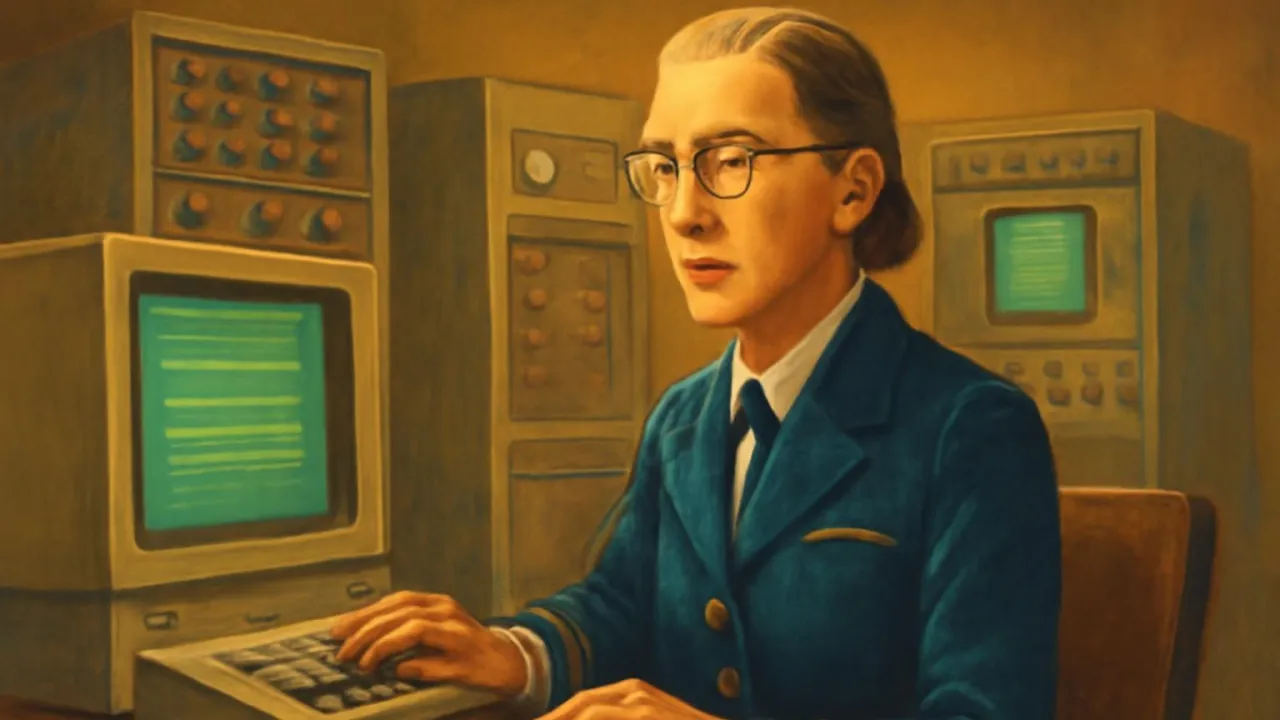
Grace Hopper was one of the first women to become a Navy Rear Admiral.
✨ Word Sparks (Grade 2 Glossary)
Tap 🔊 to hear
compiler
A tool that helps computers read code
puzzle
A problem you solve for fun
science
Learning how things work
🪝
Have you ever wondered how computers learn to follow rules?
1
Curious Mind
Grace loved and questions as a child, and she always wanted to know how things worked. She even took apart clocks at home, just to see inside. Her family encouraged her curiosity, so she kept exploring. Grace learned to solve problems in clever ways.
2
Hard Work Pays Off
When Grace grew up, she worked with giant computers. She studied math and , and she never gave up when things were hard. She invented a new way for computers to understand words, not just numbers. Her hard work made computers easier for everyone to use.
3
A Big Achievement
Grace created the first computer , which helped people write instructions for computers. She shared her ideas with other scientists and taught many people. Grace’s invention changed the world and made her a famous leader in computer .
The U.S. Navy named a guided-missile destroyer, the USS Hopper, after Grace!
✨ Word Sparks (Grade 3 Glossary)
Tap 🔊 to hear
programming
Writing instructions for computers
physics
The science of how things move
COBOL
A computer language Grace helped create
🪝
Can you imagine teaching a computer to understand your words?
1
A Curious Child
Grace Hopper was always asking questions and searching for answers, even as a young girl. She loved taking apart clocks and gadgets to see how they worked inside. Her family supported her curiosity and encouraged her to keep learning. Grace’s early adventures with machines helped her become a creative problem-solver.
2
Learning and Leading
Grace studied math and at college, where she worked very hard. She joined the U.S. Navy during World War II and started working with giant computers. Grace noticed that computers only understood numbers, so she wondered if they could use real words. Her idea was bold and new for her time.
3
Inventing the Compiler
Grace invented the first compiler, a special program that turned words into computer code. This made it possible for more people to write instructions for computers. Her invention made computers easier and faster to use for everyone. Grace’s work helped launch the field of computer .
4
Lasting Impact
Grace became a Navy Rear Admiral and a famous computer scientist. She inspired many young people, especially girls, to try computer science. She even helped create the language, which is still used today. Grace’s curiosity and determination changed technology for the whole world.
2. Which programming language did Grace help invent?
🤯 Mind-Blowing Fact • Grade 4
Grace Hopper received the National Medal of Technology from President George H.W. Bush in 1991.
✨ Word Sparks (Grade 4 Glossary)
Tap 🔊 to hear
compiler
A tool that changes words into code
legacy
What someone leaves behind for others
innovation
A new idea that changes things
🪝
What if you could invent a way for computers to understand human language?
1
Curiosity Sparks Innovation
As a child in early 1900s New York, Grace Hopper was famous for her endless curiosity and her habit of taking apart everything from alarm clocks to radios. Her mother encouraged her to explore and never stop asking questions, even when her experiments left the house in a mess. This fearless curiosity set the stage for her future as a pioneer in technology. Grace’s love for math and science grew stronger as she excelled in school and college.
2
From War Rooms to Computer Labs
During World War II, Grace joined the U.S. Navy and started working with the Mark I, one of the earliest computers. She quickly realized that computers were powerful but hard to use because they only understood numbers. Grace’s big idea was to invent a way for computers to read instructions written in English words. This idea was revolutionary and challenged the beliefs of many scientists at the time.
3
The Compiler Revolution
Grace developed the first , a remarkable program that translated human language into computer code. This invention made programming much more accessible and opened the door for more people to use computers. She later led the team that created COBOL, a programming language designed for business and government use. Her work shaped the future of software development and made computers useful for millions.
4
Legacy of Leadership
Grace Hopper became a Rear Admiral in the Navy and received many honors for her achievements. She was a dedicated teacher who traveled the world to inspire young people to study computer science. The Navy even named a ship after her, and her ideas are still used in technology today. Grace’s lives on in every computer program written in words instead of numbers.
1. Why was Grace’s idea about computer language so important?
2. What honor did Grace receive late in her life?
🤯 Mind-Blowing Fact • Grade 5
At age 79, Grace Hopper was the oldest active-duty officer in the U.S. Navy when she retired.
✨ Word Sparks (Grade 5 Glossary)
Tap 🔊 to hear
electromechanical
Machines that use both electricity and moving parts
perseverance
Never giving up, even when it’s hard
syntax
The rules for writing computer language
🪝
How did one woman’s bold idea transform the way the world communicates with computers?
1
A Childhood Fueled by Curiosity
Long before computers filled rooms, young Grace Hopper roamed her New York City home, screwdriver in hand, determined to unlock the mysteries inside every clock and gadget. Her mother, recognizing Grace’s insatiable curiosity, encouraged her to keep asking questions and never stop learning, even when her experiments left a trail of springs and gears behind. This fearless approach to discovery, combined with a love of mathematics and logic, led Grace to Vassar College and then Yale University, where she earned a Ph.D. in mathematics—an extraordinary accomplishment for a woman in the 1930s. Grace’s childhood curiosity laid the foundation for her groundbreaking career in computer science.
2
Breaking Barriers in Wartime Technology
During World War II, Grace Hopper joined the U.S. Navy Reserve, eager to help her country and solve complex problems. Assigned to the Harvard Mark I project, she worked on one of the world’s first computers, programming it to solve calculations for the war effort. Grace quickly noticed the limitations of programming in machine code, which was tedious and difficult for most people to understand. She began to imagine a future where computers could be programmed using English words, making technology accessible to more people. Her vision challenged the conventional wisdom of her time, but Grace was determined to prove it possible.
3
Inventing the Compiler and Shaping Modern Programming
Grace’s most famous achievement was inventing the first compiler, a revolutionary program that translated instructions written in English into machine code that computers could process. This innovation paved the way for the development of high-level programming languages, including COBOL, which Grace helped design for business and government use. COBOL’s user-friendly allowed millions of people to write software, transforming industries and making computers an everyday tool. Grace’s compiler fundamentally changed the relationship between humans and machines, opening the door for today’s digital world.
4
A Lasting Legacy of Leadership and Inspiration
Grace Hopper rose to the rank of Rear Admiral in the U.S. Navy, becoming one of the highest-ranking female officers in American history. She received over 40 honorary degrees and numerous awards, including the National Medal of Technology in 1991. Grace was renowned as a mentor and educator, traveling the world to encourage young people, especially girls, to pursue science and technology careers. The U.S. Navy honored her by naming the guided-missile destroyer USS Hopper after her, and computer science conferences and awards bear her name, ensuring her influence endures for generations.
5
Inspiration for Future Innovators
Grace Hopper’s story teaches us the power of curiosity, , and daring to imagine new possibilities. She broke barriers in both science and society, proving that one person’s bold ideas can change the world. Today, her inventions and leadership continue to inspire computer scientists, engineers, and students everywhere. Whenever you use a computer or write a line of code, you are benefiting from Grace Hopper’s trailblazing work. Her legacy reminds us to keep asking questions and never be afraid to try something new.