2. How did Gorgonops hold its legs compared to sprawling lizards?
🤯 Mind-Blowing Fact • Grade 2
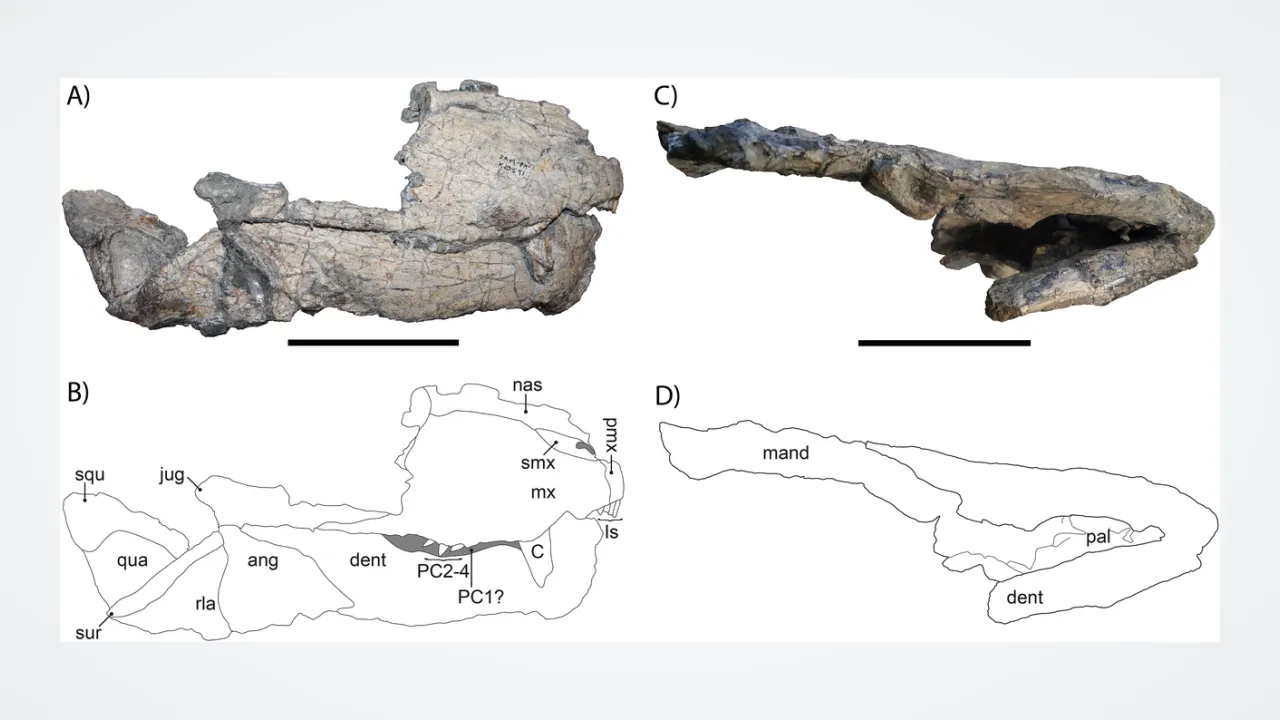
When Gorgonops closed its mouth, deep grooves on the outside of its lower jaw safely tucked away the sharp tips of its upper saber teeth!
✨ Word Sparks (Grade 2 Glossary)
Tap 🔊 to hear
Pangaea
Ancient supercontinent when all landmasses joined together
Therapsid
Ancient mammal relative with upright-style legs and fangs
Ambush
Surprise dash from hiding to catch prey
🪝
How could an ancient hunter open its mouth wide enough to bite past five-inch fangs?
1
Named After Mythical Monsters
Imagine standing on the dry plains of South Africa 256 million years ago, when all Earth's continents formed one supercontinent called ! Trotting out of low scrub bushes is Gorgonops, whose name means 'Gorgon face' after fierce monsters from Greek myth.
2
A Super-Wide Jaw Hinge
Gorgonops was a —an advanced cousin on the ancient path toward mammals. Its upper canine teeth stretched nearly five inches long! Special double-jointed jaw hinges let its lower jaw drop open almost ninety degrees to clear those giant sabers.
3
Built for Quick Ambushes
Strong front teeth locked neatly together to pull away bites after a strike, letting Gorgonops hunt tough, Thick-skinned plant eaters.
1. How did Gorgonops manage to bite with five-inch saber teeth in the way?
2. Where were the first Gorgonops fossils discovered?
🤯 Mind-Blowing Fact • Grade 3
Unlike Ice Age saber-toothed cats that grew just one permanent pair of adult fangs, Gorgonops could grow replacement saber teeth if one broke while hunting!
✨ Word Sparks (Grade 3 Glossary)
Tap 🔊 to hear
Incisors
Chisel-like front teeth between the large canines
Karoo
Fossil-rich semi-desert region in South Africa
Gape
How wide an animal can open its jaws
🪝
What made Gorgonops and its saber-toothed family the undisputed top predators right before Earth's biggest extinction?
1
Next Step Beyond Sail-Backs
Twenty million years after sail-backed Dimetrodon vanished, a sleeker, faster wave of mammal relatives called therapsids ruled Pangaea. In 1876, paleontologist Richard Owen studied a long, narrow skull from South Africa's Basin and named it Gorgonops torvus—giving its name to the entire saber-toothed family Gorgonopsia!
2
Why Sabers Evolved So Early
Late Permian floodplains were crowded with armored pareiasaurs and barrel-bodied tusked herbivores called dicynodonts. Ordinary short teeth struggled against thick, leathery hides. Gorgonops evolved twelve-centimeter blade-like canines lined with fine serrations to pierce tough skin rapidly, then used interlocking front to tear food free without snapping its sabers.
3
Warming Up Inside?
Tiny bony ridges inside gorgonopsian nasal passages hint at fast breathing and higher energy levels than cold-blooded reptiles, helping them stay alert during cool nights.
4
End of a Dynasty
Gorgonopsians thrived from South Africa to Russia—where cousin Inostrancevia grew to polar-bear size—until massive volcanic eruptions triggered the end-Permian extinction 252 million years ago.
1. What big advantage did Gorgonops have over modern mammals if one of its long saber teeth snapped?
2. How did Gorgonops protect its fragile saber canines once prey was down?
🤯 Mind-Blowing Fact • Grade 4
Fossilized bony eye rings—called scleral ossicles—inside gorgonopsian skulls show pupil proportions tuned for hunting both in sunny afternoon light and shadowy dusk!
✨ Word Sparks (Grade 4 Glossary)
Tap 🔊 to hear
Cathemeral
Active during intervals of both day and night
Turbinates
Thin nasal bone scrolls warming air and saving moisture
Parasagittal
Moving limbs straight forward underneath the body
🪝
How did Gorgonops combine reptilian tooth replacement with mammal-like stride and brain clues 255 million years ago?
1
Predators of the Beaufort Floodplains
Picture the semi-arid river channels of South Africa's Karoo Basin 256 million years ago during the Wuchiapingian Stage of the Late Permian. Stalking silently behind stands of Glossopteris trees is Gorgonops torvus, a two-meter therapsid weighing up to ninety kilograms. Named by Sir Richard Owen in 1876, Gorgonops anchored a clade of stem-mammals that perfected saber-toothed predation more than 200 million years before Cenozoic nimravids and felids.
2
Kinetic Jaw Hinges and Incisor Nipping
Driving twelve-centimeter serrated canines into thick-skinned dicynodonts demanded specialized cranial mechanics. Gorgonops possessed a deep, box-framed snout reinforced against bending forces and reduced cheek teeth behind the sabers. At the back of the jaw, a streptostylic—movable—quadrate bone slid forward as the mandible dropped, allowing a ninety-degree gape without overstretching jaw muscles. Once prey was immobilized, peg-like upper and lower incisors interdigitated tightly to strip flesh cleanly away from bone.
3
Dual Gait and Endothermic Hints
Limb articulations show Gorgonops could shift from a relaxed semi-sprawling walk into a , mammal-like upright trot for rapid bursts. Rings of scleral ossicles inside its eye sockets reveal adaptation to both bright day and dim twilight— hunting—paired with maxilloturbinal ridges inside the snout that conserved moisture during rapid, elevated-metabolism breathing.
4
Fall in the Great Dying
Though gorgonopsians dominated Permian Pangaea up to three-meter Russian giants, hyper-specialized apex carnivores perished completely during the end-Permian mass extinction 252 million years ago.
1. How did a movable quadrate bone at the rear jaw joint help Gorgonops use its giant saber teeth?
2. What do bony eye rings (scleral ossicles) and nasal turbinate ridges suggest about Gorgonops's daily life?
🤯 Mind-Blowing Fact • Grade 5
CT X-ray scans of Gorgonops jaws proved its left and right saber fangs replaced themselves on staggered schedules so the hunter was never stuck 'toothless' on both sides at once!
✨ Word Sparks (Grade 5 Glossary)
Tap 🔊 to hear
Streptostylic
Having a movable quadrate bone in the jaw joint
Hypercarnivory
Diet consisting almost entirely of vertebrate meat
Fibrolamellar
Fast-growing microscopic bone texture linked to warm-bloodedness
🪝
What cranial and locomotor breakthroughs made Gorgonopsia the template for saber-toothed hypercarnivory a quarter-billion years before Smilodon?
1
Type Genus of a Saber-Toothed Radiation
Described by Sir Richard Owen in 1876 from a crushed snout unearthed near Mildenhall in South Africa's Beaufort Group (Karoo Supergroup), Gorgonops torvus established the suborder Gorgonopsia—the dominant terrestrial apex predators of the Late Permian (260–252 MYA). Measuring 1.2 to 2.0 meters long and massing 45 to 90 kilograms, Gorgonops patrolled seasonal semi-arid floodplains across southern Gondwana while larger Rubidgeinae relatives in Africa and Inostrancevia in Russia approached grizzly-bear dimensions.
2
Biomechanics of the Saber-Strike Complex
Finite-element skull modeling and osteological studies reveal remarkable convergence between Gorgonops and Cenozoic machairodont felids despite 250 million years of evolutionary separation. A tall, tubular rostrum with fused nasals resisted torsional stress as serrated 12-centimeter upper canines plunged into dicynodont or pareiasaur prey. Because extreme canine length risked muscle over-extension at wide gapes, gorgonopsians evolved a kinetic quadrate-articular joint and reflected lamina of the angular bone, permitting ~90-degree jaw depression. Postcanine cheek teeth were tiny or absent; instead, five robust upper incisors interlocked tightly with lower incisors in an 'incisor-arcade nip' that sheared muscle free without subjecting flat saber blades to lateral fracture.
3
Alternating Saber Replacement
CT scans by Megan Whitney and colleagues demonstrated that gorgonopsians solved a vulnerability faced by single-generation mammalian sabers: functional and developing replacement canines alternated asynchronously between left and right maxillae, ensuring the predator always possessed at least one fully erupted saber.
4
Postcranial Posture, Vision, and Paleophysiology
Expanded iliac blades and inwardly angled femoral heads supported an upright-capable crurotarsal stride, recently corroborated by 2024 discoveries of the oldest Mediterranean gorgonopsian fossils and low-sprawling-to-erect trackways on Mallorca. Mesotarsal ankles, nasal maxilloturbinal ridges, bone cortex, and cathemeral scleral-ring apertures all point toward an active, incipiently endothermic physiology.
5
Collapse at the Permian-Triassic Boundary
When Siberian Traps flood volcanism unleashed runaway greenhouse warming 251.9 million years ago, collapsing primary productivity stripped apex hypercarnivores of prey—extinguishing Gorgonopsia completely while smaller cynodont cousins survived to engender mammals.