1. Which living animal is a close relative of Glyptodon?
2. What did Glyptodon like to eat?
🤯 Mind-Blowing Fact • Grade 2
Glyptodon's shell alone weighed about 800 pounds—as heavy as a grand piano!
✨ Word Sparks (Grade 2 Glossary)
Tap 🔊 to hear
carapace
a hard upper shell covering an animal's back
rosette
a round pattern shaped like a rose
grazer
an animal that feeds on low grass
🪝
Could Glyptodon pull its head inside its shell like a turtle?
1
Built Like a Beetle Car
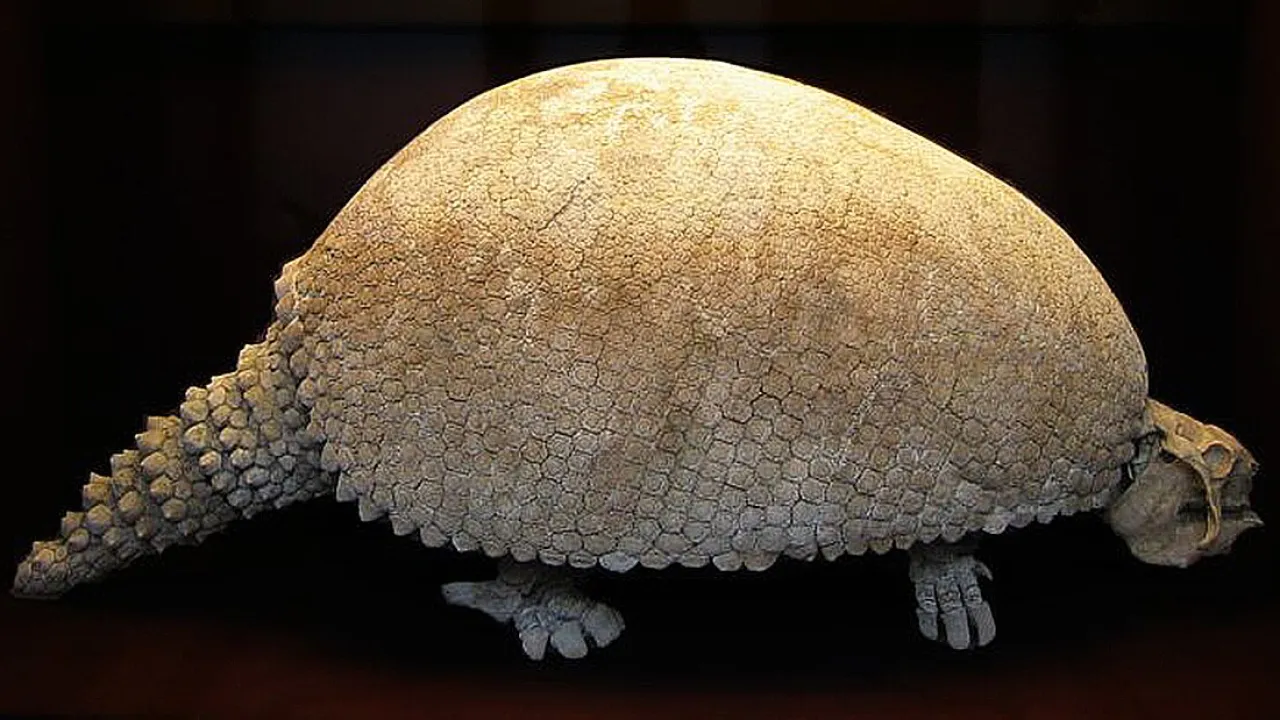
Picture a small round car covered in flower-patterned tiles strolling beside an ancient river! Glyptodon weighed up to two tons, and its bony shell alone weighed nearly 800 pounds. Short, sturdy legs carried that heavy dome slowly across South American grasslands.
2
A Helmet Instead of Hiding
Turtles can tuck their necks inside their shells, yet Glyptodon could not pull its head in at all! Instead, nature gave it a hard bony cap right on top of its skull and rings of bony armor wrapped around its thick, muscular tail.
3
Rosette Tile Patterns
Each inch-thick tile on Glyptodon's shell had a central circle surrounded by smaller bumps like a blooming flower! Scientists call these pretty bony plates osteoderms.
1. How did Glyptodon protect its head since it could not pull its neck inside its shell?
2. What did the tiles on Glyptodon's shell look like up close?
🤯 Mind-Blowing Fact • Grade 3
To hold up its 800-pound shell, Glyptodon's backbones fused together into a single solid arch like a stone bridge!
✨ Word Sparks (Grade 3 Glossary)
Tap 🔊 to hear
fused
joined tightly together into one solid piece
grooves
long narrow channels cut into a surface
distribute
spread weight or items out evenly
🪝
Why is Glyptodon named after 'carved teeth' instead of its giant shell?
1
How Glyptodon Got Its Name
Tap a fossil Glyptodon shell and it sounds like solid stone! Yet when British scientist Sir Richard Owen named Glyptodon in 1839, he actually studied its unusual cheek teeth first. Each tall tooth had three deep along the sides, so Owen named it Glyptodon—Greek for 'grooved or carved tooth!'
2
Special Neck and Spine Support
Carrying an 800-pound bony carapace took remarkable skeleton engineering. While humans have separate backbones that bend easily, Glyptodon's spine into a solid, arched beam bolted directly under its shell to weight evenly down to its hips and shoulders.
3
Armored Tail Rings
Some cousins of Glyptodon, such as Doedicurus, swung spiked tail clubs like medieval maces! Glyptodon itself had a shorter tail wrapped in nested bony rings with knobby cones that protected its rear and balanced its heavy body.
4
Warm-Keeping Nasal Passages
Inside Glyptodon's blunt, boxy snout ran wide coiled nasal passages. Those winding airways warmed chilly winter breezes and trapped moisture before dust from dry Pampas grasslands could reach its lungs.
1. What does the Greek name Glyptodon actually mean?
2. How did Glyptodon's spine hold up such a heavy shell?
🤯 Mind-Blowing Fact • Grade 4
Ancient DNA revealed that one of two-ton Glyptodon's closest living relatives is the tiny, pocket-sized pink fairy armadillo—only five inches long!
✨ Word Sparks (Grade 4 Glossary)
Tap 🔊 to hear
mitochondrial
DNA passed down inside cell energy centers
convergent
unrelated species evolving similar traits independently
millstones
heavy flat stones that grind grain fine
🪝
How did ancient DNA solve the mystery of where giant car-sized Glyptodons fit on the mammal family tree?
1
Cracking the Family Tree with DNA
For more than a century, paleontologists thought glyptodonts were an ancient sister branch that split away from all modern armadillos tens of millions of years ago. Then in 2016, scientists extracted DNA from a 12,000-year-old carapace and made a blockbuster discovery! Giant glyptodonts are actually nested right inside the modern armadillo family Chlamyphoridae—closely related to the tiny, five-inch-long pink fairy armadillo!
2
Convergent Evolution in Action
Look at an ankylosaur dinosaur, a giant tortoise, and a Glyptodon side by side: a reptile, a dinosaur, and a warm-blooded mammal separated by millions of years all evolved domed shells and armored tails! Biologists call this evolution—when unrelated lineages independently invent similar body plans to solve the same survival challenge.
3
Cheek Muscles Attached to Cheekbones
Peek at a Glyptodon skull and you will spot two long, downward-pointing bone prongs hanging beneath its eye sockets. Massive jaw muscles anchored to these prongs slid the lower jaw forward and backward like , grinding silica-packed grasses and marsh plants into fine pulp.
4
Crossing Northward to the United States
While Glyptodon stayed in South America, its close cousin Glyptotherium marched north across the Isthmus of Panama, grazing wetlands from Florida to Arizona and Texas during the Ice Age!
1. Which tiny living mammal turned out to be a close relative of Glyptodon in 2016 DNA tests?
2. Why did Glyptodon skulls have long bony prongs hanging beneath their cheekbones?
🤯 Mind-Blowing Fact • Grade 5
Microscopic slices of Glyptodon armor show sandwich-core engineering—two dense bone layers around a spongy shock-absorbing center, just like spacecraft panels!
✨ Word Sparks (Grade 5 Glossary)
Tap 🔊 to hear
trabecular
spongy lattice bone that absorbs shock lightly
sutures
interlocking seams joining bony plates together
propalinal
sliding the jaw forward and backward
🪝
Why did an armadillo lineage balloon from the size of a loaf of bread into a two-ton armored fortress?
1
Runaway Gigantism on Open Grasslands
Imagine standing on the flooded Pampas of Pleistocene Argentina while herds of car-sized domes wade calmly through sedge marshes! In 2016, ancient mitogenomes sequenced from a 12,000-year-old Doedicurus carapace overturned decades of morphological classification by placing glyptodonts squarely inside Chlamyphoridae alongside fairy and giant armadillos. Molecular clocks show their ancestors weighed barely six kilograms (13 pounds) in the Miocene before cooling, drying climates expanded South American grasslands—triggering a more than three-hundred-fold surge in body mass to outgrow terror birds and saber-toothed predators.
2
Composite Biomechanics of the Carapace
A mature Glyptodon clavipes carapace united over 1,000 hexagonal and pentagonal osteoderms, each 2.5 to 5 centimeters thick, locked via jagged collagenous . Microscopic cross-sections reveal sandwich-panel engineering identical to modern aircraft composites: dense outer and inner cortical bone layers framed a spongy core that absorbed heavy impacts without adding crippling weight.
3
Trivertebral Fusion and Descending Zygomatics
Beneath that rigid vault, cervical, thoracic, and sacral vertebrae fused into specialized blocks—including a 'trivertebral bone' at the base of the neck and a massive synsacrum welded to the pelvis. Forward on the cranium, remarkable descending processes of the zygomatic arch dropped below the tooth row, repositioning the masseter muscles horizontally to power (fore-and-aft) grinding across sixteen rootless, trilobed teeth.
4
Intraspecific Tail Duels
CT analyses of fractured carapaces in glyptodont fossils show localized circular dents over the flanks and shoulders—evidence that rival males squared off side-by-side and swung armored tails in ritualized contests rather than fleeing predators.
5
Darwin's Law of Succession
Observing fossil glyptodont osteoderms in South America alongside living banded armadillos gave Charles Darwin one of his earliest insights into 'the law of the succession of types,' realizing living species descend from ancient neighbors in the very same continent.