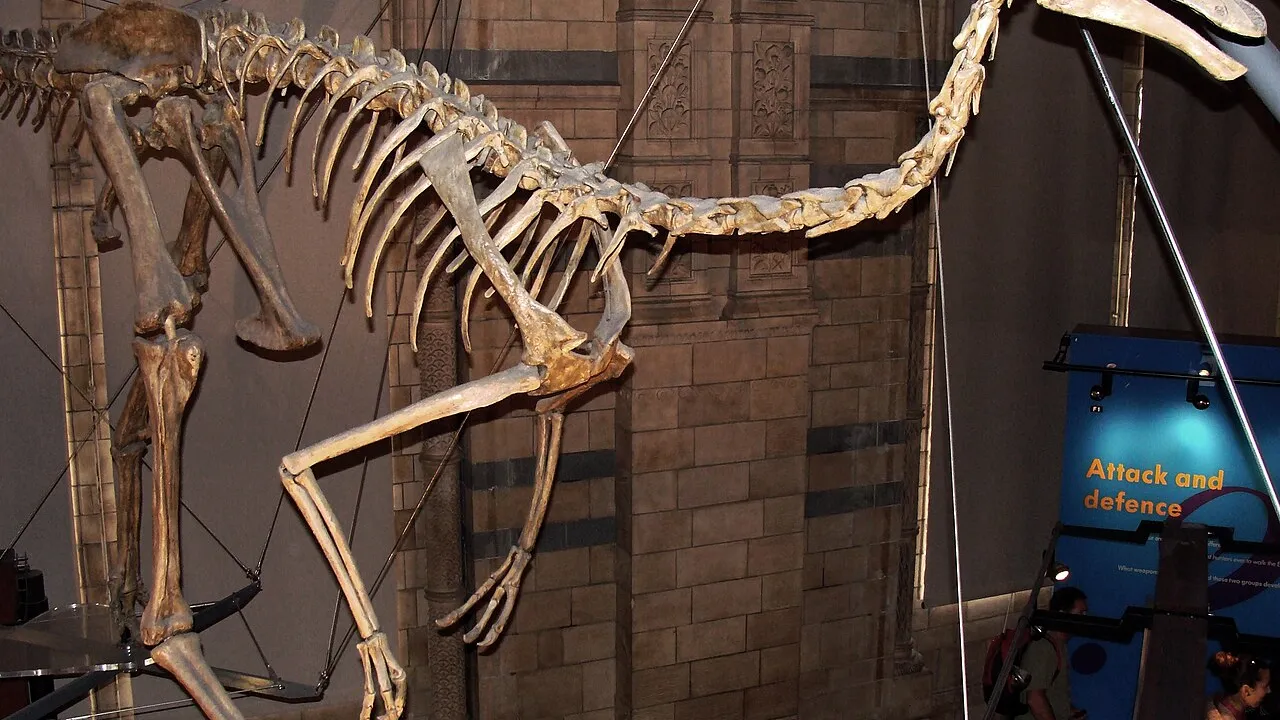
1. How many teeth did an adult Gallimimus have inside its beak?
2. Why did eyes on the sides of its head help Gallimimus survive?
🤯 Mind-Blowing Fact • Grade 2
Pioneering Polish scientist Zofia Kielan-Jaworowska led the historic Gobi Desert expeditions in the 1960s that discovered both Gallimimus and the giant arms of Deinocheirus!
✨ Word Sparks (Grade 2 Glossary)
Tap 🔊 to hear
Ornithomimid
Fast, toothless dinosaur family nicknamed ostrich mimics
Strain
Filter tiny food bits out of pond water
Shin
Lower leg bone between knee and ankle
🪝
Why did a Polish woman paleontologist name this twenty-foot giant 'chicken mimic'?
1
Historic Gobi Expeditions
Imagine camping under starry Mongolian skies in the 1960s with pioneering Polish paleontologist Zofia Kielan-Jaworowska and her team! Excavating sandstones in the Gobi Desert, they uncovered Gallimimus skeletons ranging from tiny toddlers to twenty-foot adults twice as tall as modern ostriches.
2
Built for Pure Speed
Long bones, tightly bound ankle bones, hollow air-filled skeletons, and a stiff balancing tail turned Gallimimus into a marathon sprinter! Scientists calculate it raced at thirty to thirty-five miles per hour to outrun Tarbosaurus.
3
Dabbling Like a Giant Duck
One exquisite skull preserved tiny comb ridges lining its beak—just like modern ducks that water plants and tiny shrimp from ponds!
1. What surprising feature was found lining a well-preserved Gallimimus beak?
2. Who led the famous Polish-Mongolian Gobi Desert expeditions that unearthed Gallimimus?
🤯 Mind-Blowing Fact • Grade 3
Because Gallimimus had zero teeth, its cousin skeletons preserve piles of polished stomach stones (gastroliths) right inside the ribcage that ground up food like a bird's gizzard!
✨ Word Sparks (Grade 3 Glossary)
Tap 🔊 to hear
Gastroliths
Swallowed pebbles inside a gizzard that grind plants
Bulla
Hollow rounded bone capsule beneath the skull
Gizzard
Muscular stomach chamber birds use to crush food
🪝
Why did Gallimimus have hands built like garden rakes instead of grasping raptor claws?
1
Largest of the True Ostrich-Mimics
Step onto lush river deltas of Mongolia's Nemegt Basin seventy million years ago. Wading through shallow marshes and sprinting across open sandbars strides Gallimimus bullatus—stretching twenty feet long and weighing nearly half a ton!
2
Bulb at the Base of the Skull
When paleontologists Halszka Osmólska, Ewa Roniewicz, and Rinchen Barsbold named Gallimimus bullatus in 1972, they noticed a hollow, inflated bubble of bone underneath its braincase—resembling a Roman locket called a !
3
Hooking Hands, Not Grasping Talons
Although Gallimimus had long arms with three fingers, its thumb could not twist across the palm to squeeze prey. Instead, all three fingers bent together like a three-pronged rake to hook fern fronds or uncover eggs and roots in soft mud.
4
Swallowing Gizzard Stones
Without teeth to chew, ornithomimids swallowed smooth pebbles called that tumbled inside muscular to grind seeds and tough plants!
1. How did toothless ornithomimids like Gallimimus grind up tough seeds and fibrous plants?
2. What inspired the species name bullatus for Gallimimus?
🤯 Mind-Blowing Fact • Grade 4
Fossils of ostrich-mimic dinosaurs revealed that youngsters wore only fuzzy down coats and grew fancy ostrich-like arm wings only when they became teenagers—just for courtship displays and shading nests!
✨ Word Sparks (Grade 4 Glossary)
Tap 🔊 to hear
Lamellae
Fine comb-like ridges lining the inside of beaks
Carbonized
Preserved as thin dark carbon films on rock
Arctometatarsal
Pinched middle foot bone cushioning high-speed running
🪝
How did Canadian fossils prove Gallimimus and its ostrich-mimic cousins grew flashy arm wings only after becoming teenagers?
1
Feathers and Wings Confirmed in Cousins
For decades, artists drew Gallimimus completely scaly because coarse river sand in Mongolia rarely preserved fragile feathers. Then in 2012, paleontologists Darla Zelenitsky and François Therrien discovered three skeletons of close North American cousin Ornithomimus in Alberta preserving dark feathers! Fluffy down covered both juveniles and adults—yet only older adults sported long pennaceous wing feathers along their arms!
2
Wings for Courtship, Not Flying
Why grow bird-like wings on a 950-pound sprinter far too heavy to fly—and only upon reaching maturity? Just like modern ostriches fanning gorgeous plumes during dances or shielding sunny nests, adult Gallimimus evolved display wings ('pennibrachia') to attract mates and shelter clutches of eggs!
3
Debate Over the Comb-Lined Beak
In 2001, Peter Makovicky and Mark Norell discovered microscopic vertical ridges () inside a fossilized Gallimimus keratin beak. While initial studies compared it to filter-feeding flamingos, 2005 biomechanical reviews noted a half-ton animal needed higher-calorie fare too—using those ridges like tortoises and geese to shear tough pond weeds, fruits, and invertebrates!
4
Pinched Shock-Absorbing Foot
Like tyrannosaurs, Gallimimus possessed an arctometatarsalian foot whose wedged middle bone absorbed impact forces during thirty-five-mile-per-hour sprints across open river sandbars and floodplains whenever Tarbosaurus approached.
1. Why do scientists conclude the long arm-wing feathers on adult ornithomimids were used for courtship and brooding rather than flight?
2. How do modern geese and tortoises help explain the ridged keratin beak of Gallimimus?
🤯 Mind-Blowing Fact • Grade 5
The 1972 scientific naming of Gallimimus bullatus by Halszka Osmólska, Ewa Roniewicz, and Rinchen Barsbold following Zofia Kielan-Jaworowska's Gobi expeditions stands as a landmark moment led by women in paleontology!
✨ Word Sparks (Grade 5 Glossary)
Tap 🔊 to hear
Ratite
Modern group of large flightless running birds like ostriches
Gregarious
Living and traveling together in social flocks or herds
Inertia
Resistance to swinging fast when lower legs are heavy
🪝
How did Gallimimus evolve convergent ostrich anatomy seventy million years before modern ostriches existed?
1
Polish-Mongolian Paleontological Milestone
Between 1963 and 1971, pioneering joint Polish-Mongolian expeditions directed by Zofia Kielan-Jaworowska excavated pristine Maastrichtian skeletons across the Nemegt Basin. Formally described in 1972 by Halszka Osmólska, Ewa Roniewicz, and Rinchen Barsbold—one of the earliest major dinosaur monographs co-authored predominantly by women paleontologists—`Gallimimus bullatus` spanned an extraordinary ontogenetic series from half-meter skulls-in-miniature to six-meter (20-foot), 440-kilogram adults.
2
Convergent Cursorial Biomechanics
Seventy million years before birds (ostriches, emus, and rheas) evolved similar proportions, `Gallimimus` perfected bipedal cursoriality across Asian floodplains. Its tibia exceeded femur length by twenty percent, elongated metatarsals locked into a spring-loaded arctometatarsus that minimized distal limb , and interlocking prezygapophyses stiffened the caudal series into an aerodynamic stabilizer capable of fifty-five-kilometer-per-hour sprints.
3
Cranial Ontogeny and Sensory Specialization
Juvenile `Gallimimus` skulls featured proportionally enormous orbits and short snouts; during growth, the edentulous rostrum elongated dramatically while lateral eye placement preserved wide panoramic vigilance against ambush hunters. Hollow parasphenoid bullae at the basicranium lightened the skull and likely enhanced low-frequency acoustic sensitivity across open river valleys.
4
Keratinous Rhamphotheca Preservation
Specimen `IGM 100/1133` preserved three-dimensional impressions of the upper and lower keratinous rhamphotheca lined with columnar lamellae spaced fractions of a millimeter apart, documenting versatile mesoherbivorous-omnivorous foraging across seasonal Nemegt wetlands, oxbow lakes, and forested riverbanks.
5
Gregarious Bonebed Evidence
Multi-individual bonebeds of closely related Asian ornithomimids (`Sinornithomimus`) trapped simultaneously in lake mud confirm juveniles and subadults traveled in protective, age-sorted flocks across Cretaceous floodplains while mature adults invested energy in display plumage and nest brooding—mirroring modern ostrich life histories in remarkable detail.