1. What strong material are your fingernails actually made of?
2. Which grows faster: your fingernails or your toenails?
🤯 Mind-Blowing Fact • Grade 2
Nails on the hand you write and throw with actually grow slightly faster than nails on your other hand!
✨ Word Sparks (Grade 2 Glossary)
Tap 🔊 to hear
translucent
clear enough to let light shine through
nail bed
pink blood-rich skin under your nail plate
lunula
pale half-moon shape at a nail's base
🪝
Why does the main part of your fingernail look rosy pink while the tip turns white?
1
A Clear Window Over Pink Skin
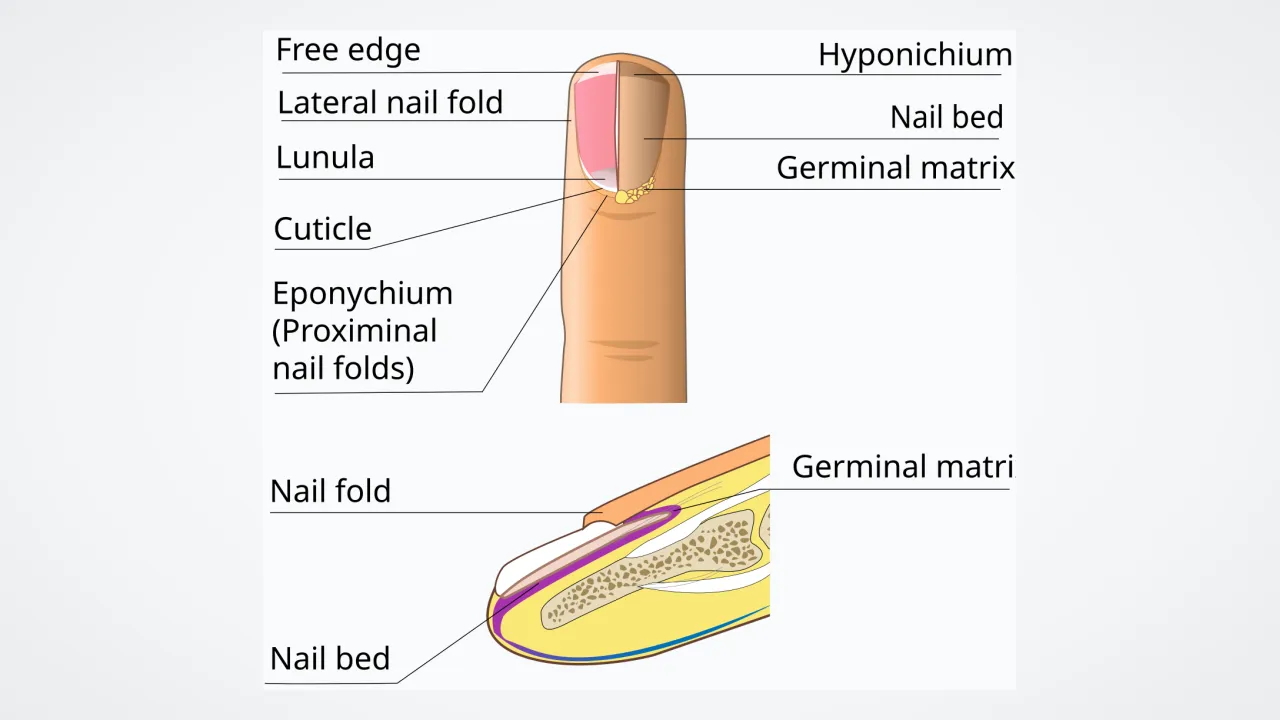
Look closely at one of your fingernails right now! Even though it looks pink, the hard nail plate itself is actually see-through. It looks rosy because tiny blood vessels shine right through from the living underneath!
2
Why the Free Edge Turns White
Once your nail grows past the end of your fingertip, air sits underneath instead of pink skin. Light bounces off that free edge and makes the tip look white.
3
Helping Your Fingers Feel
Stiff keratin nails press back when your soft finger pads touch things, helping you pick up tiny LEGO bricks, untie knots, and feel fine textures.
2. How do fingernails make your fingertips even better tools?
🤯 Mind-Blowing Fact • Grade 3
Your middle fingernail is the fastest-growing nail on your hand, while your pinky nail and thumbnail grow the slowest!
✨ Word Sparks (Grade 3 Glossary)
Tap 🔊 to hear
nail matrix
hidden growth zone building new nail cells
crescent
a curved shape like a young moon
protein
chain molecule that builds body tissues
🪝
What links your fingernails to an eagle's talons, a horse's hooves, and a tortoise's outer shell?
1
Nature's Favorite Armor Protein
Try untying a tight shoelace knot—your fingernails slip right between the laces like miniature pry bars! Humans, hawks, horses, and rhinos all build their nails, claws, hooves, and horns out of the exact same tough family: keratin.
2
Inside the Hidden Nail Matrix
Tucked beneath the skin fold at the base of your nail lies a busy factory called the . You can peek at its front edge as a pale called the lunula, Latin for 'little moon.' Living matrix cells divide, pack themselves with hard keratin, flatten out, and fuse into a solid plate.
3
The Waterproof Cuticle Seal
Notice the thin rim of skin hugging the bottom edge of your nail? That cuticle works like waterproof caulk around a window, stopping bacteria and dishwater from sneaking down into the delicate growing matrix.
4
Summer Speed Boost
Fingernails glide forward about 3.5 millimeters a month, growing noticeably faster during warm, sunny summers than chilly winters!
1. Why should you never bite or rip away the cuticle rim at the base of your nail?
2. Which animal structures are built from the same keratin protein family as human fingernails?
🤯 Mind-Blowing Fact • Grade 4
Replacing one entire fingernail from the base matrix all the way to the free tip takes about six months, while replacing a big toenail takes twelve to eighteen months!
✨ Word Sparks (Grade 4 Glossary)
Tap 🔊 to hear
cysteine
sulfur-rich amino acid hardening nail keratin chains
onychocyte
flattened keratin-packed cell inside a nail plate
primate
mammal group including humans, apes, and monkeys
🪝
Why are fingernails rigid like stiff plastic while skin made of keratin is soft and bendy?
1
Sulfur Bridges Make Hard Keratin
Press on your cheek, then tap on your thumbnail: astonishingly, both surfaces are built primarily of keratin! Why is one pillowy soft and the other shield-hard? Fingernails are forged from 'hard alpha-keratin' packed with high levels of , a sulfur-bearing amino acid. Neighboring protein chains lock together with countless sulfur-to-sulfur disulfide bridges, like ladder rungs bolted with steel.
2
Gliding Along Grooved Tracks
Beneath the proximal nail fold, germinal cells in the nail matrix compress roughly one hundred microscopic layers of dead, keratinized into a single dense nail plate about half a millimeter thick. Longitudinal ridges and grooves on the underlying nail bed guide the growing plate straight forward like train rails.
3
Why Primates Traded Claws for Flat Nails
Squirrels and cats sharpen curved keratin claws to climb bark, so why do humans and monkeys wear broad, flat nails? Evolution widened fingertips into sensitive touch pads for grasping slender twigs and crafting tools, using flat dorsal nails as rigid backboards that amplify mechanoreceptor touch accuracy.
4
Busting the White-Spot Calcium Myth
Ever spot a tiny white speck drifting up your nail? Despite popular myth, it almost never means low calcium—nails contain less than 0.2 percent calcium! Instead, harmless minor bumps to the matrix trap microscopic pockets of unflattened cells that grow out over four to six months.
1. What makes nail keratin so much stiffer than outer skin keratin?
2. What usually causes a harmless tiny white spot on a child's fingernail?
🤯 Mind-Blowing Fact • Grade 5
Physicians can press gently on a fingernail to blanch it white and watch pink blood refill the nail bed in under two seconds—a rapid bedside check of healthy circulation!
✨ Word Sparks (Grade 5 Glossary)
Tap 🔊 to hear
eponychium
anatomical name for the protective cuticle seal
alpha-helix
spiral spring shape of coiled keratin proteins
Beau's lines
shallow crosswise nail grooves marking past illness
🪝
How can a half-millimeter plate of sulfur-crosslinked filaments record months of your body's health history?
1
Composite Biomechanics of the Nail Unit
Engineers admire biological composites that combine stiffness with crack resistance, and the human nail apparatus—unguis—is a masterwork of miniature materials science. Rather than a brittle slab, the nail plate stacks three trilaminar zones of flattened, anucleate onychocytes: tough dorsal and ventral keratin sheets sandwiching a slightly more pliable intermediate layer oriented perpendicular to growth, stopping splits from tearing downward into living flesh.
2
Alpha-Helices and Disulfide Cross-Linking
Inside the hidden germinal matrix beneath the (cuticle), epithelial progenitors synthesize hard alpha-keratins containing up to eighteen percent cystine by weight. Coiled-coil alpha-helical filaments embed inside an amorphous sulfur-rich protein matrix cross-linked by covalent disulfide bonds. Meanwhile, the pale lunula marks the distal matrix where thicker cells scatter light before thinning firmly onto the vascular nail bed and sealing at the distal hyponychium.
3
Counter-Pressure Biomechanics in Hominin Hands
Anchored by collagen fibers directly to the periosteum of the distal phalanx bone, the fingernail acts as a rigid mechanical buttress. When you pinch a sewing needle, upward pad compression against the unyielding nail plate focuses strain directly onto Merkel discs and Meissner's corpuscles, sharpening tactile resolution.
4
Circulatory Clues to Growth Rate
Advancing roughly 0.1 millimeters per day—about 3.5 millimeters monthly—fingernails outpace toenails three-to-one largely because hands experience richer blood perfusion, warmer ambient temperatures, and constant micro-mechanical stimulation. Because keratin filaments lock trace minerals permanently into place as they harden, forensic toxicologists and clinicians can analyze clipped nail tips to reconstruct months of metabolic health.
5
Linus Pauling and Clinical Window Clues
In 1951, chemist Linus Pauling and Robert Corey solved the coiled structure of keratin using X-ray diffraction, transforming molecular biology. Physicians also read nails as living health timelines: transverse grooves called —described by French physician Joseph Honoré Simon Beau in 1846—mark the exact week a high fever briefly paused matrix division.