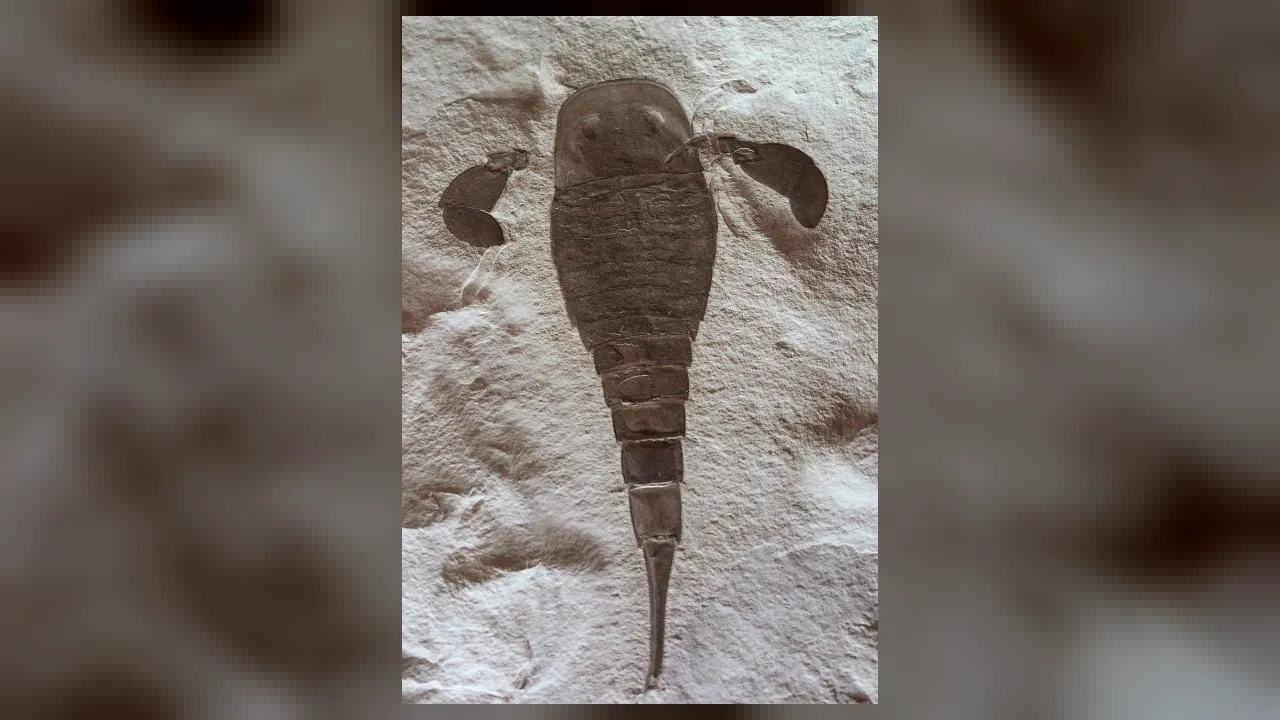
1. What special shape were the back legs of Eurypterus?
2. Did Eurypterus use its pointed tail spike to inject venom like land scorpions?
🤯 Mind-Blowing Fact • Grade 2
Over ninety percent of all Eurypterus fossils ever found are shed outer shells left behind when growing sea scorpions molted into bigger armor!
✨ Word Sparks (Grade 2 Glossary)
Tap 🔊 to hear
molted
Shed an old tight shell to grow
exoskeleton
Hard skeleton worn outside an animal's body
Silurian
Ancient ocean period before dinosaurs or trees
🪝
Why do fossil hunters find piles of empty Eurypterus shells lined up in New York rock quarries?
1
When New York Was a Tropical Sea
Imagine splashing in a warm, extra-salty tropical lagoon right where Buffalo and Syracuse, New York, sit today! Around 425 million years ago during the Period, swarms of Eurypterus remipes ('broad-winged oar-foot') prowled these shallow coastal flats.
2
Growing By Shedding Old Armor
Most Eurypterus fossils aren't dead animals at all—they are empty suits of armor! Just like crabs and lobsters today, Eurypterus crawled out of its tight old whenever it grew bigger, leaving neat shells behind in calm mud.
3
Cousin to Horseshoe Crabs
Although nicknamed 'sea scorpions,' Eurypterus was closely related to horseshoe crabs, spiders, and scorpions. Most grew eight to ten inches long, though rare giants stretched four feet!
1. What are most of the Eurypterus fossils found in New York limestone actually made from?
2. Which living seashore animal is a close relative of Eurypterus?
🤯 Mind-Blowing Fact • Grade 3
Some giant sea scorpion cousins of Eurypterus—like Jaekelopterus from Germany—grew past eight feet long, making them the biggest arthropods in Earth's history!
✨ Word Sparks (Grade 3 Glossary)
Tap 🔊 to hear
chelicerae
Small front pincer mouthparts on arachnid relatives
book gills
Stacked leaf-thin gill pages underneath the belly
telson
Pointed tail spike used for steering and flipping
🪝
Could a Silurian sea scorpion crawl right out of salty lagoons and take a short stroll across damp mudflats?
1
Prowler of Hypersaline Flats
Four hundred twenty-five million years ago, land plants were still ankle-high moss-like stems and zero four-legged vertebrates walked ashore yet. In warm, shallow bays of New York's Bertie Sea—where evaporation made water extra salty—hardy Eurypterus remipes thrived by the thousands!
2
Six Pairs of Specialized Limbs
Flip Eurypterus over and you'd count six pairs of appendages tucked beneath its rounded head shield! Up front, small pincers called tore soft worms and small fish into bite-sized pieces. Four pairs of spiny walking legs tiptoed across mud, while the broad sixth pair acted like hydrofoil oars!
3
Double Vision: Four Eyes!
Two crescent-shaped compound eyes watched sideways for motion, while two tiny simple eyes (ocelli) perched dead center on its head shield to sense light changes overhead.
4
Breathing Damp Air Briefly
Tucked underneath its belly plates sat folded '' plus spongy respiratory pads! As long as those gills stayed wet, Eurypterus could scurry across damp tidal mudflats between pools!
1. How could Eurypterus survive brief crawls across wet tidal mudflats?
2. How were the six pairs of limbs under Eurypterus's head divided by job?
🤯 Mind-Blowing Fact • Grade 4
Eurypterus chewed its food with its hips—spiny tooth-like grinders called gnathobases built right into the bases of its walking legs!
✨ Word Sparks (Grade 4 Glossary)
Tap 🔊 to hear
chelicerates
Arthropod branch with spiders, scorpions, and horseshoe crabs
gnathobases
Spiny leg bases that grind food into mouth
hypersaline
Water much saltier than normal ocean water
🪝
How did underwater figure-eight wing physics let armored Eurypterus hover and sprint like a water beetle?
1
America's First Named Eurypterid
When physician Silvanus Miller found a strange segmented fossil in Oneida County, New York, in 1818, naturalist Samuel Latham Mitchill initially mistook it for a fossilized catfish! Seven years later in 1825, paleontologist James Ellsworth DeKay recognized its jointed arthropod segments and named it Eurypterus remipes—launching scientific study of Eurypterida ('sea scorpions'), a 200-million-year dynasty of aquatic .
2
Lift-Based Rowing Mechanics
How did that broad sixth appendage actually propel Eurypterus? Biomechanical hydrodynamic calculations by Roy Plotnick and Paul Selden revealed Eurypterus didn't just push backward clumsily like a rowboat! Tilting its jointed swimming paddles at precise angles on both upstrokes and downstrokes generated lift and thrust like sea-turtle flippers or diving water beetles—letting it hover, bank, and sprint rapidly.
3
Mass Molting Gatherings in Hypersaline Lagoons
Why does New York's Upper Silurian Bertie Dolostone preserve dense beds of pristine Eurypterus cuticles? , shallow carbonate lagoons kept big jawed predators and burrowing scavengers out! Like modern horseshoe crabs congregating along Delaware Bay, Eurypterus gathered en masse in sheltered lagoons to molt safely and mate.
4
Gnathobase Jaws Inside Its Leg Bases!
Eurypterus lacked vertebrate jaws! Instead, spiky inner hips where its walking legs met under its head—called —ground worms, phyllocarid shrimp, and soft carrion right into its mouth!
1. What surprising body part did Eurypterus use to chew and grind up food?
2. Why did calm, extra-salty lagoons in ancient New York preserve so many perfect Eurypterus molts?
🤯 Mind-Blowing Fact • Grade 5
Fossilized Eurypterus shells from Estonia are so astonishingly preserved that paleontologists can peel flexible, amber-colored sheets of 425-million-year-old skin right out of limestone to study under microscopes!
✨ Word Sparks (Grade 5 Glossary)
Tap 🔊 to hear
prosoma
Fused front head-and-chest section of chelicerates
What can translucent 425-million-year-old chitin and respiratory gill tracts tell us about arthropod conquest of coastal environments?
1
Type Genus of Eurypterida
Established by James Ellsworth DeKay in 1825 from Upper Silurian waterlimes of New York State—and designated New York's official State Fossil in 1984—Eurypterus remipes anchors the order Eurypterida alongside Balto-Scandian sister species Eurypterus tetragonophthalmus (found on Estonia's Saaremaa Island). Whereas Devonian–Carboniferous pterygotid and hibbertopterid cousins reached two-to-2.5-meter gigantism, Eurypterus typically spanned twenty centimeters (rarely 1.2 meters), dominating Pridoli peritidal ecosystems.
2
Organic Cuticle Preservation and Vision
Remarkably, Estonian dolostones preserve original unmineralized brown cuticle thin enough to mount directly onto microscope slides after mild acid dissolution! Optical analyses of Eurypterus compound eyes reveal thousands of tightly packed ommatidia lacking crystal calcite lenses, paired with median ocelli tuned to bright, shallow photic zones—contrasting sharply with large-facet ambush eyes of giant predatory pterygotids.
3
Tagmosis and Appendage Biomechanics
Anatomically divided into an anterior (fused head-thorax bearing six appendage pairs) and a twelve-segmented opisthosoma terminating in a styliform telson, Eurypterus exemplifies euchelicerate tagmosis. Hydrodynamic modeling confirms its expanded sixth prosomal paddles operated as high-precision hydrofoils combining lift-based figure-eight sculling with drag-based power strokes while coxal gnathobases macerated benthic prey.
4
Dual Respiratory Organs: Kiemenplatten
Beneath five ventral abdominal opercular plates, Eurypterus housed lamellate book gills homologous to modern Xiphosura (horseshoe crabs) PLUS vascularized spongy cuticular tracts called ('gill plates'). This dual respiratory architecture enabled gas exchange in oxygen-poor hypersaline pools and permitted brief amphibious excursions across wet Silurian microbial mats—leaving hexapodous-style trackways called Palmichnium!
5
Shift to Freshwater and End-Permian Finale
As fast, jawed placoderms, acanthodians, and early chondrichthyan sharks diversified aggressively across Devonian seas, marine eurypterid diversity declined steadily. Hardy brackish and freshwater sea scorpion lineages nevertheless persisted through lush Carboniferous coal-age river deltas and lakes for over a hundred million additional years, until the very last eurypterids perished during Earth's devastating End-Permian mass extinction 252 million years ago.