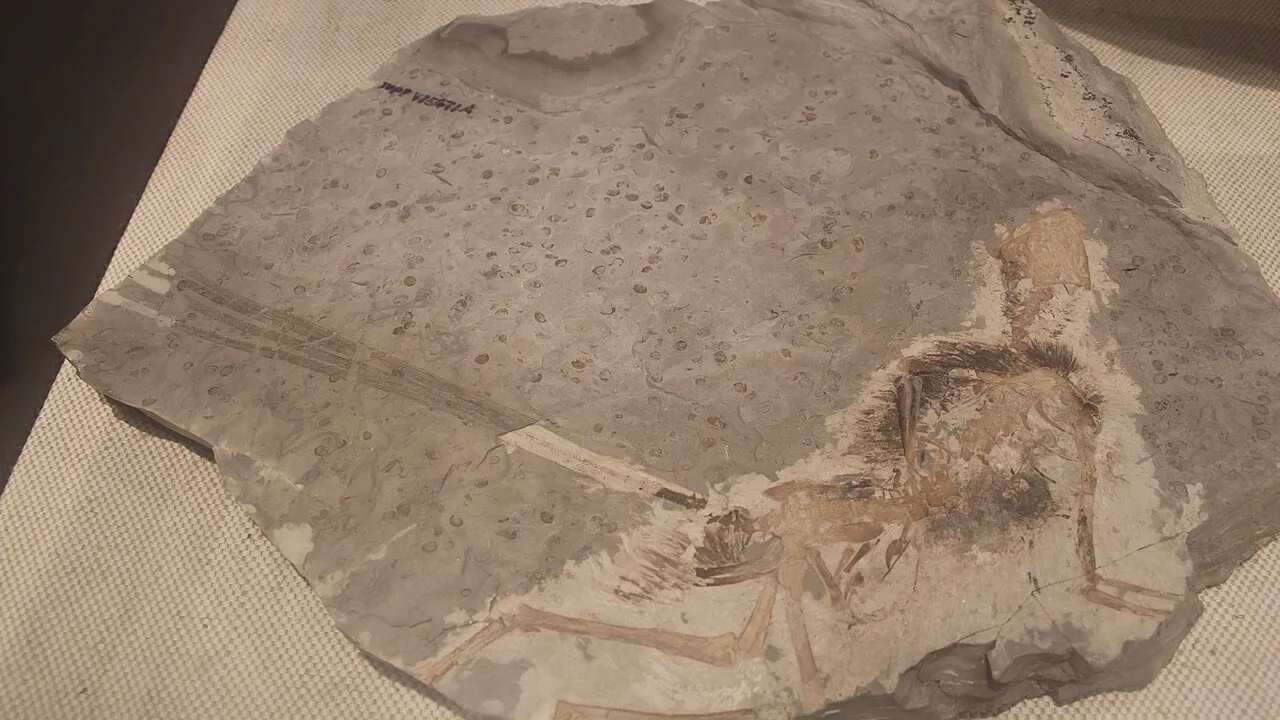
1. How many long ribbon feathers grew from Epidexipteryx's tail?
2. How did Epidexipteryx use its forward-tilted front teeth?
🤯 Mind-Blowing Fact • Grade 2
Epidexipteryx had a super-short bony tail tip much like modern peacocks and turkeys, anchoring its four long display streamers!
✨ Word Sparks (Grade 2 Glossary)
Tap 🔊 to hear
Display
Showing off colors or shapes to communicate
Nimble
Quick, light, and steady in movement
Grub
Soft baby beetle hiding inside wood
🪝
Did dinosaurs grow fancy show-off feathers even before birds learned how to fly?
1
Dressed to Impress
Peek into a leafy forest in China 160 million years ago! Climbing as a squirrel is Epidexipteryx, whose name means feather. Its body was only ten inches long, yet four sleek ribbon feathers nearly doubled its total length!
2
Fancy Before Flight
Soft fuzz kept Epidexipteryx cozy, while its arms had zero stiff flight feathers. That taught scientists an amazing lesson: dinosaurs evolved colorful feathers to attract friends or warn rivals before using feathers for bird flight!
3
Built for Tree Life
With extra-long fingers and curved claws, Epidexipteryx clung tightly to tree trunks while poking under loose bark for beetle .
2. What big scientific secret did Epidexipteryx's feathers reveal?
🤯 Mind-Blowing Fact • Grade 3
Epidexipteryx lived several million years BEFORE Archaeopteryx, making its tail streamers the oldest known ornamental display feathers in the fossil record!
✨ Word Sparks (Grade 3 Glossary)
Tap 🔊 to hear
Ornamental
Serving as decoration or visual attraction
Crevice
Narrow crack in bark or rock
Larvae
Immature, worm-like stage of many insects
🪝
How did a six-ounce dinosaur combine lemur-like bug-hunting fingers, tweezers teeth, and bird-of-paradise tail plumes?
1
A Jewel of the Daohugou Beds
Travel back 160 million years to the misty lakes and ginkgo woods of Inner Mongolia, China. Fine volcanic mud in the Daohugou Beds preserved delicate fossils right down to individual feather strands—including tiny Epidexipteryx hui, older than even famous Archaeopteryx!
2
Streamers on a Short Tail
Unlike most dinosaurs with long whip-like tails, Epidexipteryx had only sixteen short tail vertebrae. Fanning out from the tip were four long, unbranched ribbon feathers with central shafts. Just like modern peacocks and birds of paradise, it flashed these streamers for visual signals and balance.
3
The Aye-Aye of the Jurassic
Epidexipteryx belonged to the scansoriopterygids, tree climbers with a remarkably long third finger. Paired with long, forward-slanted front teeth at the tip of its short jaw, that skinny finger probed tree to hook hidden insect .
4
Honoring Yaoming Hu
Described in 2008, its species name hui honors Chinese paleontologist Yaoming Hu, who studied ancient Mesozoic mammals from the same fossil beds.
1. Which modern rain-forest mammal uses an extra-long finger to fish grubs out of bark much like Epidexipteryx did?
2. How did Epidexipteryx's bony tail compare to most other theropod dinosaurs?
🤯 Mind-Blowing Fact • Grade 4
Unlike other dinosaurs whose teeth lined the entire jaw, Epidexipteryx grew teeth ONLY at the very front of its mouth, angled forward like precision bug-catching forceps!
✨ Word Sparks (Grade 4 Glossary)
Tap 🔊 to hear
Procumbent
Teeth angled forward instead of pointing straight
Courtship
Animal behaviors and displays attracting a mate
Forceps
Handheld pincers used for grasping small objects
🪝
Why did visual communication evolve in feathered dinosaurs millions of years before powered bird flight?
1
Older Than Archaeopteryx
Imagine standing beside a quiet volcanic lake in Jurassic Inner Mongolia roughly 160 million years ago. Hopping through the overhanging conifers is Epidexipteryx hui, a 164-gram (5.8-ounce) paravian dinosaur measuring just 25 centimeters in skeletal length—or 44.5 centimeters counting its sweeping tail plumes! Described in 2008 by Zhang Fucheng and colleagues, it predates Germany's famed Archaeopteryx by nearly ten million years.
2
Ornamentation Preceding Aerodynamics
Two distinct feather types cloaked Epidexipteryx. Parallel filaments formed warm downy insulation across its torso, while four elongated, ribbon-like vane feathers sprouted from its shortened sixteen-vertebra tail. Crucially, its forelimbs bore zero stiff flight feathers, proving complex vane structures served , species recognition, and balance long before generating aerodynamic lift.
3
Specialized Arboreal Foraging
Every inch of Epidexipteryx's skeleton screamed tree life. Its short, high skull held —forward-leaning—teeth restricted strictly to the front of the jaws, functioning like precision . Meanwhile, an extraordinarily elongated third finger probed deep beneath loose bark to extract wood-boring beetle larvae.
4
Did It Have Skin Membranes Too?
Because its close scansoriopterygid cousins Yi qi and Ambopteryx later revealed bat-like wrist membranes, paleontologists also spotted faint folded skin traces near Epidexipteryx's arms—suggesting early gliding experiments may have paired with dazzling tail displays!
1. Why is Epidexipteryx's age (~160 million years ago) so important for understanding feather evolution?
2. Where were Epidexipteryx's procumbent teeth located in its mouth?
🤯 Mind-Blowing Fact • Grade 5
The compact tip of Epidexipteryx's sixteen-bone tail closely mirrors the 'pygostyle' tailbone that modern birds use to fan their tail feathers, even though Epidexipteryx evolved it independently!
✨ Word Sparks (Grade 5 Glossary)
Tap 🔊 to hear
Pygostyle
Fused tailbone tip supporting bird tail feathers
Xylophagous
Insects that feed on or bore wood
Lagerstätte
Fossil site preserving extraordinary soft-tissue detail
🪝
How did a 164-gram Jurassic fossil rewrite the timeline of skeletal tail reduction and display plumage in paravian dinosaurs?
1
Exquisite Preservation in the Yanliao Lagerstätte
Roughly 160 million years ago during the Oxfordian age of the Middle-to-Late Jurassic transition, fine-grained lacustrine shales of the Daohugou Beds in Ningcheng County, Inner Mongolia, entombed delicate forest organisms in low-oxygen bottom muds. Unveiled in Nature in 2008 by Zhang Fucheng, Zhou Zhonghe, Xu Xing, Wang Xiaolin, and Corwin Sullivan, Epidexipteryx hui offered an unprecedented window into early paravian evolution several million years prior to Archaeopteryx.
2
Caudal Reduction and Ribbon Rectrices
Weighing an estimated 164 grams with a 25-centimeter body length, Epidexipteryx exhibited startling skeletal convergence with modern birds (Pygostylia). Its caudal series was shortened to just sixteen vertebrae, with the final vertebrae compressed into a blade-like structure evocative of an avian . Anchored to this stubby tail were four incomplete ribbon-like rectrices exceeding 20 centimeters, each composed of a central rachis flanked by continuous unbranched vanes—parallel to the ornamental tail streamers later seen in Cretaceous Confuciusornis.
3
Cranial and Manual Specializations for Insectivory
Epidexipteryx's tall, vaulted cranium housed uniquely specialized dentition: long, procumbent premaxillary and anterior dentary teeth angled sharply forward while posterior cheek teeth were completely absent. Combined with the scansoriopterygid hallmark—a hyper-elongated manual digit III longer than digits I and II—this apparatus formed an ecological analog to Madagascar's aye-aye (Daubentonia), prying insect larvae from conifer and ginkgo bark.
4
Re-evaluating Membranes in Scansoriopterygidae
Remarkably, the 2008 description noted faint dark organic impressions near the forelimbs and hindlimbs even before Yi qi (2015) and Ambopteryx (2019) confirmed styliform-supported gliding membranes across the clade. Though the wrist region of Epidexipteryx's holotype is slightly damaged, researchers suspect small patagia may already have assisted its canopy leaps.
5
Social Signaling in the Jurassic Canopy
Above all, Epidexipteryx demonstrates that visual communication—flashing conspicuous tail ribbons through sunbeams in dark woodland canopies—acted as a primary evolutionary driver shaping dinosaurian feathers.