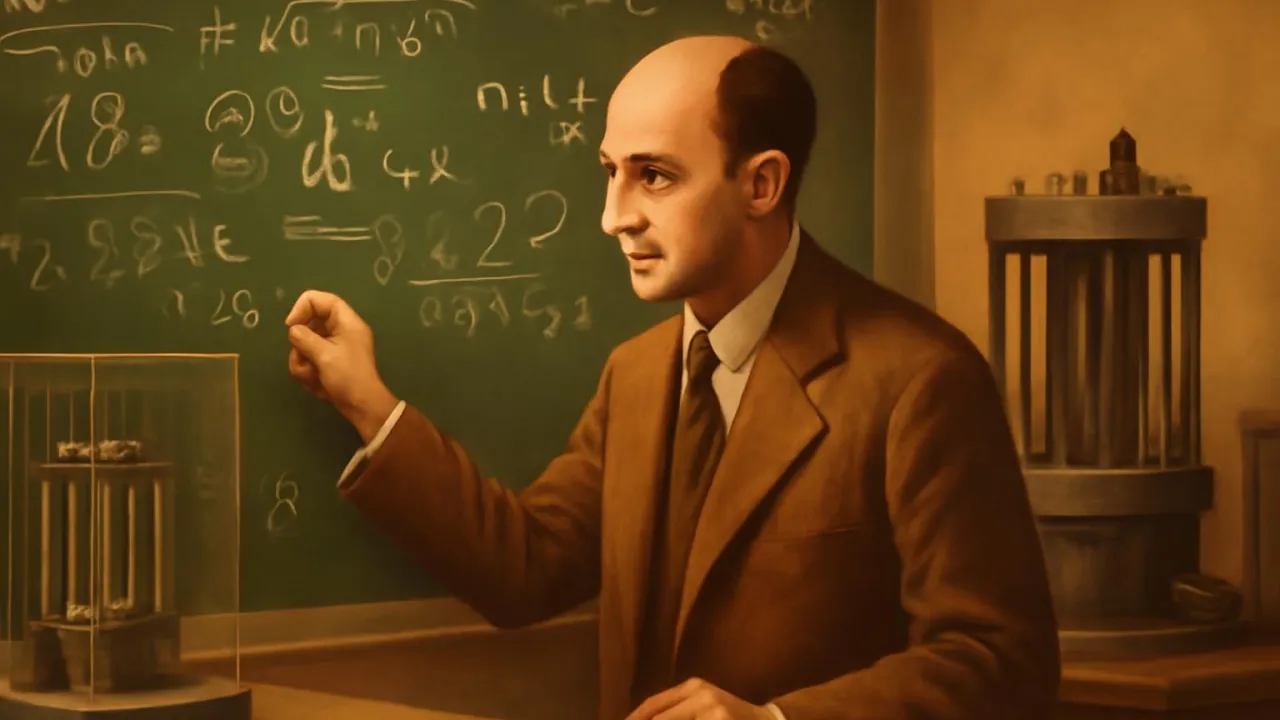
Enrico’s team built the first nuclear reactor under a football stadium in Chicago.
✨ Word Sparks (Grade 2 Glossary)
Tap 🔊 to hear
reactor
A machine that makes energy from atoms.
energy
The power that makes things move.
discovery
Finding out something new.
🪝
Have you ever wondered what makes up everything you can see?
1
Curious Kid
Enrico loved to take things apart and put them back together again. He read many books about science and math. He always wanted to know how the world worked.
2
Hard Work Pays Off
He studied very hard and became a scientist. Enrico spent long hours in the lab, testing ideas and making discoveries. He never gave up, even when things were tough.
3
A Big Discovery
Enrico showed the world how to split atoms. This helped people understand and led to new inventions. His work changed science forever.
Enrico’s nickname was “The Pope” because everyone trusted his answers in physics.
✨ Word Sparks (Grade 3 Glossary)
Tap 🔊 to hear
physics
The science of energy and motion.
neutron
A tiny part inside an atom.
reactor
A machine that uses atoms for energy.
🪝
Imagine building a machine that unlocks the secrets of invisible atoms!
1
A Mind Full of Questions
Young Enrico Fermi loved to read science books and solve tricky puzzles. He often took apart clocks and gadgets to see how they worked. His curiosity about nature and tiny things grew every year. He dreamed of discovering something amazing.
2
Learning and Experimenting
Enrico studied and math in school, always asking deep questions. He learned about atoms, the tiny building blocks of all matter. In his laboratory, he tried experiments to test his ideas about how atoms behave. He worked with other scientists to explore new science.
3
The First Nuclear Reactor
Enrico led a team to build the world’s first nuclear in 1942. A nuclear reactor is a special machine that splits atoms to release energy. This invention helped create new ways to use atomic energy for science and medicine. Enrico’s careful planning made the experiment safe and successful.
4
Changing the World
Enrico Fermi’s discoveries changed how people understand energy and matter. He won the Nobel Prize for his work on radioactivity and . Scientists still use his ideas to make new inventions today. Enrico inspired many people to ask big questions about the universe.
The element fermium, discovered in 1952, was named after Enrico Fermi to honor his legacy.
✨ Word Sparks (Grade 4 Glossary)
Tap 🔊 to hear
radioactivity
Energy released from some atoms.
chain reaction
A process where one event causes another.
Nobel Prize
A famous award for great discoveries.
🪝
What happens when a curious mind dares to split the secrets of the atom?
1
A Childhood of Curiosity
From a young age, Enrico Fermi was fascinated by how things worked, often taking apart mechanical toys and reading advanced science books. His curiosity led him to study physics and mathematics at a very early age, impressing teachers with his sharp mind. Living in Italy during the early 1900s, he witnessed a world rapidly changing with new inventions and discoveries. These experiences inspired him to dream of unraveling the mysteries of the universe.
2
A Pioneer in Physics
Fermi became a leading physicist, known for his ability to solve complex problems and explain difficult ideas simply. He made groundbreaking discoveries about and the behavior of neutrons, which are tiny particles inside atoms. His research helped scientists understand how atoms could be split to release enormous amounts of energy. Fermi’s work laid the foundation for nuclear physics, a new and exciting field at the time.
3
Building the First Nuclear Reactor
In 1942, during World War II, Enrico led a diverse team of scientists in Chicago to construct the world’s first nuclear reactor, called Chicago Pile-1. This remarkable machine used layers of graphite and uranium to safely control a , releasing energy from atoms. The successful experiment proved that nuclear energy could be harnessed for peaceful purposes, such as producing electricity and advancing medicine. Fermi’s careful planning and leadership made this risky project a historic success.
4
Legacy and Inspiration
Enrico Fermi’s achievements earned him the and worldwide respect as a brilliant scientist and teacher. His ideas continue to shape modern physics, engineering, and even space exploration. Fermi inspired generations of scientists to ask big questions and never stop exploring. Today, his name lives on in the element fermium and in the Fermi National Accelerator Laboratory, a center for scientific discovery.
1. What was the name of Fermi’s first nuclear reactor?
2. What did Fermi’s discoveries help create?
🤯 Mind-Blowing Fact • Grade 5
Fermi’s calculations were so precise that his predictions for the first nuclear chain reaction were almost exactly correct.
✨ Word Sparks (Grade 5 Glossary)
Tap 🔊 to hear
nuclear fission
When an atom splits and releases energy.
neutrino
A tiny, nearly invisible particle from atoms.
Fermi Paradox
A big question about life in space.
🪝
How did Enrico Fermi’s bold experiments forever change our understanding of the atom and energy?
1
Early Curiosity and Learning
As a child in Rome, Enrico Fermi displayed a remarkable curiosity for science, often dismantling clocks and mechanical toys to understand their inner workings. His passion for learning led him to advanced physics and mathematics texts while still in elementary school, astonishing his teachers with his problem-solving abilities. Fermi’s early fascination with the mysteries of nature inspired him to pursue a career in physics, even as Italy was experiencing rapid scientific and technological change. He believed that asking deep questions and exploring the unknown were essential for discovery.
2
Innovations in Atomic Physics
Fermi’s groundbreaking research in the 1920s and 1930s focused on radioactivity, quantum mechanics, and the structure of atoms. He developed the theory of beta decay, explaining how certain atoms change by emitting particles, and introduced the concept of the , a nearly invisible particle. Fermi’s experiments with neutrons led to the discovery that slow-moving neutrons could efficiently split atoms, a process called . His insights provided the scientific foundation for harnessing atomic energy, which would soon transform the world.
3
The First Controlled Nuclear Chain Reaction
In December 1942, during the height of World War II, Fermi led an international team at the University of Chicago to construct Chicago Pile-1, the world’s first nuclear reactor. This historic device, made from layers of graphite and uranium, achieved the first controlled, self-sustaining nuclear chain reaction. Fermi’s meticulous calculations and safety precautions ensured the experiment’s success and paved the way for peaceful uses of nuclear energy, such as electricity generation and medical treatments. The project also played a crucial role in the development of atomic science.
4
Teaching, Legacy, and Honors
Beyond his laboratory achievements, Fermi was renowned as an inspiring teacher and mentor, guiding many future Nobel Prize winners. He received the Nobel Prize in Physics in 1938 for his work on induced radioactivity and the discovery of new elements. After immigrating to the United States, Fermi contributed to the Manhattan Project and later advocated for responsible scientific progress. His name endures in the element fermium, the Fermi National Accelerator Laboratory, and the , which questions why we have not found extraterrestrial life despite the vastness of the universe.
5
Inspiration for Future Scientists
Enrico Fermi’s legacy demonstrates the power of curiosity, rigorous thinking, and teamwork in advancing human knowledge. His ability to combine theoretical ideas with practical experiments changed the course of physics and engineering. Fermi’s life encourages students to ask bold questions, embrace challenges, and contribute to discoveries that benefit society. Today, his work continues to inspire scientists around the world to unlock the secrets of the universe and use science for the greater good.