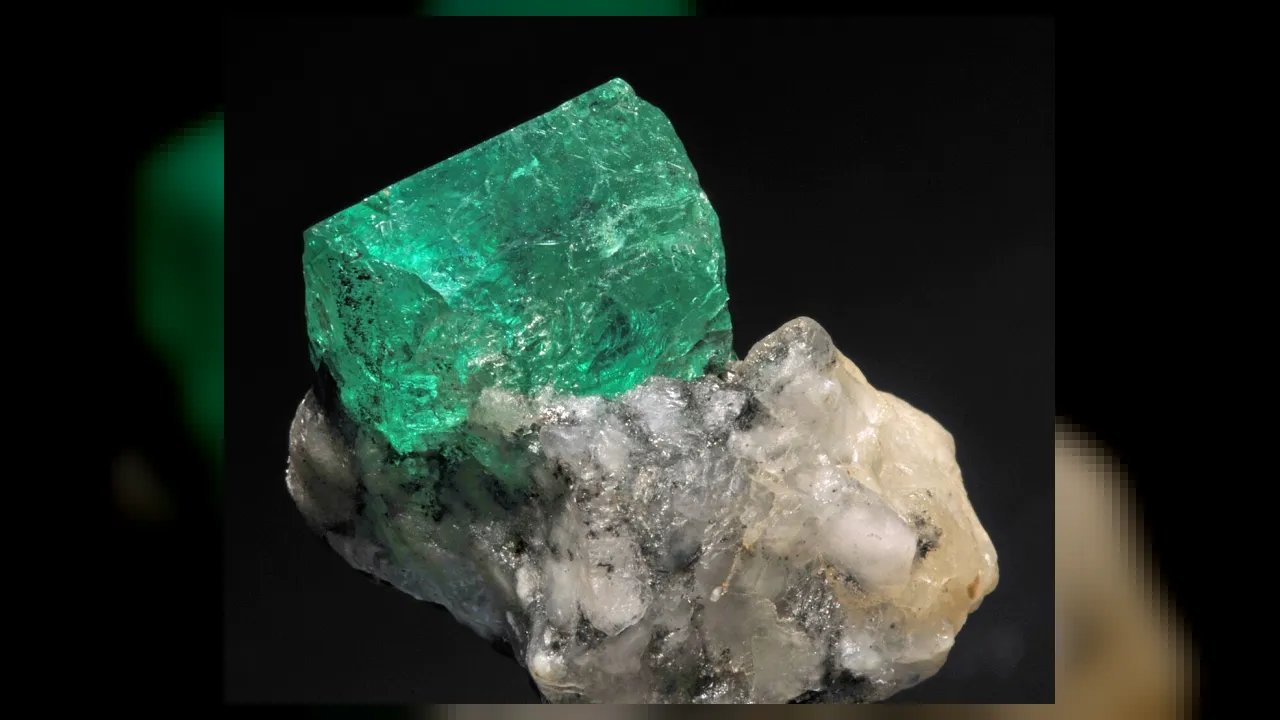
1. How many flat sides does a natural emerald column usually have?
2. What does the French gem word 'jardin' mean in English?
🤯 Mind-Blowing Fact • Grade 2
North Carolina is one of the only places in North America where big, bright green emeralds have been found hidden inside mountain rocks!
✨ Word Sparks (Grade 2 Glossary)
Tap 🔊 to hear
beryl
The six-sided mineral family that includes emerald
vein
A mineral-filled crack running through solid rock
ancient
From a very long time ago in history
🪝
How are green emeralds and pale blue aquamarines related?
1
Cousins in the Beryl Family
Hold a lush green gem beside an icy-blue aquamarine and you are looking at mineral cousins! Both crystals belong to the family and grow as six-sided pillars.
2
Hot Underground Soup
Deep inside mountain cracks, super-hot mineral water flows like underground soup. When rare beryllium meets tiny specks of chromium or vanadium, clear turns brilliant emerald green.
3
Treasured for Thousands of Years
People in Egypt mined emeralds near the Red Sea thousands of years ago. Today, high mountain mines in Colombia and Zambia produce the brightest green crystals on Earth.
1. Which blue gemstone belongs to the same beryl mineral family as emerald?
2. Which South American country is world-famous for bright green emeralds?
🤯 Mind-Blowing Fact • Grade 3
Through a microscope, Colombian emeralds reveal tiny sealed pockets holding ancient liquid water, a gas bubble, and a cube of rock salt all together!
✨ Word Sparks (Grade 3 Glossary)
Tap 🔊 to hear
hydrothermal
Formed by super-hot mineral-rich underground water
emerald cut
A rectangular gem shape with trimmed safe corners
beryllium
A rare lightweight element inside beryl crystals
🪝
Why did jewelers invent a special rectangular gem cut just for emeralds?
1
Unlikely Neighbors Meet
Imagine two ingredients that live in totally different parts of Earth's crust trying to bake a cake together. Emeralds need from light granite rocks AND chromium or vanadium from dark, heavy rocks. Only when mountain-building squeezes those rocks together and hot water mixes them can green emeralds crystallize!
2
Three-Phase Microscopic Worlds
Because emeralds grow in turbulent rock fractures, almost every natural crystal traps tiny pockets called inclusions. Colombian emeralds often hold three-phase inclusions: a microscopic chamber containing liquid saltwater, a gas bubble, and a tiny square salt crystal!
3
Why the Emerald Cut Exists
Emerald scores 7.5 to 8 on the Mohs Hardness Scale, which resists scratches well. However, its internal garden of inclusions makes sharp corners fragile. Gem cutters invented the rectangular '' with trimmed corners to protect the stone from chipping.
4
Appalachian Emeralds Nearby
Right in the southern Appalachian Mountains of North Carolina, just south of Virginia, geologists have unearthed vibrant green emeralds formed when ancient continents collided.
1. Why did gem cutters design the rectangular 'emerald cut' with trimmed corners?
2. What three things sit inside a famous Colombian 'three-phase inclusion'?
🤯 Mind-Blowing Fact • Grade 4
Because emerald is significantly less dense than diamond or sapphire, a one-carat emerald looks noticeably larger when viewed from above than a one-carat diamond of the same shape!
✨ Word Sparks (Grade 4 Glossary)
Tap 🔊 to hear
pegmatite
Coarse igneous rock rich in rare large crystals
brine
Water packed with dissolved mineral salts
specific gravity
A mineral's density compared with pure water
🪝
How did ancient black ocean mud in the Andes Mountains brew the clearest green emeralds on Earth?
1
Geochemistry Against the Odds
Earth scientists marvel that emeralds exist at all! Beryllium has tiny atoms that concentrate in late-stage continental granite , whereas chromium and vanadium concentrate in dense oceanic and mantle rocks. Normally those rocks sit miles apart. Only when tectonic faults thrust those contrasting formations side by side—and superheated hydrothermal fluids circulate between them—can green beryl, Be3Al2(SiO3)6, crystallize.
2
Colombia's Unique Black-Shale Recipe
Most world emerald deposits form in dark metamorphic schists rich in iron, which slightly dims the stone's glow. Colombia's Muzo and Chivor mines formed differently: hot salty flowed through organic-rich black shales, flushing out iron into pyrite cubes while feeding pure vanadium and chromium into sparkling calcite veins. With almost zero iron, Colombian emeralds glow with warm bluish-green brilliance.
3
Low Density, Big Visual Size
Because beryl's hexagonal ring framework leaves open microscopic channels, emerald has a low of about 2.7—much lighter than ruby or diamond. Consequently, a one-carat emerald looks noticeably larger face-up than a one-carat ruby!
4
Historical Lenses and Modern Spectroscopy
Roman historian Pliny the Elder wrote that tired gem engravers rested their eyes by gazing at soothing green emeralds. Today gemologists shine lasers through emeralds to read chemical fingerprints that pinpoint which continent—and even which mountain valley—grew the crystal.
1. Why are emeralds so rare to form in Earth's crust?
2. What locked away the iron in Colombia's black-shale emerald veins so the gems stayed extra bright?
🤯 Mind-Blowing Fact • Grade 5
By measuring oxygen isotope ratios inside centuries-old museum emeralds, geochemists traced 16th-century Mughal treasures in India all the way back to specific mountain mines in Colombia!
✨ Word Sparks (Grade 5 Glossary)
Tap 🔊 to hear
cyclosilicate
Silicate mineral built from linked atomic rings
isotope
Atoms of one element with different weights
autoclave
A sealed high-pressure heated vessel for crystals
🪝
What can ancient oxygen atoms locked inside historic royal emeralds reveal about global trade routes centuries ago?
1
Cyclosilicate Ring Architecture
Examine beryl's crystal structure at the atomic scale and you find stacked six-membered silicate rings—(Si6O18)—aligned like hollow hexagonal tunnels along the crystal's main c-axis. Beryllium and aluminum ions stitch those rings sideways into a sturdy framework scoring 7.5 to 8 on the Mohs scale. Meanwhile, the central tunnels are roomy enough to trap water molecules, alkali ions such as sodium, and dissolved gases carried by hydrothermal fluids during crystallization.
2
Tectonic Schist Versus Sedimentary Brine Systems
Economic geologists divide major emerald deposits into two principal genetic models. In Type I tectonic-magmatic deposits—such as Zambia's Kafubu belt, Brazil, and Russia's Ural Mountains—granitic pegmatites intrude chromium-bearing ultramafic schists, producing iron-enriched emeralds along reactive biotite rims. In Type II sedimentary-hydrothermal systems of Colombia's Eastern Cordillera, evaporitic brines heated to roughly 300 degrees Celsius leached beryllium, chromium, and vanadium from Cretaceous black shales along thrust faults without magmatic intrusion.
3
Crystal Field Coloration in Beryl
When Cr3+ or V3+ substitutes for octahedral Al3+ inside beryl, the surrounding silicate framework exerts a weaker crystal field than corundum's dense oxide lattice. As a result, Cr3+ absorbs both violet-blue and yellow-red bands while opening a brilliant transmission window right at 500 to 550 nanometers—the peak green sensitivity of the human eye.
4
Oxygen Isotope Fingerprinting of Historic Gems
Geochemists vaporize nanogram specks of ancient museum emeralds with an ion microprobe to measure oxygen ratios (18O/16O). Because every geological fluid leaves a distinct isotopic signature, scientists proved that flawless emeralds set into 16th-century Asian royal treasures had sailed across the Pacific and Atlantic oceans from newly opened mines in Colombia within decades of Spanish contact!
5
Hydrothermal Synthesis in Modern Labs
In lined with pure gold or platinum to prevent corrosion, materials scientists mimic Earth's crust by dissolving nutrient beryl in superheated hydrothermal solutions around 600 degrees Celsius, growing flawless synthetic emerald crystals atom by atom over several weeks.