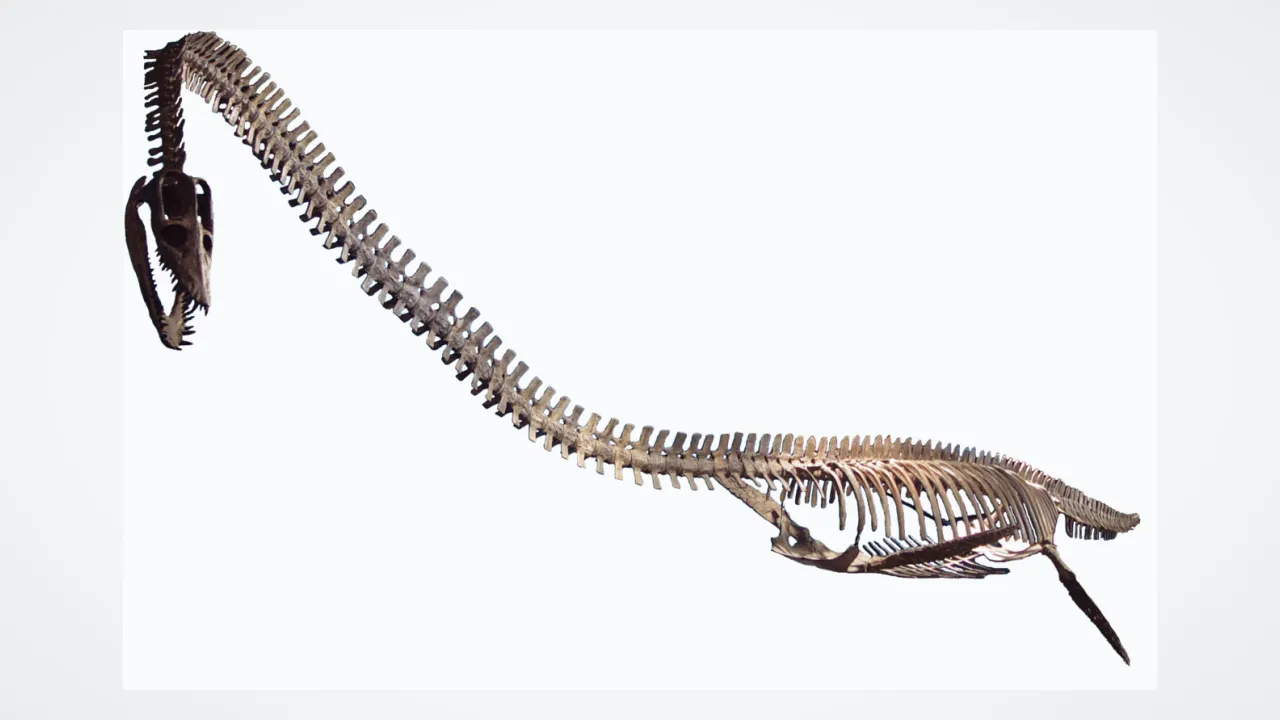
1. How many bones made up Elasmosaurus's super-long neck?
2. How much of Elasmosaurus's total body length was just its neck?
🤯 Mind-Blowing Fact • Grade 2
When paleontologist Edward Drinker Cope realized he had published drawings of Elasmosaurus with its head on its tail tip in 1869, he tried to buy back every copy of the journal!
✨ Word Sparks (Grade 2 Glossary)
Tap 🔊 to hear
Crate
Sturdy wooden box used for shipping
Bone Wars
Famous 1800s fossil-hunting rivalry between two scientists
Rivalry
Fierce competition to outdo someone else
🪝
Did a famous scientist really put Elasmosaurus's head on the wrong end of its skeleton by mistake?
1
Swimming Over Kansas
Eighty million years ago, deep ocean waves rolled right across western Kansas! Cruising gracefully with four giant paddles was Elasmosaurus, whose name means thin-plate lizard because of the flat, wide bones in its chest and hips. In 1867, army doctor Theophilus Turner dug its huge backbone out of dark Kansas shale.
2
The Backwards Head Oops!
Turner shipped the of bones to paleontologist Edward Drinker Cope in Philadelphia. Never dreaming any reptile could have a twenty-three-foot neck and a short tail, Cope accidentally mounted the skull on the tip of the tail!
3
Fixing the Mistake
When scientists Joseph Leidy and Othniel Charles Marsh pointed out the backwards bones, embarrassed Cope rushed to fix it—sparking America's famous fossil-hunting !
1. What funny mistake did Edward Drinker Cope first make when assembling Elasmosaurus in 1868?
2. Who first discovered Elasmosaurus's fossils in western Kansas in 1867?
🤯 Mind-Blowing Fact • Grade 3
Only one other plesiosaur ever beat Elasmosaurus's 72 neck bones: its younger cousin Albertonectes from Canada, which packed 76 bones into its neck!
✨ Word Sparks (Grade 3 Glossary)
Tap 🔊 to hear
Shoal
Dense crowd of fish swimming together
Barrel
Wide, rounded body shape holding strong muscles
Elasmosaurid
Plesiosaur family famous for ultra-long necks
🪝
How could Elasmosaurus swim straight ahead without its twenty-three-foot neck flopping sideways in ocean currents?
1
Extreme Champion of Plesiosaurs
Earlier Jurassic plesiosaurs already had impressive necks, yet Late Cretaceous Elasmosaurus platyurus took neck length to the extreme! Measuring thirty-four to forty-six feet overall, this two-ton swimmer stretched a twenty-three-foot neck in front of its compact body and four hydrofoil flippers.
2
Built-In Neck Stiffeners
Why didn't ocean currents bend that super-long neck sideways like a wet noodle? Each of its seventy-two neck vertebrae locked closely into its neighbors! That kept the neck steady while cruising forward, yet still allowed smooth horizontal and gentle upward curves to reach unsuspecting fish from below.
3
Sneak Attack From Underneath
Because Elasmosaurus's eyes angled slightly upward on top of its small triangular skull, many paleontologists think it glided dimly beneath sunlit fish schools—silently lifting its head into the silver to snap prey in long interlocking teeth!
4
Polished Stomach Stones
Relatives in the elasmosaur family swallowed dozens of smooth pebbles—sometimes over a hundred stones!—to mash fish bones and shells inside their stomachs.
1. Why did upward-angled eyes on top of Elasmosaurus's small head give it a clever hunting advantage?
2. Why does Elasmosaurus's name mean 'thin-plate lizard'?
🤯 Mind-Blowing Fact • Grade 4
Unlike giraffes, which stretched just seven neck bones to extreme lengths, Elasmosaurus tweaked its embryonic growth clock to add 65 extra vertebrae!
✨ Word Sparks (Grade 4 Glossary)
Tap 🔊 to hear
Hox Gene
Master gene controlling body plan segments
Teleost
Modern group of ray-finned bony fish
Segmentation
Dividing a growing backbone into repeating bones
🪝
How did adding dozens of extra neck bones help Elasmosaurus outsmart fast-swimming Cretaceous fish—and what danger lurked behind that giant neck?
1
Stealth Cruiser of the Pierre Shale
Plunge into the deep, dark mud-bottomed waters of North America's Western Interior Seaway 80.5 million years ago! Gliding alongside giant sea turtles and fierce Xiphactinus fish is Elasmosaurus platyurus. While Edward Drinker Cope originally guessed the holotype stretched over 45 feet, modern re-measurements of Dr. Theophilus Turner's 1867 Kansas skeleton show a 10.3-meter (34-foot) adult—with related elasmosaurs reaching up to 14 meters!
2
Developmental Magic of 72 Vertebrae
Whereas mammals stay locked at seven neck vertebrae via strict boundaries—forcing giraffes to stretch each individual bone—elasmosaurs tweaked embryonic genes (somitogenesis) to bud off 72 separate, compact cervical vertebrae! Keeping individual vertebrae relatively short prevented awkward stiff joints while creating a seven-meter (23-foot) fishing boom.
3
Interlocking Fish-Basket Jaws
At the tip of that slender neck sat a sleek, 40-centimeter skull armed with long, curved, widely spaced fang-like front teeth that interlocked outside the closed mouth. Because its small skull could not swallow giant prey, Elasmosaurus targeted bite-sized schooling fish, ammonites, and squid.
4
Hydrodynamic Trade-Offs
Computer fluid simulations show a seven-meter neck created minor drag only when bent sharply sideways during fast swimming—meaning Elasmosaurus glided straight and steady while cruising, curving its neck deliberately once inside striking range while staying alert for giant mosasaurs like Tylosaurus!
1. How did Elasmosaurus build its 23-foot neck differently from how a modern giraffe builds its 6-foot neck?
2. What did computer water-flow models reveal about how Elasmosaurus swam with a 23-foot neck?
🤯 Mind-Blowing Fact • Grade 5
In 2005, paleontologist Sven Sachs discovered a missing skull fragment and double-checked the original 1867 Philadelphia skeleton—discovering Elasmosaurus actually had 72 neck vertebrae, one more than even Cope had counted!
✨ Word Sparks (Grade 5 Glossary)
Tap 🔊 to hear
Somitogenesis
Embryo process forming repeating backbone segments
How did one backwards skeleton in Philadelphia ignite Paleontology's 'Bone Wars'—and how do modern hydrodynamics explain 72 cervical vertebrae?
1
Discovery at Fort Wallace and the Bone Wars Spark
In spring 1867, U.S. Army surgeon Dr. Theophilus H. Turner excavated huge articulated vertebrae and pectoral plates from Campanian (~80.5 MYA) marine shales of the Pierre Shale near Fort Wallace, Kansas. Shipped to Philadelphia's Academy of Natural Sciences, the holotype (ANSP 10081) was named Elasmosaurus platyurus by Edward Drinker Cope in 1868. Misinterpreting the unprecedented 72-vertebra neck as a whip-like lizard tail, Cope famously reconstructed the skull on the caudal extremity ('Streptosauria')—an error publicly exposed by mentor Joseph Leidy and rival Othniel Charles Marsh in 1870, igniting the legendary multi-decade Bone Wars!
2
Somitogenesis and Extreme Axial Elongation
Accurate modern restudy by Kenneth Carpenter and Sven Sachs establishes the holotype at 10.3 meters (34 feet) in total length, of which more than 7 meters—over two-thirds of pre-caudal length!—consisted of 72 elongated, dumbbell-faced cervical vertebrae (exceeded only by 76 in Canadian relative Albertonectes). Evolutionary developmental studies show elasmosaurids accelerated embryonic clock-and-wavefront prior to Hoxc6 expression, adding dozens of cervical segments without sacrificing intervertebral joint stability.
3
Osteology of Neck Stiffness and Cranial Trap
Contrary to vintage art depicting rubbery swan loops above waves, closely articulated zygapophyses, flat articular centra, and overlapping ventral cervical ribs restricted Elasmosaurus's neck to ~75–170 degrees of smooth ventral/lateral arc and ~85 degrees dorsally. Tipping this hydrodynamic boom was a low, streamlined skull housing procumbent, interlocking fang-like premaxillary and anterior dentary teeth tailored for snatching pelagic teleosts and coleoids.
4
Computational Fluid Dynamics of a Seven-Meter Neck
Three-dimensional CFD simulations by Troelsen et al. (2019) demonstrated that an extended straight neck added negligible skin-friction drag compared to shorter-necked plesiosaurs! Only sharp lateral neck bends at high cruising velocities generated significant pressure torque—confirming Elasmosaurus cruised linearly on four tandem flippers before executing measured ambush sweeps beneath schooling prey.
5
Pelagic Food-Web Role
Sharing the Western Interior Seaway with giant Tylosaurus mosasaurs and Cretoxyrhina sharks, Elasmosaurus thrived through stealthy and mid-water foraging rather than brute force.