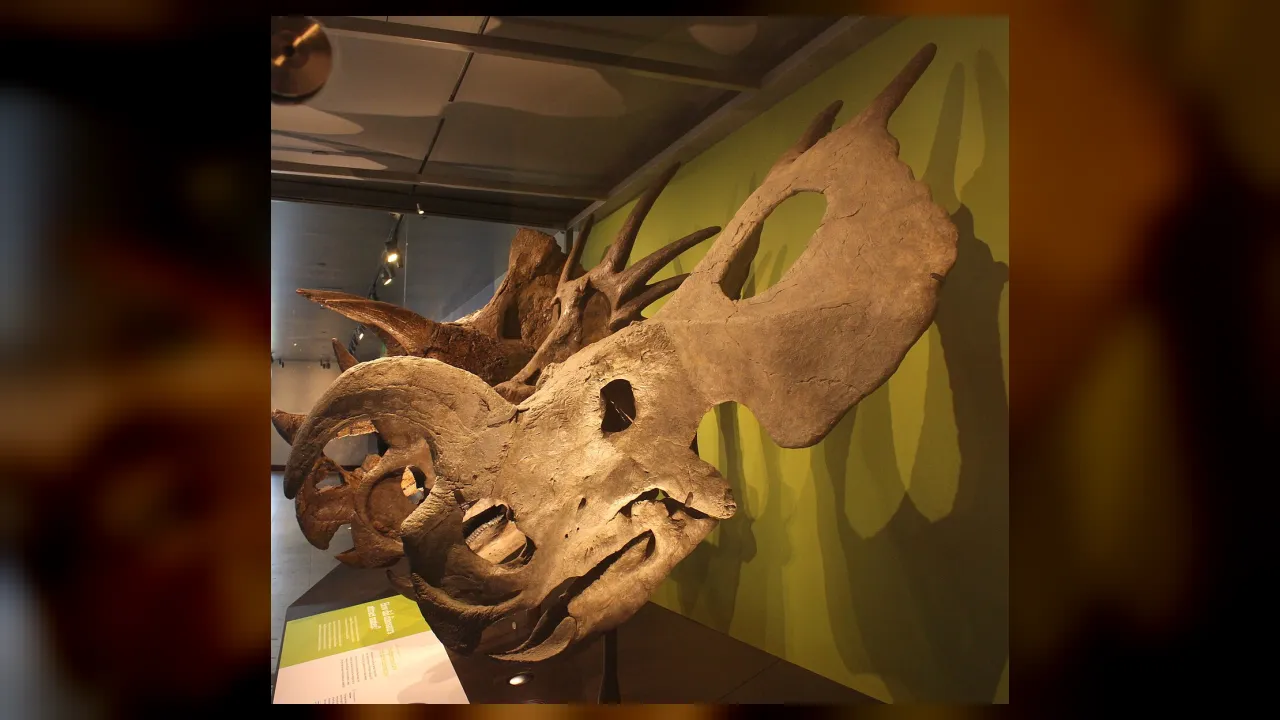
1. What did an adult Einiosaurus's nose horn look like?
2. What stuck straight out from the top edge of Einiosaurus's neck frill?
🤯 Mind-Blowing Fact • Grade 2
Its full scientific name, Einiosaurus procurvicornis, translates to 'buffalo lizard with a forward-curving horn'!
✨ Word Sparks (Grade 2 Glossary)
Tap 🔊 to hear
Profile
Side-view outline of an animal's face
Watering Hole
Pond where thirsty wild animals gather
Reservation
Homeland governed by a Native American nation
🪝
How did Blackfeet elders in Montana inspire the name 'buffalo lizard'?
1
Honoring Blackfeet Lands
Dust swirls across sunny plains in northwestern Montana 74 million years ago as a herd of rhino-sized Einiosaurus marches toward a . Because paleontologist Jack Horner found their fossils on Blackfeet Nation lands, its name uses the Blackfeet word eini, meaning buffalo!
2
Growing a Bottle Opener
Teenagers started out with normal upright nose horns. In many adults, though, that horn grew rapidly along the back edge until it curved sharply forward and downward right over the snout tip!
3
Twin Spear Frill
Rounding out its bold , two long, straight spikes jutted backward from the top of its short neck shield.
1. Where does the word 'einio' in Einiosaurus come from?
2. When did Einiosaurus's nose horn bend forward into a hook shape?
🤯 Mind-Blowing Fact • Grade 3
Ash from ancient Rocky Mountain volcanoes buried right beside Einiosaurus bonebeds let scientists date its lifetime to within a tiny window around 74.5 million years ago!
✨ Word Sparks (Grade 3 Glossary)
Tap 🔊 to hear
Drought
Long dry spell with almost zero rain
Transitional
Showing an in-between step in evolution
Ash
Fine gray powder blown from volcanoes
🪝
How did Einiosaurus bridge the evolutionary gap between spiky Styracosaurus and boss-nosed Pachyrhinosaurus?
1
Dry Seasons Under Volcano Skies
Imagine standing below distant smoking volcanoes in Late Cretaceous Montana 74.5 million years ago. Unlike swampy coastlines, the Two Medicine Formation experienced long dry spells! Gathering around shrinking ponds were herds of 15-foot, 1.3-ton Einiosaurus.
2
Why Curve a Horn Downward?
Pointing a sharp tip straight down couldn't stab a tyrannosaur easily, yet it created a broad top ridge! Rivals could press those curved ridges together in safe head-pushing contests—and show off their maturity to the herd.
3
Caught in an Evolutionary Step
Comparing rock layers revealed something amazing: older cousins like Styracosaurus had tall pointed nose horns, Einiosaurus bent its horn flat forward, and slightly younger cousins like Achelousaurus and Pachyrhinosaurus turned that bent ridge into a thick bumpy boss!
4
Drought Bonebeds
Paleontologist Scott Sampson studied at least fifteen Einiosaurus individuals buried together in two bonebeds after severe dried up their watering holes.
1. Why is Einiosaurus such an exciting link in horned dinosaur evolution?
2. What natural event trapped herds of Einiosaurus in Montana's Two Medicine Formation?
🤯 Mind-Blowing Fact • Grade 4
Slightly higher in the exact same Montana cliffs sits Achelousaurus—sharing Einiosaurus's twin frill spikes while swapping its curved hook for a gnarled Pachyrhinosaurus-style nose boss!
✨ Word Sparks (Grade 4 Glossary)
Tap 🔊 to hear
Semi-arid
Mostly dry climate with brief rainy seasons
Morph
Distinct body or horn shape within species
Histology
Studying thin bone slices under a microscope
🪝
What happened inside Montana's Two Medicine rocks when upright nose horns transformed into battering bosses?
1
Discovery on Landslide Butte
Between 1985 and 1989, field crews led by Jack Horner excavated two extraordinary bonebeds on Blackfeet Nation lands at Landslide Butte, Montana. Packed inside fine pond mudstones lay bones from at least fifteen centrosaurines ranging from youngsters to adults—zero other dinosaur species mixed in! Formally named Einiosaurus procurvicornis by Scott Sampson in 1995, this compact 4.5-meter herbivore illuminated life on upland plains.
2
Two Nose Morphs in One Herd
Measuring skulls across ages revealed how Einiosaurus built its signature 'can-opener' horn. Juveniles and subadults possessed laterally compressed, upright nasal horns. Upon reaching maturity, uneven bone growth surged along the rear and upper edge, bending the horn sharply forward—though some adults kept slightly straighter horns, hinting at age stages or differences between males and females!
3
Stepping-Stone to Bosses
Stacked directly above Einiosaurus in slightly younger Two Medicine rock layers sits Achelousaurus horneri, which bears the exact same twin backward-pointing P3 frill spikes—except its forward-bent nose horn has flattened into a rough, grooved boss just like Pachyrhinosaurus!
4
Fast Growth Before Maturity
Bone-ring by Rebecca Reizner showed Einiosaurus sprinted upward in size until ages three to five, slowing down rapidly once it joined the breeding herd and grew its adult horn shape.
1. How does Achelousaurus in younger Montana rocks connect directly to Einiosaurus below it?
2. At what age did Einiosaurus's fastest juvenile growth spurt start slowing down?
🤯 Mind-Blowing Fact • Grade 5
Argon-argon crystal dating of volcanic ash layers in Montana pinned the evolutionary shift from hook-horned Einiosaurus to boss-nosed Achelousaurus inside less than half a million years!
✨ Word Sparks (Grade 5 Glossary)
Tap 🔊 to hear
Anagenesis
One whole species evolving directly into another
Skeletochronology
Counting yearly bone rings to determine age
Osteogenesis
Living cells building fresh new bone tissue
🪝
How do stacked Montana bonebeds place Einiosaurus procurvicornis at the center of an evolutionary lineage caught in action?
1
Upland Ecology of the Two Medicine Formation
Around 74.5 million years ago during the late Campanian, volcanic uplift along the nascent Rocky Mountain Cordillera cast a rain shadow over northwestern Montana's Two Medicine Formation. Unlike humid coastal swamps farther east, these seasonal semi-arid plains supported drought-adapted shrubs and conifers browsed by herds of Einiosaurus procurvicornis—a 4.5-meter (15-foot), 1.3-metric-ton centrosaurine excavated by Jack Horner's Museum of the Rockies teams and described by Scott Sampson in 1995.
2
Ontogeny of the Procurved Nasal Horn
Recovered from two low-diversity, drought-induced pond bonebeds (Canyon and Dino Ridge quarries) preserving at least fifteen individuals across age classes, Einiosaurus offered a complete cranial growth series. Juveniles possessed small, erect, laterally compressed nasal horncores and low rounded supraorbital ridges. At somatic maturity, differential posterior bent the nasal horn dramatically forward and downward in most large adults ('B-morphs'), while straight-projecting paired P3 epiparietal spikes elongated posteriorly from a modest, sub-rounded parietal frill lacking P1 hooks.
3
Anagenesis vs. Branching Into Pachyrhinosaurs
In 1992, Jack Horner, David Varricchio, and Mark Goodwin famously proposed direct —unbranched species-to-species transformation—linking Styracosaurus ovatus (Rubeosaurus), Einiosaurus procurvicornis, and overlying Achelousaurus horneri within 500,000 years of Two Medicine strata! Whether strictly linear anagenesis or rapid cladogenesis within the tribe Pachyrhinosaurini, Einiosaurus captures the exact morphological bridge where erect conical horns folded anteriorly to provide broad dorsal contact surfaces before coalescing into pachyostotic bosses.
4
Skeletochronology and Life History
Osteohistological analyses of Canyon Bonebed tibiae and femora by Rebecca Reizner (2010) documented dense fibrolamellar bone interrupted by annual lines of arrested growth (LAGs): individuals achieved rapid asymptotic size plateaus around three to five years of age—synchronizing growth deceleration with delayed maturation of adult socio-sexual cranial weaponry.
5
Surviving Daspletosaurus Country
Sharing seasonal waterholes with towering tyrannosaurids like Daspletosaurus horneri, tightly knit multi-age Einiosaurus herds relied on collective vigilance and synchronized juvenile growth spurts to endure harsh upland droughts.