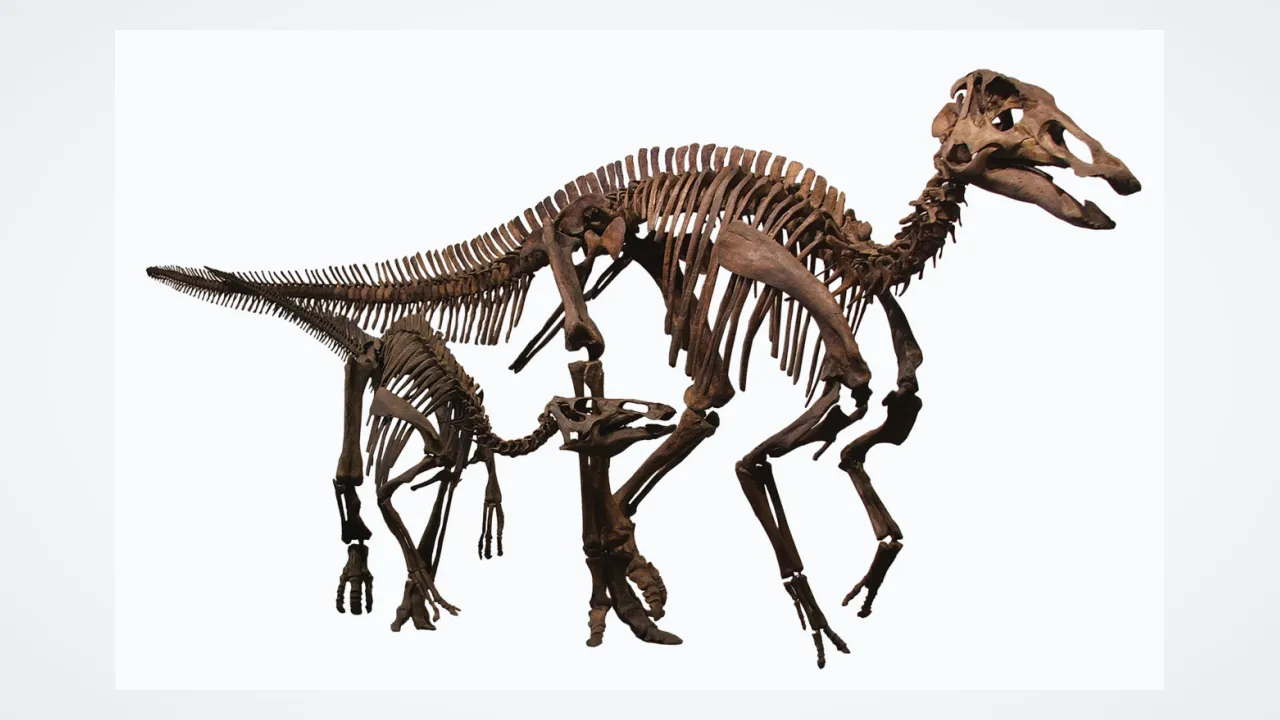
⚡ Survival SuperpowerPacked dental batteries with hundreds of self-sharpening plant-grinding teeth
🤯 Mind-Blowing Fact • Grade 1
Fossil mummies show Edmontosaurus had a soft, rooster-like comb on top of its head!
✨ Word Sparks (Grade 1 Glossary)
Tap 🔊 to hear
beak
a hard mouth part with no front teeth
herd
a big group of animals living together
fern
a green leafy plant with feathery stems
🪝
What dinosaur had a wide beak like a duck and hoof-like front feet?
1
A Wide Duck Beak
Crunch, munch, crunch! Picture a dinosaur as long as a school bus. Edmontosaurus had a flat, wide like a giant duck. It snipped leafy branches and all day long.
2
Hundreds of Teeth
Look inside its cheeks! Hundreds of tight teeth worked together like a bumpy file. When one tooth wore down, a fresh new tooth grew right up.
3
Safe in a Herd
These gentle giants walked together in huge . Staying close helped them spot hungry meat-eaters and keep their youngsters safe.
Rare fossil skin prints prove Edmontosaurus had pebbly scales and a fleshy mitten around its front toes!
✨ Word Sparks (Grade 2 Glossary)
Tap 🔊 to hear
floodplain
flat land beside a river that floods
graze
to feed steadily on growing green plants
hoof
a hard covering on an animal foot
🪝
How could a toothless beak hide one of the strongest chewing machines in history?
1
Giant of the Floodplains
Imagine thousands of footsteps rumbling across a muddy riverside! Edmontosaurus roamed western North America near the end of the Age of Dinosaurs. It grew forty feet long and weighed as much as a big elephant.
2
Built-In Plant Grinder
The front of its mouth had a smooth, toothless beak for clipping twigs and pine needles. Further back, its jaws held stacked rows of tiny teeth. It could even move its upper jaws slightly sideways to grind tough plants into mush.
3
Four Feet or Two
Edmontosaurus usually walked on four sturdy legs while grazing. Its front fingers were wrapped inside a single -like pad! When it needed to hurry, it could rear up on its strong back legs.
1. Where were the teeth inside an Edmontosaurus mouth?
2. What wrapped around the front toes of Edmontosaurus?
🤯 Mind-Blowing Fact • Grade 3
Fossilized Edmontosaurus bones have been discovered as far north as snowy ancient Alaska, where winter brought months of darkness!
✨ Word Sparks (Grade 3 Glossary)
Tap 🔊 to hear
herbivore
an animal that eats only plants
keratin
tough material that makes beaks and fingernails
impression
a shape pressed into mud or stone
🪝
What secrets did paleontologists uncover when they found rare dinosaur mummies buried in sandstone?
1
A Herd on the Move
Low, booming calls echo through a misty redwood forest seventy million years ago. A vast herd of Edmontosaurus marches from coastal swamps in Colorado all the way to cool river valleys in Alaska. Named after rocks near Edmonton, Canada, this duck-billed was one of the most successful plant-eaters of the Late Cretaceous.
2
Super-Powered Dental Batteries
Most reptiles swallow food without chewing, yet Edmontosaurus chewed better than almost any dinosaur alive. Its sharp beak snipped horsetails, conifers, and branches. Behind the beak sat tight columns of teeth called dental batteries, holding more than seven hundred teeth at once!
3
Clues from Dinosaur Mummies
Sometimes sand buried an Edmontosaurus rapidly before scavengers arrived, preserving amazing fossil of dried skin. One specimen from Alberta showed a soft fleshy crest perched like a rooster comb on its head, while another from North Dakota preserved a tough nail-covered hoof on its forelimb.
4
Sharing Land with Giants
Living alongside Tyrannosaurus rex meant staying alert every single day. Edmontosaurus relied on keen eyesight, sharp hearing, muscular tails, and safety in massive herds to survive.
1. What are dental batteries in a duck-billed dinosaur?
2. Why are Edmontosaurus mummy fossils so valuable to scientists?
🤯 Mind-Blowing Fact • Grade 4
A healed Tyrannosaurus tooth mark found on an Edmontosaurus tail bone proves the herbivore survived a direct ambush by the famous predator!
✨ Word Sparks (Grade 4 Glossary)
Tap 🔊 to hear
hadrosaur
a member of the duck-billed dinosaur family
pulverize
to crush or grind into tiny bits
camouflage
colors or patterns that help animals blend in
🪝
How did a dinosaur without horns or armor thrive right beside Tyrannosaurus rex?
1
Masters of Late Cretaceous Forests
Picture a sprawling coastal plain stretching along a warm inland sea from modern Wyoming up into northern Canada. Between 73 and 66 million years ago, Edmontosaurus dominated these lush lowlands in enormous herds. Reaching lengths of forty feet and weighing up to seven tons, this —or duck-billed dinosaur—shaped entire forests by pruning shrubs and conifers.
2
Engineering a Reptilian Chew
Mammals chew by swinging their lower jaws side to side, yet Edmontosaurus evolved a completely different mechanical solution. When its lower jaw pressed upward, specialized hinges allowed the upper jawbones to flex slightly outward. That sliding motion dragged upper and lower dental batteries across each other like coarse sandpaper, pulverizing fibrous bark, needles, and seeds.
3
Extraordinary Soft-Tissue Fossils
Because minerals occasionally mineralized around sun-dried carcasses before decay finished, Edmontosaurus boasts some of the finest soft-tissue fossils in paleontology. Specimens such as Dakota revealed polygonal scales striped in patterns that likely provided forest , a soft head crest on Edmontosaurus regalis, and wedge-shaped forelimb hooves built for long marches.
4
Surviving Apex Predators
Healed bite marks from Tyrannosaurus rex on fossilized Edmontosaurus tail vertebrae prove that adults sometimes escaped attacks! Rapid growth from hatchling to giant size, constant herd vigilance, and powerful swimming or sprinting muscles helped populations flourish until the end of the Cretaceous.
1. How did Edmontosaurus create a grinding motion without swinging its lower jaw sideways?
2. What evidence shows that an adult Edmontosaurus could survive a predator ambush?
🤯 Mind-Blowing Fact • Grade 5
Some giant Edmontosaurus annectens skulls exceed three and a half feet in length, pointing to rare elder individuals approaching forty-nine feet from snout to tail!
✨ Word Sparks (Grade 5 Glossary)
Tap 🔊 to hear
pleurokinesis
sideways flexing of upper skull bones while chewing
rhamphotheca
the tough keratin sheath covering a beak
megaherbivore
an extra-large plant-eating animal shaping its habitat
🪝
Why do paleontologists consider Edmontosaurus the ultimate window into dinosaur skin, posture, and feeding mechanics?
1
From Alberta Cliffs to Arctic Valleys
Step onto a Late Cretaceous delta sixty-eight million years ago, where mist curls above bald cypress swamps and herds of multi-ton ornithischians stretch to the horizon. First named in 1917 by Canadian paleontologist Lawrence Lambe from skeletons unearthed in Alberta's Horseshoe Canyon Formation, Edmontosaurus includes two well-known species: the older, crested Edmontosaurus regalis and the later Edmontosaurus annectens. Their fossils span thousands of miles from Colorado to northern Alaska, demonstrating remarkable adaptability across warm floodplains and cool polar woodlands.
2
Biomechanics of Pleurokinetic Chewing
Unlike sauropods that stripped foliage whole, hadrosaurids evolved —a sophisticated cranial hinge system. Behind a broad, keratin-sheathed that cropped tough gymnosperms and horsetails, each jaw quadrant housed columns of stacked teeth cemented into a continuous grinding pavement. Varying hardness of enamel, dentine, and cementum caused each tooth surface to wear unevenly, automatically maintaining sharp self-honing ridges throughout the animal's life.
3
Lessons from Mummified Carcasses
Few dinosaurs reveal their living appearance as vividly as Edmontosaurus. Famous mummified specimens—including the 1908 Sternberg mummy from Wyoming and the North Dakota specimen nicknamed Dakota—preserved three-dimensional skin envelopes mineralized in ironstone and sandstone. High-resolution scans uncovered clustered mosaic scales, deep tail musculature indicating brisk locomotion, a fleshy cranial comb on Edmontosaurus regalis, and hooves encasing the weight-bearing digits of the hand.
4
Growth Rates and Polar Endurance
Microscopic bone-ring studies show that young Edmontosaurus grew rapidly, reducing the years spent vulnerable to mid-sized theropods. Northern populations endured months of winter twilight in ancient Alaska, sustaining themselves on woody twigs and dried flora rather than migrating thousands of miles south.
5
Ecological Keystone of the Final Cretaceous
Right up to the asteroid impact 66 million years ago, Edmontosaurus functioned as a primary alongside Triceratops, recycling vast quantities of plant matter and anchoring food webs across western North America.