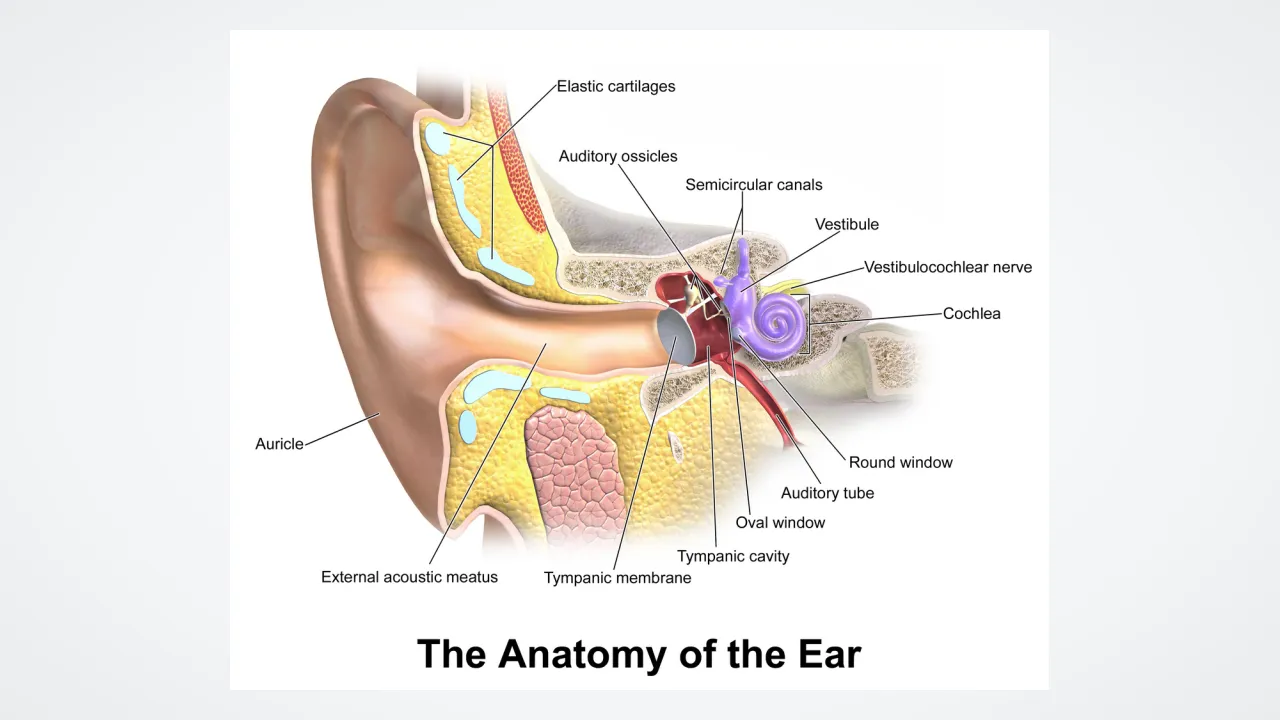
1. What happens when invisible sound waves reach your eardrum?
2. What is the safest rule for taking care of your delicate eardrums?
🤯 Mind-Blowing Fact • Grade 2
Your eardrum grows its skin sideways from the center outward like a slow conveyor belt, carrying tiny specks of dust safely out of your ear!
✨ Word Sparks (Grade 2 Glossary)
Tap 🔊 to hear
tympanic
Shaped and acting like a musical drum
pressure
Gentle push of air against a surface
canal
Narrow tube leading inward from outer ear
🪝
Why do your ears 'pop' when an airplane climbs into the clouds or drives up a mountain?
1
Pearly Gray Drumhead
Picture stretching a thin balloon tightly across the top of a cup and humming near it—feel it buzz! About an inch inside each ear sits your membrane, or eardrum, a pearly gray circle thinner than a sheet of paper.
2
High Notes and Low Notes
Deep tubas send slow air waves that make your eardrum sway slowly back and forth. High bird chirps send rapid waves that make it buzz thousands of times every single second!
3
Why Yawning Makes Ears Pop
Behind your eardrum sits a pocket of air connected to the back of your throat by a tiny tube. Swallowing or yawning on an airplane lets air match on both sides—pop!—so your eardrum vibrates freely again.
1. How does your eardrum move differently for a high bird chirp compared to a deep tuba note?
2. Why does yawning or swallowing help muffled ears feel better on an airplane?
🤯 Mind-Blowing Fact • Grade 3
Frogs don't hide their eardrums down tunnels—you can see a bullfrog's big flat round tympanic membrane right on the outside of its head behind each eye!
✨ Word Sparks (Grade 3 Glossary)
Tap 🔊 to hear
otoscope
Lighted magnifying tool checking inside ears
eustachian
Tube balancing air pressure behind the eardrum
frequency
Number of sound wave vibrations each second
🪝
Why is your eardrum shaped more like a loudspeaker cone than a flat marching-band drum?
1
Border Gate of the Middle Ear
Cup your hands behind your outer ears and notice how sounds grow louder! Funneling down your 2.5-centimeter ear canal, invisible sound waves strike your tympanic membrane—the airtight border wall separating your outer ear from your middle-ear chamber.
2
Shaped Like a Tiny Speaker Cone
Look through a doctor's lighted and you will see a shiny, pearly cone tilted inward at its center! Attached to the back of that inward dimple sits the handle of the hammer bone, ready to pass every tiny vibration onward.
3
Eustachian Tube Pressure Helper
For a drumhead to vibrate crisply, air pressure inside and outside must match. A narrow hallway called the tube links the air space behind your eardrum to the back of your nose and throat, opening briefly whenever you chew, yawn, or swallow.
4
Self-Cleaning and Self-Healing
Even if a loud pop or ear infection ever causes a tiny tear in an eardrum, healthy cells usually knit that ten-millimeter membrane back together within weeks!
1. What tool does a doctor use to peek gently at your pearly gray eardrum?
2. What attaches directly to the back center of your cone-shaped eardrum?
🤯 Mind-Blowing Fact • Grade 4
At the softest whisper a child can hear, your eardrum moves back and forth by less than one-tenth the width of a single hydrogen atom!
✨ Word Sparks (Grade 4 Glossary)
Tap 🔊 to hear
acoustic
Relating to sound waves and hearing physics
mucosa
Moist protective lining inside body air spaces
hertz
Unit counting one vibration cycle per second
🪝
How can a membrane thinner than a playing card move less than the width of an atom and STILL let you hear?
1
Triple-Layer Acoustic Engineering
Stretch a flat rubber sheet across a frame and it rings softly for one pitch while muffling others. To catch every human pitch cleanly from twenty vibrations per second up to twenty thousand, your nine-millimeter tympanic membrane is engineered as a shallow, angled cone built from three ultra-thin layers! Outer skin faces the ear canal, delicate inner faces the air-filled middle ear, and sandwiched between them weave BOTH radial (wheel-spoke) and circular collagen fibers that snap crisply back to rest so sounds never blur into muddy echoes.
2
Collecting Force for Liquid Ears
Why not let air sound waves hit your inner-ear sensors directly? Because your inner ear is filled with watery fluid, and 99.9 percent of faint air waves would bounce straight off water like pebbles skipping off a pond! Having an eardrum seventeen times larger in area than the inner ear's tiny oval window gathers wide air energy and concentrates it onto the middle-ear bones.
3
Sub-Atomic Whisper Sensitivity
At the quietest rustle of autumn leaves a young ear can detect—around three thousand —physicists calculate that your tympanic membrane sways back and forth less than ten picometers, smaller than the diameter of one hydrogen atom!
4
Protecting Your Drumheads
Keeping headphone volume moderate—around sixty percent or lower—protects both your hard-working eardrum and delicate inner-ear sensors for decades of crisp music.
1. Why is the eardrum's wide area (about 17 times larger than the inner ear's oval window) so important?
2. What keeps your eardrum from ringing endlessly after a sharp clap stops?
🤯 Mind-Blowing Fact • Grade 5
Try clenching your jaw or yawning deeply in a quiet room—that soft low 'rumble' you hear inside your head is your tiny tensor tympani muscle flexing and gently tugging your eardrums!
✨ Word Sparks (Grade 5 Glossary)
Tap 🔊 to hear
umbo
Inward-pointed center peak of the eardrum cone
impedance
How strongly a material resists sound vibration
decibel
Logarithmic unit measuring sound loudness intensity
🪝
How did curved-cone geometry discovered in loudspeakers already exist for millions of years inside your hundred-micrometer eardrum?
1
Pars Tensa, Pars Flaccida, and the Umbo
Tilted obliquely at roughly fifty-five degrees across the floor of the external acoustic meatus, the adult tympanic membrane measures about nine by ten millimeters and averages just 0.1 millimeters thick, yet withstands millions of daily pressure oscillations. Its central depression—the , Latin for the boss of a warrior's shield—anchors the manubrium of the malleus bone. Anatomists divide the membrane into two zones: the expansive lower pars tensa stiffened by dual radial and circular collagen strata, and the smaller upper pars flaccida (Shrapnell's membrane), whose looser elastic fibers flex gently during subtle middle-ear pressure shifts.
2
Solving Acoustic Impedance Mismatch
Acoustic engineers admire the tympanic membrane as stage one of an exquisite ' transformer.' Air has very low acoustic impedance while cochlear fluid has high impedance; without a transformer, 99.9% of airborne sound energy (about 30 ) would reflect away! Vibrating roughly fifty-five square millimeters of functional pars tensa and funneling that force onto the 3.2-square-millimeter stapes footplate delivers a seventeen-fold hydraulic pressure boost before ossicular lever gains even add in.
3
Curved-Cone Mechanics and Tensor Tympani
Nobel laureate Georg von Békésy and later laser-Doppler vibrometry pioneers showed that the membrane's curved conical profile—just like modern hi-fi loudspeaker cones—couples wide peripheral vibrations smoothly to the stiffer central across broad frequencies. Meanwhile, a tiny striated muscle called the tensor tympani tugs inward on the malleus handle whenever you chew crunchy carrots or shout, dampening bone-conducted self-noise!
4
Epithelial Conveyor Belt Migration
How do dead skin cells escape a blind-ended ear canal without piling up against the drum? Germinative skin cells at the central migrate radially outward at ~0.05 millimeters per day—roughly the speed fingernails grow—escalating debris onto canal walls where jaw movements carry it harmlessly out!
5
Clinical Otoscopy and Tympanoplasty
When physicians inspect a healthy membrane, they check for the triangular 'cone of light' reflection in its anterior-inferior quadrant; if trauma or severe otitis media leaves a persistent perforation, microsurgeons perform tympanoplasty using a tiny fascia graft as a scaffold for natural regrowth.