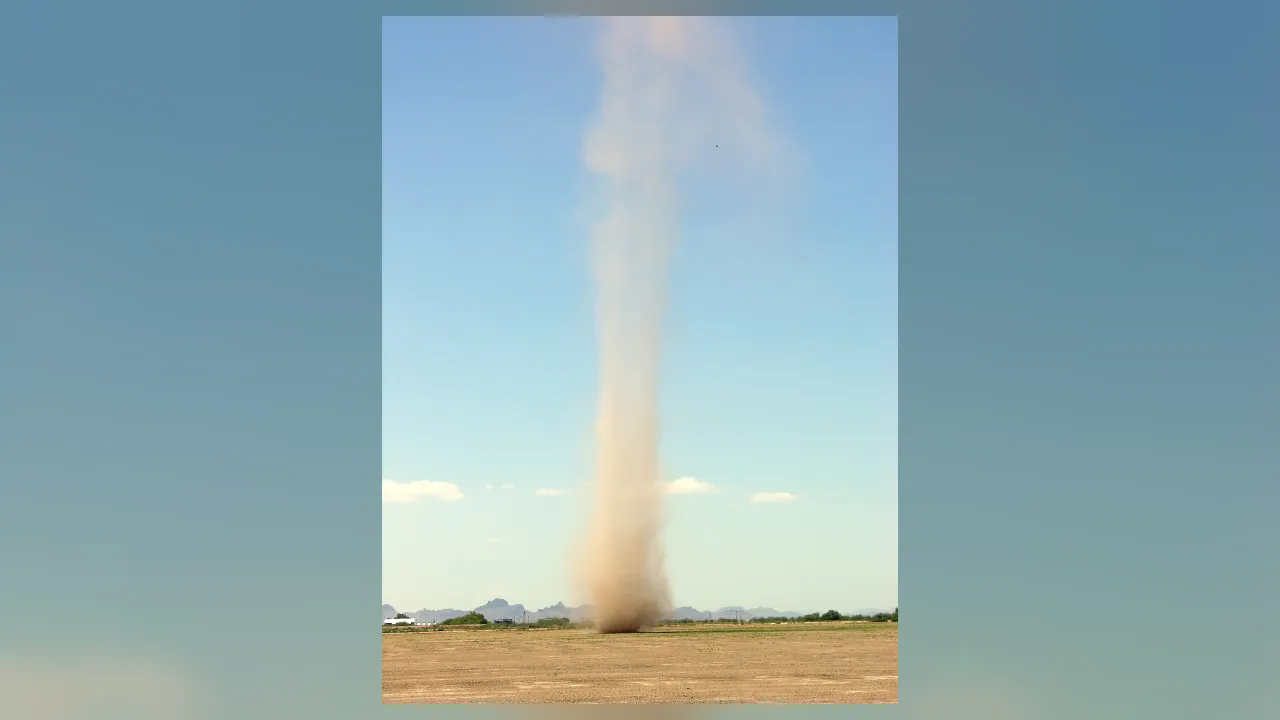
⚡ Planet Earth SparkSpins towering columns of dust under cloudless sunny skies on both Earth and Mars
🤯 Mind-Blowing Fact • Grade 1
NASA rovers have filmed giant dust devils spinning across the rusty red deserts of Mars!
✨ Word Sparks (Grade 1 Glossary)
Tap 🔊 to hear
whirlwind
A column of air spinning very fast
column
A tall, upright pillar shape
vanish
Disappear suddenly from sight
🪝
Can a mini whirlwind spin up when there is not a single cloud in the sky?
1
Spinning in the Sun
Whoosh! Dry leaves and tan dirt suddenly dance in a circle on the playground. The bright sun shines overhead with zero rain clouds. You just spotted a dust devil!
2
Hot Ground Below
Sunlight bakes the dry dirt until the air right above it gets super warm. That hot air rushes up fast and starts to spin.
3
Quick and Gentle
Loose dust rides inside the spinning so you can see its shape. Most dust devils are weak and in less than a minute!
1. What kind of weather usually helps a dust devil form?
2. What makes the spinning air of a dust devil easy for our eyes to see?
🤯 Mind-Blowing Fact • Grade 2
Spinning dust grains bump into each other so fast inside a dust devil that they create tiny sparks of static electricity!
✨ Word Sparks (Grade 2 Glossary)
Tap 🔊 to hear
asphalt
Dark pavement that absorbs lots of heat
static
Electric charge built by rubbing surfaces together
tumbleweed
Dry desert plant blown by the wind
🪝
How is a sunny desert dust devil different from a stormy tornado?
1
A Clear-Sky Swirl
Imagine standing beside a dry baseball field on a hot, sunny afternoon. Without warning, a tall cone of golden dirt twists upward from home plate and dances across the outfield. That clear-sky whirlwind is a dust devil.
2
Built From the Ground Up
Unlike tornadoes, which drop down from dark storm clouds, dust devils grow from the hot ground upward. Intense sunshine heats patches of bare soil, , or desert sand, creating a rising bubble of warm air.
3
A Short Desert Dance
Gentle breezes nudge that rising air into a tight spin that sweeps up sand, , and bits of grass. Once the dust devil drifts onto cooler ground or shady grass, it loses heat and quickly falls apart.
2. Why does a dust devil fade away when it rolls over cool, shady grass?
🤯 Mind-Blowing Fact • Grade 3
NASA's Perseverance rover recorded the crackling sound of a Martian dust devil passing directly over its microphone in 2021!
✨ Word Sparks (Grade 3 Glossary)
Tap 🔊 to hear
absorb
Soak up heat, light, or liquid
inflowing
Rushing inward toward a central spot
monopoly
Being the only one having something
🪝
Why do desert highways and plowed farm fields spawn so many spinning whirlwinds?
1
Uneven Solar Heating
Step onto dark desert sand at noon in Arizona, and your shoes feel the intense heat right away. Bare soil and blacktop sunlight much faster than leafy plants nearby. This uneven heating bakes a thin layer of air right against the ground until it becomes hotter and lighter than the cooler air sitting above it.
2
The Chimney Effect
Suddenly, a pocket of that super-heated air punches upward like hot smoke rising inside a chimney. Cooler surrounding air rushes inward along the ground to replace it. If light breezes enter slightly off-center, the air begins whirling faster and faster around a low-pressure core.
3
Size, Speed, and Safety
Most dust devils measure three to thirty feet wide and spin at twenty-five miles per hour—strong enough to toss picnic plates or beach umbrellas. Occasionally, giant desert whirlwinds tower half a mile high with sixty-mile-per-hour gusts, so campers always secure tents tightly.
4
Whirlwinds on Another World
Earth does not hold a on dust devils. On Mars, thin dry air heats rapidly in sunlight, creating monster dust devils up to five miles tall that even blew dust off NASA solar panels!
1. Why do bare dirt and dark pavement help trigger dust devils?
2. How did Martian dust devils unexpectedly help early NASA rovers like Spirit and Opportunity?
🤯 Mind-Blowing Fact • Grade 4
Unlike hurricanes, which spin in one fixed direction in each hemisphere, dust devils spin clockwise and counterclockwise with equal fifty-fifty odds!
✨ Word Sparks (Grade 4 Glossary)
Tap 🔊 to hear
thermal
A rising column of sun-warmed air
conduction
Heat moving directly between touching surfaces
saltation
Bouncing motion of windblown sand grains
🪝
How does a simple pocket of rising desert air spin fast enough to lift sand hundreds of feet high?
1
Thermal Plumes in the Boundary Layer
Walk across the Mojave Desert on a calm July afternoon when calm skies allow solar radiation to bake the ground above 140 degrees Fahrenheit. Just inches above the soil, air heats by , while air ten feet higher remains noticeably cooler. Meteorologists call this unstable setup a superadiabatic lapse rate. Because hot air is less dense than cooler air overhead, buoyant pockets called break loose and surge skyward.
2
Spinning Either Way
As surface air converges horizontally toward the base of the rising , small obstacles like bushes, rocks, or gentle wind shear nudge the inward flow into a spin. Because dust devils are narrow and short-lived, Earth's rotation—the Coriolis effect—is far too weak on such a tiny scale to pick their direction. Consequently, roughly half of all dust devils spin clockwise and half spin counterclockwise!
3
Saltation and Static Charge
Inside the tightening core, air pressure drops slightly and upward drafts lift fine silt. Heavier sand grains bounce along the ground in a hopping motion called , knocking tiny clay dust particles loose so they ride upward into the visible column. Millions of colliding grains swap electrons, generating strong electric fields inside the swirling plume.
4
Why Strong Wind Stops Them
Surprisingly, windy days actually prevent dust devils! Howling gales mix surface heat evenly before an isolated hot pocket can build, whereas calm or light breezes let tall columns organize cleanly.
1. Why do clockwise and counterclockwise dust devils happen equally often in North America?
2. Why do howling, gusty winds make dust devils LESS likely to form?
🤯 Mind-Blowing Fact • Grade 5
Electric fields measured inside Earth's desert dust devils can top 10,000 volts per meter, strong enough to create faint radio static on nearby instruments!
✨ Word Sparks (Grade 5 Glossary)
Tap 🔊 to hear
insolation
Incoming sunlight energy reaching a planet's surface
triboelectric
Static charge created when particles rub together
arid
Extremely dry with very little rainfall
🪝
What links sunny Arizona whirlwinds, electric fields in desert dust, and eight-kilometer plumes on Mars?
1
Convective Vortices and Heat Engines
Atmospheric physicists model a dust devil as a miniature thermodynamic heat engine powered directly by rather than latent heat from cloud condensation. On clear afternoons over basins, ground temperatures can exceed air temperatures at two meters altitude by 20 to 30 degrees Celsius. This extreme near-surface temperature gradient produces buoyant convective plumes. As ambient air converges radially into the rising updraft, conservation of angular momentum amplifies gentle background vorticity into tangential winds typically ranging from 7 to 25 meters per second.
2
Structure of the Low-Pressure Core
Field probes placed directly in the paths of Arizona dust devils reveal a surprisingly calm, warm eye at the exact center where barometric pressure drops by 2 to 5 hectopascals. Inside this core, dry air actually sinks slightly while a fierce upward ring of swirling air surrounds it like a cylinder wall. Friction at the rough ground surface paradoxically strengthens inflow across pressure lines, feeding dusty air straight into the base of the updraft until cooler ground or downdrafts disrupt the thermal supply.
3
Triboelectric Charging of Mineral Grains
When saltating quartz sand grains repeatedly strike smaller clay and silt particles, charging transfers negative charges to smaller grains and positive charges to larger ones. Updrafts sort these particles by mass—lifting lightweight negatively charged dust high into the column while heavier positively charged sand stays near the base—generating measurable electric fields exceeding 10,000 volts per meter without a single raindrop.
4
Aviation and Outdoor Hazards
Although more than ninety percent of terrestrial dust devils dissipate within three minutes without causing harm, rare intense vortices reach heights of 1,000 meters with gusts topping 100 kilometers per hour. Small aircraft, glider pilots, and skydivers train carefully to avoid sudden updraft shear near dry lakebeds and runways.
5
Planetary Dust Cycles on Mars
Because Mars possesses an atmospheric pressure less than one percent of Earth's, solar heating creates towering convective boundary layers up to ten kilometers deep. Martian dust devils grow hundreds of meters wide and inject huge quantities of iron-oxide dust into the sky, helping regulate the Red Planet's global temperature and seasonal climate.