1. What does the dinosaur name Dreadnoughtus mean?
2. What surprised scientists most when they checked how old Dreadnoughtus was?
🤯 Mind-Blowing Fact • Grade 2
Scientists unearthed over one hundred bones from Dreadnoughtus, making it the most complete skeleton ever found of a super-giant titanosaur!
✨ Word Sparks (Grade 2 Glossary)
Tap 🔊 to hear
dreadnought
a huge, heavily armored battleship that feared nothing
complete
having almost all its parts still together
quicksand
wet, loose sand that sinks under heavy weight
🪝
Why is Dreadnoughtus like a treasure chest for dinosaur scientists?
1
Named After Giant Battleships
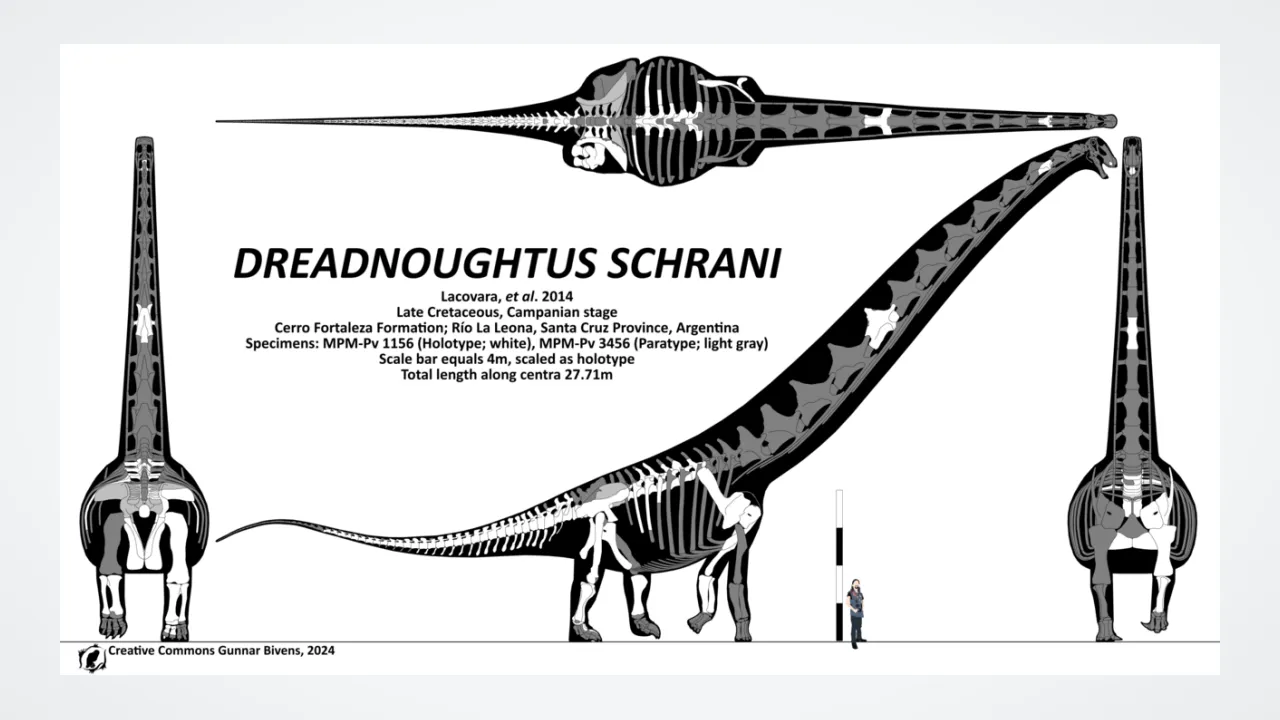
Imagine an animal as long as a basketball court with a muscular thirty-foot tail! Scientists named it Dreadnoughtus after huge steel battleships called , because an adult had nothing to fear in its forest home.
2
A Rare Complete Giant
Most super-giant dinosaurs are known from only a handful of broken bones. Dreadnoughtus is famous because a sudden river flood buried it quickly in deep sand, saving more than seventy percent of its skeleton!
3
Power in Its Tail
Bony bumps under its tail held thick bands of muscle. With one mighty swing, that heavy tail could knock back any predator foolish enough to sneak close!
1. Why is the Dreadnoughtus fossil so important to dinosaur scientists?
2. How were so many Dreadnoughtus bones protected for millions of years?
🤯 Mind-Blowing Fact • Grade 3
It took sixteen tons of plaster-wrapped rock jackets and a freight ship voyage just to bring the Dreadnoughtus fossils safely to a lab for study and 3D scanning!
✨ Word Sparks (Grade 3 Glossary)
Tap 🔊 to hear
badlands
dry, rocky hills carved by wind and rain
scavenger
an animal that feeds on dead remains
quarry
a dig site where fossils are excavated
🪝
How did four summers of digging at the southern tip of South America reveal the clearest picture yet of a super-giant dinosaur?
1
A Bone Ledge in Windy Patagonia
While hiking across windswept in southern Argentina in 2005, paleontologist Kenneth Lacovara spotted a cluster of fossil bones jutting from a hillside. By the end of the first afternoon, his team had already mapped ten bones—and over four field seasons, that number grew past one hundred thirty!
2
Trapped by an Ancient Flood
Rock layers around the tell a dramatic story from seventy-seven million years ago. After a river burst its banks, flooded silt turned into deep quicksand that trapped two Dreadnoughtus individuals and buried them before could scatter their skeletons.
3
Measuring Both Leg Bones at Once
Because Dreadnoughtus preserved both a six-foot thigh bone and an upper arm bone from the very same animal, scientists could directly measure how much weight its four legs carried—between forty-five and nearly sixty tons!
4
Built Like a Living Crane
With a thirty-seven-foot neck balanced by a powerhouse thirty-foot tail, Dreadnoughtus could sweep wide swaths of hardwood and conifer branches while standing completely still.
1. Which two limb bones found together let scientists calculate the weight of Dreadnoughtus directly?
2. How long was the neck of Dreadnoughtus?
🤯 Mind-Blowing Fact • Grade 4
Microscopic slices of Dreadnoughtus's bones showed rich blood-vessel channels and zero signs of slowing growth, proving this 85-foot titan had not even reached full adult size!
the distance measured all the way around something
counterweight
heavy mass balancing weight on the opposite end
🪝
Why did finding one single individual's arm, leg, neck, and tail bones transform how scientists study ALL giant dinosaurs?
1
Solving the Missing-Pieces Problem
For over a century, the biggest titanosaurs frustrated paleontologists because giants like Argentinosaurus and Puertasaurus survived as just a few isolated vertebrae. When Kenneth Lacovara's team unveiled Dreadnoughtus schrani in 2014, science finally gained over seventy percent of the non-head skeleton from a single super-massive titanosaur—eliminating the need to stitch together guesses from distant cousins.
2
Reading Microscopic Growth Clues
Even more astonishing than its 26-meter length was what researchers saw inside its bones. Its shoulder blade and pelvic bones had not yet fused completely, and microscopic bone slices lacked the tightly spaced outer rings called an external fundamental system that mark full adulthood. Despite already weighing dozens of tons, this Dreadnoughtus was still actively growing when river quicksand claimed its life!
3
Weaponized Tail Anatomy
Along the underside of its thirty-two preserved tail vertebrae sat expanded, paddle-shaped bones called . Deep muscle scars on those chevrons show Dreadnoughtus wielded its 9-meter tail not merely as a passive , but as a muscular battering whip capable of fending off large megaraptoran predators.
4
Sharing Data With the World
Before returning every fossil bone permanently to a museum in Río Gallegos, Argentina, researchers laser-scanned the entire skeleton so students and scientists worldwide can study 3D digital replicas anytime.
1. How did scientists prove that the giant Dreadnoughtus specimen had not finished growing yet?
2. What do the expanded paddle-shaped chevron bones under Dreadnoughtus's tail reveal?
🤯 Mind-Blowing Fact • Grade 5
Because the team published 3D laser scans of every Dreadnoughtus bone online for free, rival scientists could immediately build digital body models—sparking a famous scientific debate over whether it weighed 40 tons or nearly 60 tons!
✨ Word Sparks (Grade 5 Glossary)
Tap 🔊 to hear
holotype
the single original fossil specimen defining a species
quadrupedal
walking on all four legs for support
osteohistology
studying microscopic bone slices to learn growth history
🪝
Why did Dreadnoughtus spark one of modern paleontology's liveliest scientific debates over how to weigh a dinosaur?
1
Catastrophe Preserves a Paleontological Rosetta Stone
Seventy-seven million years ago along a forested meander belt of the Cerro Fortaleza Formation in southern Patagonia, a crevasse-splay flood liquefied unconsolidated sands into a deadly mire. Two titanosaurs—one vast, one smaller—sank rapidly beneath sediment, preserving 115 bones of the larger individual in exquisite three-dimensional detail before weathering or scavenging theropods could disperse them.
2
Why Seventy Percent Completeness Matters
Described in 2014 by Kenneth Lacovara and colleagues as Dreadnoughtus schrani (honoring Early-Twentieth-Century battleships and supporter Adam Schran), the represents roughly 70.4 percent of all non-cranial bone types, including a 1.91-meter femur—the longest complete titanosaur thigh bone then known—alongside an intact humerus, shoulder girdle, pelvis, cervical ribs, and nearly complete tail.
3
The Great Mass-Estimation Debate
Having both a humerus and femur from one individual allowed Lacovara's team to apply standard limb-shaft scaling equations, yielding a startling body mass of 59.3 metric tons (about 65 short tons). A year later, Karl Bates and colleagues constructed 3D digital hull volumes around the laser-scanned skeleton, arguing its torso could not hold enough flesh for 59 tons and revising its weight to roughly 38 to 49 metric tons—illustrating how healthy scientific testing refines our knowledge of extinct giants.
4
Ontogeny and Biomechanical Power
Regardless of whether Dreadnoughtus weighed 40 or 59 metric tons, osteohistological thin sections of its humerus revealed abundant fibrolamellar bone tissue with zero external fundamental system, proving this 26-meter giant died before reaching skeletal maturity. Meanwhile, pneumatized 1.1-meter cervical vertebrae supported an 11.3-meter neck counterbalanced by an 8.7-meter muscular tail.
5
Open-Access Paleontology for the Digital Age
By publishing high-resolution 3D laser meshes of every excavated Dreadnoughtus element online while repatriating the physical fossils to Río Gallegos, Argentina, the discovery team turned one Patagonian flood victim into a permanent global laboratory for sauropod biomechanics.