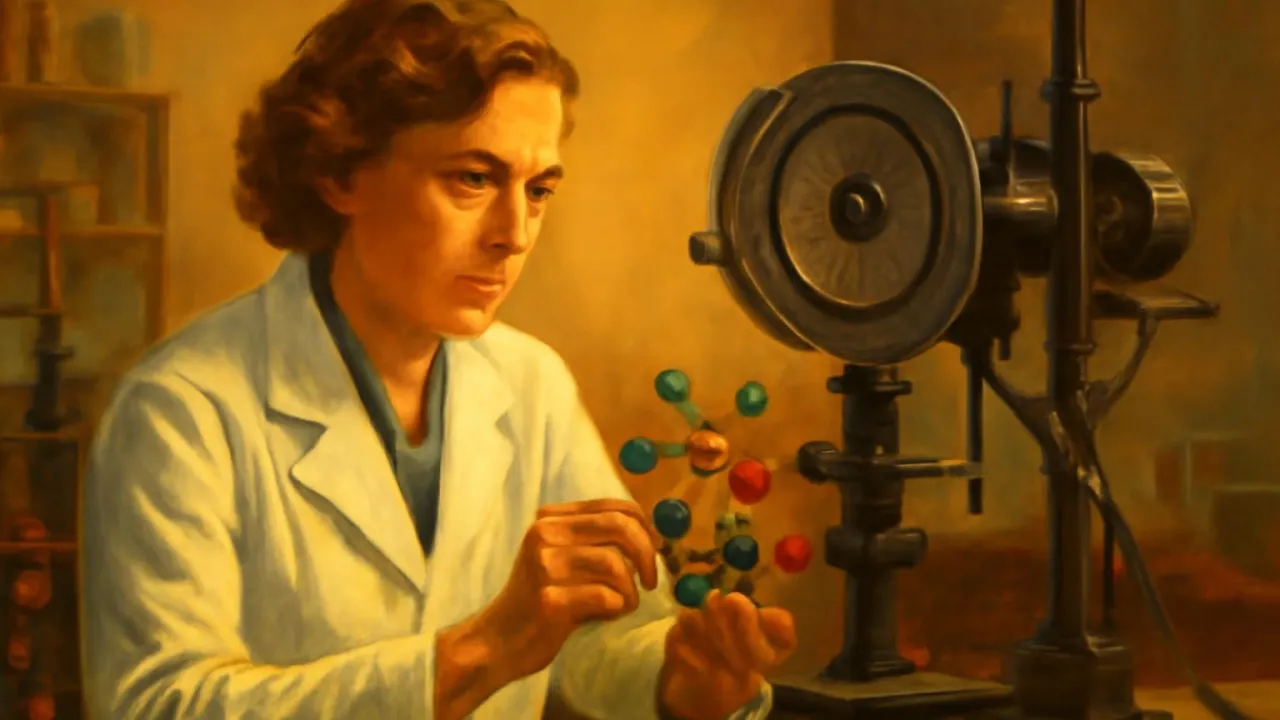
1. What tool did Dorothy use to see tiny molecules?
2. Why were Dorothy’s discoveries important?
🤯 Mind-Blowing Fact • Grade 3
Dorothy Hodgkin was only the third woman to win the Nobel Prize in Chemistry!
✨ Word Sparks (Grade 3 Glossary)
Tap 🔊 to hear
perseverance
Keep trying even when it is hard
hypothesis
A smart guess to test in science
crystal
A solid with a special repeating shape
🪝
What if you could use light to see the tiny shapes of life-saving medicines?
1
A Passion for Science
Dorothy Hodgkin showed great as she studied chemistry. She used X-ray crystallography to test her about molecules. This method helped her see atoms arranged in . She was curious about how medicines worked at the smallest level.
2
Mastering X-Ray Crystallography
X-ray crystallography uses X-rays to create images of shapes. Dorothy carefully prepared samples and analyzed patterns of light. She developed new techniques to improve accuracy and speed. Her work required patience and detailed observation.
3
Overcoming Challenges
Dorothy faced many obstacles, including limited technology and skepticism from others. She persevered by refining her methods and sharing her findings. Her discoveries changed how scientists understood complex molecules. She became a leader in her field through hard work.
4
A Lasting Legacy
Dorothy’s mapping of penicillin and vitamin B12 molecules led to better medicines worldwide. Her achievements earned her the Nobel Prize in Chemistry in 1964. She inspired future scientists, especially women, to pursue science careers. Her work remains important in chemistry and medicine today.
Dorothy Hodgkin’s work helped develop life-saving antibiotics during World War II!
✨ Word Sparks (Grade 4 Glossary)
Tap 🔊 to hear
diffraction
Bending of light to see tiny shapes
antibiotic
Medicine that fights harmful germs
innovation
A new idea or way to do something
🪝
How did Dorothy Hodgkin’s X-ray vision change science forever?
1
Science in a Changing World
During the early 1900s, science was growing fast but women faced many barriers. Dorothy Hodgkin entered chemistry when few women did, showing courage and determination. She used X-ray crystallography, a new technique, to explore molecules in three dimensions. Her work came at a time when understanding medicines was very important.
2
Turning Points in Her Career
Dorothy’s breakthrough came when she mapped penicillin’s structure during World War II, helping improve . Later, she solved the complex shape of vitamin B12, a vital nutrient for health. These discoveries required innovative thinking and precise experimentation. They marked turning points that advanced both chemistry and medicine.
3
Signature Techniques and Innovations
Dorothy improved X-ray crystallography by developing better ways to prepare crystals and interpret images. She combined physics and chemistry knowledge to reveal atomic structures clearly. Her signature method involved careful analysis of patterns from crystals. This set new standards for molecular research worldwide.
4
Global Impact and Legacy
Dorothy Hodgkin’s discoveries transformed pharmaceutical science and helped save countless lives. She became a role model for women scientists around the world, advocating for education and peace. Her Nobel Prize win in 1964 highlighted her global influence. Today, her pioneering work continues to inspire new generations of researchers.
Dorothy Hodgkin’s Nobel Prize win was a historic breakthrough for women in science.
✨ Word Sparks (Grade 5 Glossary)
Tap 🔊 to hear
diffraction
Light bending to reveal tiny shapes
crystallography
Science of finding shapes inside crystals
perseverance
Never giving up, even when it’s hard
🪝
What scientific breakthroughs did Dorothy Hodgkin achieve using X-ray crystallography?
1
Early Life and Scientific Passion
Dorothy Mary Crowfoot Hodgkin grew up fascinated by science and nature, developing an early love for chemistry. She studied chemistry at Oxford University, where she met mentors who encouraged her to explore . Her passion for understanding molecular structures drove her to master complex scientific techniques despite societal challenges for women.
2
Mastering X-Ray Crystallography Techniques
Dorothy Hodgkin refined X-ray methods by improving crystal preparation and analyzing patterns with mathematical precision. She combined physics, chemistry, and mathematics to visualize atomic arrangements in three dimensions. Her innovative approach allowed scientists to see the exact shape of molecules critical for biology and medicine.
3
Major Discoveries and Career Achievements
Her landmark achievements include determining the structures of penicillin in 1945 and vitamin B12 in 1956, which were complex and challenging molecules. These discoveries revolutionized pharmaceutical chemistry by revealing how these molecules function at the atomic level. In 1964, she received the Nobel Prize in Chemistry for her outstanding contributions to science.
4
Historical Influence and Legacy
Dorothy Hodgkin’s work came during a time when female scientists were rare, yet she broke barriers and became a global role model. Her discoveries advanced medical treatments worldwide, impacting antibiotic development and nutrition science. She also advocated for peace and education, influencing science policy and inspiring future generations of women in STEM fields.
5
Inspiring Lessons from Her Life
Dorothy’s story teaches the importance of , curiosity, and innovation in science. She showed how combining different scientific disciplines leads to breakthroughs. Her dedication to sharing knowledge and mentoring others highlights the power of collaboration. Her life encourages young learners to dream big and pursue knowledge with passion and resilience.