🦴 PREHISTORIC
🦴 Aenocyon dirus • Canidae
VA Science SOL 2.5, 3.4, 3.5, 5.8 (Fossils, Adaptations & Earth History)
Dire Wolf
Real Ice Age Pack Hunter of the Americas
Grade 4 • Expanding • 196 words
🌋 Geologic Period & RegionLate Pleistocene (250,000–10,000 YA) • North & South America
📏 Size & Weight5 ft (1.5 m) long • 130–150 lbs (60–68 kg)
🦴 Diet & FossilsPack Carnivore • 4,000+ skulls at Rancho La Brea Tar Pits
⚡ Survival SuperpowerBone-crushing jaws and powerful pack teamwork across Ice Age plains
🤯 Mind-Blowing Fact • Grade 1
Over 4,000 Dire Wolf skulls sit side by side on one giant glowing wall at the La Brea Tar Pits Museum!
✨ Word Sparks (Grade 1 Glossary)
Tap 🔊 to hear
pack
a family group of wolves living together
echo
a sound bouncing back from far away
skull
the bony case that protects the brain
🪝
Were Dire Wolves real animals or just make-believe?
1
Real Ice Age Wolves
Awooo! Hear that deep howl across the grassy plain? Dire Wolves were not make-believe monsters from storybooks. Real trotted across America during the Ice Age!
2
Heavier Than Gray Wolves
Each Dire Wolf stood about as tall as a big gray wolf today. Yet its head was wider and its muscles were much heavier!
3
Working as a Team
Dire Wolves lived and hunted together in big family . Sticky tar pools in California saved thousands of their fossil bones.
1. How did a Dire Wolf compare in build to a modern gray wolf?
2. How did Dire Wolves live and hunt?
🤯 Mind-Blowing Fact • Grade 2
Dire Wolves are the single most common mammal fossil ever dug up from California's Rancho La Brea Tar Pits!
✨ Word Sparks (Grade 2 Glossary)
Tap 🔊 to hear
seep
liquid or tar oozing slowly up above ground
species
a specific kind of living plant or animal
DNA
the tiny code inside cells carrying traits
🪝
How did one sticky spot in California collect 4,000 Dire Wolf skulls?
1
Lured Into Sticky Seep
Step back twenty thousand years to sunny southern California! Shallow puddles of rainwater hid thick, sticky asphalt bubbling up from underground. Whenever an Ice Age horse or bison got stuck, hungry Dire Wolf packs rushed in and got trapped too.
2
Super-Strong Bite Force
Compared to today's gray wolves, Dire Wolves had broader foreheads and bigger back teeth. Their jaws had the strongest bite of any wild dog , letting them crunch hard bones with ease!
3
Not Just a Gray Wolf
For many years, scientists thought Dire Wolves and gray wolves were close sisters. Recent tests revealed a surprise: Dire Wolves came from a much older American dog branch!
1. What made Dire Wolf jaws special among wild dog relatives?
2. What surprising discovery did scientists make by testing Dire Wolf DNA?
🤯 Mind-Blowing Fact • Grade 3
In 2021, ancient DNA revealed that gray wolves are actually more closely related to African jackals than to American Dire Wolves!
✨ Word Sparks (Grade 3 Glossary)
Tap 🔊 to hear
genus
a group of closely related animal species
carnassials
sharp cheek teeth that slice like scissors
fractures
cracks or breaks in hard bone
🪝
Why did scientists change the Dire Wolf's scientific name in 2021 after over a century?
1
Look-Alike Cousins
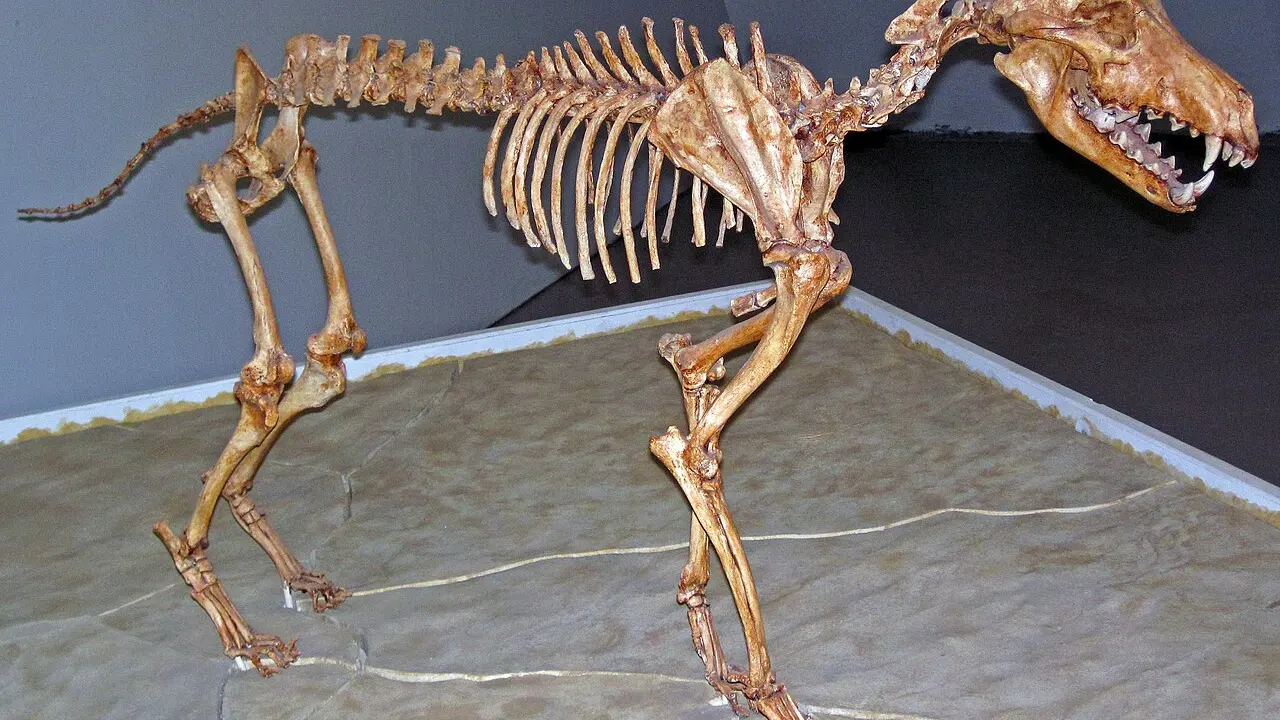
Place a Dire Wolf skeleton beside a northern gray wolf skeleton in a museum and even experts have to look closely! Because their bones looked so alike, paleontologists long called the Dire Wolf Canis dirus, placing it right inside the same as gray wolves and coyotes.
2
The 2021 DNA Surprise
In 2021, researchers extracted ancient DNA from five Dire Wolf fossils up to 50,000 years old. The genetic code shocked everyone: Dire Wolves split away from the ancestors of gray wolves nearly 5.7 million years ago! Scientists revived the name Aenocyon dirus, meaning 'terrible wolf.'
3
Built to Tackle Heavy Prey
Slightly shorter legs made Dire Wolves a bit slower than swift gray wolves, yet heavy shoulders and massive slicing teeth—called —helped packs bring down slow, muscular Ice Age horses, camels, and young mastodons.
4
Caring for Injured Packmates
Fossil leg bones and ribs from Rancho La Brea show healed . Just like modern wolves, Dire Wolf packs protected and shared food with injured family members while they recovered.
1. Roughly how long ago did the Dire Wolf lineage split from gray wolf ancestors?
2. What were a Dire Wolf's sharp slicing cheek teeth called?
🤯 Mind-Blowing Fact • Grade 4
Fossil Dire Wolves have been found from snowy Alberta, Canada, all the way south to Bolivia—and from sea level up to 7,400 feet in the mountains!
✨ Word Sparks (Grade 4 Glossary)
Tap 🔊 to hear
canids
members of the biological dog family
selection
nature favoring traits that help animals survive
interbred
mixed genes between two different animal groups
🪝
How could Dire Wolves and gray wolves look almost identical if they weren't close relatives?
1
Evolution's Twin Blueprint
Imagine two inventors on opposite sides of the ocean building nearly identical snowshoes without ever meeting! While gray wolves evolved in Eurasia and only crossed into North America later in the Ice Age, Aenocyon dirus evolved right inside the Americas. Because both lineages chased large hoofed herds in social packs, natural sculpted remarkably similar skulls, long muzzles, and running legs—a textbook case of convergent evolution among .
2
Reddish Fur Instead of Frosty Gray?
Because Aenocyon dirus evolved across warm grasslands, scrublands, and open woodlands of North and South America rather than high Arctic tundra, paleogeneticists and artists suspect its coat may have been reddish-tan rather than icy silver-gray, helping packs blend into sunlit prairies.
3
Reading Wear Marks on Teeth
Microscopic scratches and tiny pits on La Brea fossil teeth act like a diary of ancient meals! During harsh climate swings around 15,000 years ago, Dire Wolf teeth showed elevated breakage because hungry packs chewed every scrap of bone clean.
4
Why Gray Wolves Survived While Dire Wolves Vanished
Because Dire Wolves never with gray wolves or coyotes, they gained no outside immune genes or traits for chasing smaller, faster prey like deer and rabbits. When giant Ice Age horses and bison disappeared 10,000 years ago, flexible gray wolves adapted while specialized Dire Wolves went extinct.
1. What do microscopic pits and chips on fossil Dire Wolf teeth tell scientists?
2. Why did gray wolves survive the end of the Ice Age while Dire Wolves vanished?
🤯 Mind-Blowing Fact • Grade 5
Biomechanical computer models show a Dire Wolf's bite force was nearly 30 percent stronger than a modern gray wolf's!
✨ Word Sparks (Grade 5 Glossary)
Tap 🔊 to hear
petrous
rock-hard skull bone preserving ancient DNA
endemic
native exclusively to one geographic region
sagittal
a ridge along the top of a skull
🪝
What happened when scientists sequenced 50,000-year-old inner-ear bones from America's most famous fossil predator?
1
Rewriting 160 Years of Taxonomy
Peer inside the bone—the dense, pebble-hard capsule protecting a mammal's inner ear—and you find nature's best vault for ancient DNA! First named Canis dirus by paleontologist Joseph Leidy in 1858 from an Indiana riverbank jawbone, the Dire Wolf spent 163 years classified as a brawny sister species to the gray wolf (Canis lupus). Then in January 2021, an international team sequenced five Pleistocene genomes spanning Idaho, Ohio, Tennessee, and Wyoming. The results redrew the canid family tree: Dire Wolves diverged roughly 5.7 million years ago as an New World lineage, resurrecting paleontologist John Campbell Merriam's 1918 genus name Aenocyon—Greek for 'dreadful dog.'
2
Cranial Biomechanics and Bite Force
Averaging 60 to 68 kilograms (130 to 150 pounds), Aenocyon dirus weighed roughly 20 to 25 percent more than typical North American gray wolves. Finite-element skull modeling shows its high crest and wide zygomatic arches housed temporalis muscles generating approximately 129 percent of a modern gray wolf's bite force! Though its braincase was slightly smaller relative to skull length, enlarged upper fourth premolars sheared tough hide and sinew with unmatched efficiency.
3
Geographic Variations Across Two Continents
Skeletal measurements reveal two distinct regional populations in North America: western Dire Wolves preserved at Rancho La Brea had slightly shorter, stockier limbs, whereas eastern populations east of the Mississippi River evolved longer legs and reached slightly heavier maximum weights—up to 79 kilograms—adapted to chasing fleet horses across open valleys.
4
Isotopic Niche Partitioning
Stable carbon and nitrogen isotopes from La Brea bone collagen confirm Aenocyon dirus hunted open-grassland grazers—especially Western horses (Equus occidentalis) and yesterday's camels—whereas rival Smilodon cats targeted woodland bison.
5
Reproductive Isolation and Extinction
Unlike gray wolves, coyotes, and dholes—which occasionally hybridized across Eurasia and North America to exchange adaptive immune alleles—millions of years of evolutionary separation left Aenocyon dirus genetically isolated. When late-Quaternary megafaunal collapse swept away slow, heavy ungulates around 10,000 years ago, the last giant canid of the Americas vanished with its prey.