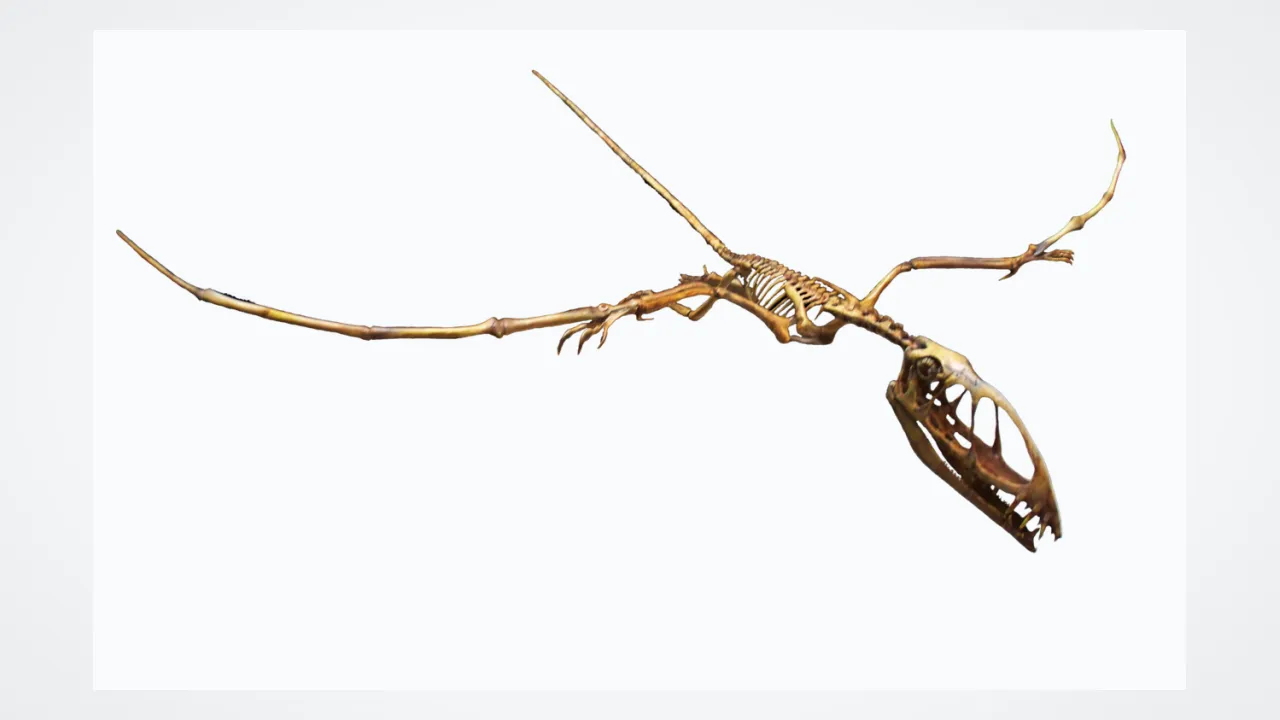
🦴 PREHISTORIC
🦴 Dimorphodon macronyx • Dimorphodontidae
VA Science SOL 2.5, 3.4, 3.5, 5.8 (Fossils, Adaptations & Earth History)
Dimorphodon
Mary Anning's Two-Toothed Tree-Climbing Flyer
Grade 3 • Fluent • 152 words
🌋 Geologic Period & RegionEarly Jurassic (195–190 MYA) • Lyme Regis, Dorset, England
📏 Size & Weight3.3 ft (1 m) long • 4.6 ft (1.4 m) wingspan • 2.2 lbs (1 kg)
🦴 Diet & FossilsInsectivore & Small Vertebrate Hunter • Blue Lias Cliffs
⚡ Survival SuperpowerTwo distinct shapes of teeth and squirrel-like curved climbing claws
🤯 Mind-Blowing Fact • Grade 1
When fossil pioneer Mary Anning found Dimorphodon along England's Dorset coast in 1828, it was the very first pterosaur skeleton ever discovered outside Germany!
✨ Word Sparks (Grade 1 Glossary)
Tap 🔊 to hear
Cliff
Steep tall wall of coastal rock
Fang
Long pointed tooth for grabbing prey
Puffin
Seabird known for a tall colorful beak
🪝
Why did this flying reptile grow two totally different kinds of teeth?
1
Scramble Up the Trunk
Scritch, climb, flutter! Curved claws grip rough tree bark above seaside . Meet Dimorphodon! Its big rounded head looked a bit like a 's.
2
Two Kinds of Teeth
Smile wide! Long pointy sat in front, while tiny little teeth lined the back of its lower jaw.
3
Found by Mary Anning
Famous fossil hunter Mary Anning discovered its bones in rocky English almost two hundred years ago!
1. Who discovered the first Dimorphodon fossil in England in 1828?
2. Why does Dimorphodon's name mean 'two-form tooth'?
🤯 Mind-Blowing Fact • Grade 2
Dimorphodon's lower jaw held four or five long fangs up front followed by thirty to forty tiny spear-point teeth smaller than grains of sand!
✨ Word Sparks (Grade 2 Glossary)
Tap 🔊 to hear
Cycad
Palm-like ancient plant from dinosaur times
Scamper
To run and climb with quick steps
Skull
Framework of bones forming the head
🪝
Did this puffin-faced pterosaur spend more time climbing forest trees than soaring far out to sea?
1
Big Head, Agile Claws
Travel back 195 million years to the wooded sea cliffs of Early Jurassic England! Darting between trees is Dimorphodon, a crow-sized flying reptile with a four-and-a-half-foot wingspan. Even though its deep, boxy looked heavy, wide openings in the bone kept it super light!
2
Built Like a Squirrel
Look closely at its hands and feet: long, curved, sharp claws gave Dimorphodon an amazing grip! Its species name macronyx actually means large claw. It scampered quickly up tree trunks and cliff rocks on all fours.
3
Snapping Up Bugs and Lizards
Instead of fishing far offshore, Dimorphodon made quick fluttering flights through coastal woods to catch beetles, dragonflies, and small lizards!
1. What does Dimorphodon's species name macronyx translate to?
2. Why wasn't Dimorphodon's big puffin-shaped head too heavy for flying?
🤯 Mind-Blowing Fact • Grade 3
When William Buckland first announced Mary Anning's Dimorphodon find in 1829, newspapers were amazed that a 'flying dragon' had once lived in England!
✨ Word Sparks (Grade 3 Glossary)
Tap 🔊 to hear
Anatomist
Scientist who studies body parts and skeletons
Fenestra
Natural weight-saving opening inside skull bones
Woodland
Land covered with trees and shrubs
🪝
Why did scientists once compare Dimorphodon to an ocean puffin—until closer bone checks revealed a woodland climber?
1
Discovery on the Dorset Coast
In December 1828, wintry waves battered the Blue Lias cliffs of Lyme Regis in southern England, exposing delicate dark bones in gray limestone. Self-taught paleontologist Mary Anning carefully extracted the skeleton—creating a sensation across Europe! Thirty-one years later, Richard Owen named it Dimorphodon macronyx.
2
Rethinking the Puffin Myth
Because Dimorphodon's tall, arched snout looked slightly like an Atlantic puffin's bill—and its fossils washed into coastal sea mud—people long assumed it hunted ocean fish. However, modern studies of its teeth and jaw muscles tell a very different story: its quick-snapping jaws excelled at catching crunchy insects, frogs, and small land lizards!
3
Short Wings for Tight Spaces
Compared with ocean gliders like Pteranodon, Dimorphodon had relatively short, broad wings. Just like pheasants or woodpeckers today, short wings helped it burst rapidly into the air and weave between tree branches.
4
Master Climber
Strong finger joints, long grasping toes, and a stiff counterbalance tail let Dimorphodon scramble effortlessly up trunks and rocky ledges.
1. How did Dimorphodon's short, broad wings match its lifestyle?
2. What prey did Dimorphodon's 'two-form' teeth actually suit best?
🤯 Mind-Blowing Fact • Grade 4
Dimorphodon had a special extra-long fifth toe without a claw that helped stretch a web of skin between its ankles and its long stiff tail!
✨ Word Sparks (Grade 4 Glossary)
Tap 🔊 to hear
Heterodont
Having teeth of different shapes and functions
Homodont
Having teeth that all share one shape
Trackway
Trail of fossilized footprints preserved in stone
🪝
How did bone mechanics overturn old drawings of Dimorphodon running upright on two legs like a tiny dinosaur?
1
An Early Branch of the Pterosaur Tree
Step onto the forested cliffs overlooking Early Jurassic seas in southern England 195 million years ago. Scrambling briskly up an araucaria trunk is Dimorphodon macronyx, one of the earliest well-preserved pterosaurs in the fossil record. Measuring roughly one meter long with a 1.4-meter (4.6-foot) wingspan, it weighed barely one kilogram thanks to expansive skull fenestrae framed by slender bony struts.
2
Heterodont Jaws in a Reptile
Most reptiles are , meaning all their teeth share one uniform shape. Sir Richard Owen coined the name Dimorphodon ('two-form tooth') in 1859 after observing a striking contrast: the upper jaw held four tall, fang-like premaxillary teeth followed by spaced medium teeth, while the lower jaw paired five large front fangs with thirty to forty minuscule, lancet-shaped cheek teeth!
3
Bipedal Runner or Quadrupedal Climber?
In the 1980s, paleontologist Kevin Padian famously reconstructed Dimorphodon sprinting upright on two hind legs like a roadrunner. However, subsequent 3D joint reconstructions and fossil pterosaur (Pteraichnus) showed its wing membranes attached down to its ankles, linking all four limbs! Walking and climbing on all fours—assisted by deep, strongly curved claws and an elongated fifth toe—made Dimorphodon an agile arboreal specialist.
4
Short-Burst Flier
Relatively short wing proportions meant high energetic cost during long flights, confirming Dimorphodon fluttered in rapid bursts between trees and coastal crags rather than cruising open seas.
2. What fossil evidence showed pterosaurs like Dimorphodon walked on all fours rather than running upright on two legs?
🤯 Mind-Blowing Fact • Grade 5
Tiny vertical ridges on Dimorphodon's compressed back teeth worked like miniature steak knives for slicing crunchy insect exoskeletons!
✨ Word Sparks (Grade 5 Glossary)
Tap 🔊 to hear
Scansorial
Anatomically adapted for climbing trees or cliffs
Uropatagium
Skin membrane stretched between ankles and tail
Articulated
Fossil bones preserved still connected at joints
🪝
How did Mary Anning's 1828 Lyme Regis specimen spark two centuries of scientific debate over early pterosaur posture, flight, and ecology?
1
Mary Anning's Milestone in the Blue Lias
In December 1828, pioneering paleontologist Mary Anning excavated a dark, skeleton from Sinemurian-age (~195–190 MYA) marine shales of the Lower Lias along Dorset's Lyme Regis coast. Announced by William Buckland in 1829 as Pterodactylus macronyx and reassigned by Richard Owen in 1859 to the new genus Dimorphodon, Anning's discovery marked the first substantial pterosaur recovered outside Bavaria and revealed remarkable diversity near the dawn of the Jurassic Period.
2
Cranial Architecture and Heterodont Dentition
Dimorphodon's deep, arched 22-centimeter skull achieved extreme lightness through vast antorbital and narial fenestrae separated by paper-thin bony trabeculae. Its diagnostic heterodonty paired needle-sharp anterior fangs for impaling swift insects or small sphenodontians with thirty to forty microscopic, laterally compressed mandibular denticles—forming a fine-toothed shear totally unsuited to slippery pelagic fish.
3
Arboreal Scansoriality vs. Bipedalism
Few pterosaurs have fueled livelier locomotor debates. While late-20th-century studies proposed digitigrade bipedalism, modern biomechanical analyses by Mark Witton, David Unwin, and Sarah Sangster highlight Dimorphodon's strongly curved, deep unguals (claws), grasping phalangeal proportions, and ankle-attached stretched across elongated fifth pedal digits. Together with quadrupedal Pteraichnus trackways, these features paint a climber adept at scaling trunks and coastal cliffs.
4
Reluctant Flier of Coastal Forests
Compared with pelagic rhamphorhynchids, Dimorphodon possessed a shorter fourth wing-finger and higher wing loading. Aerodynamic modeling indicates rapid, energetically expensive flapping bursts analogous to modern galliform birds (pheasants and tinamous) or rails—ideal for escaping predators and darting across canopy clearings.
5
Global Cousins
In 1998, paleontologists described a second species, Dimorphodon weintraubi, from Middle Jurassic canyon beds in Tamaulipas, Mexico—confirming dimorphodontids thrived across landmasses bordering the opening Atlantic.