🧬 HUMAN BODY
🧬 Thoracic Diaphragm • Respiratory & Muscular Systems
VA Science & Health SOL 1.1, 3.1, 4.2, 5.1 (Cells, Organs & Body Systems)
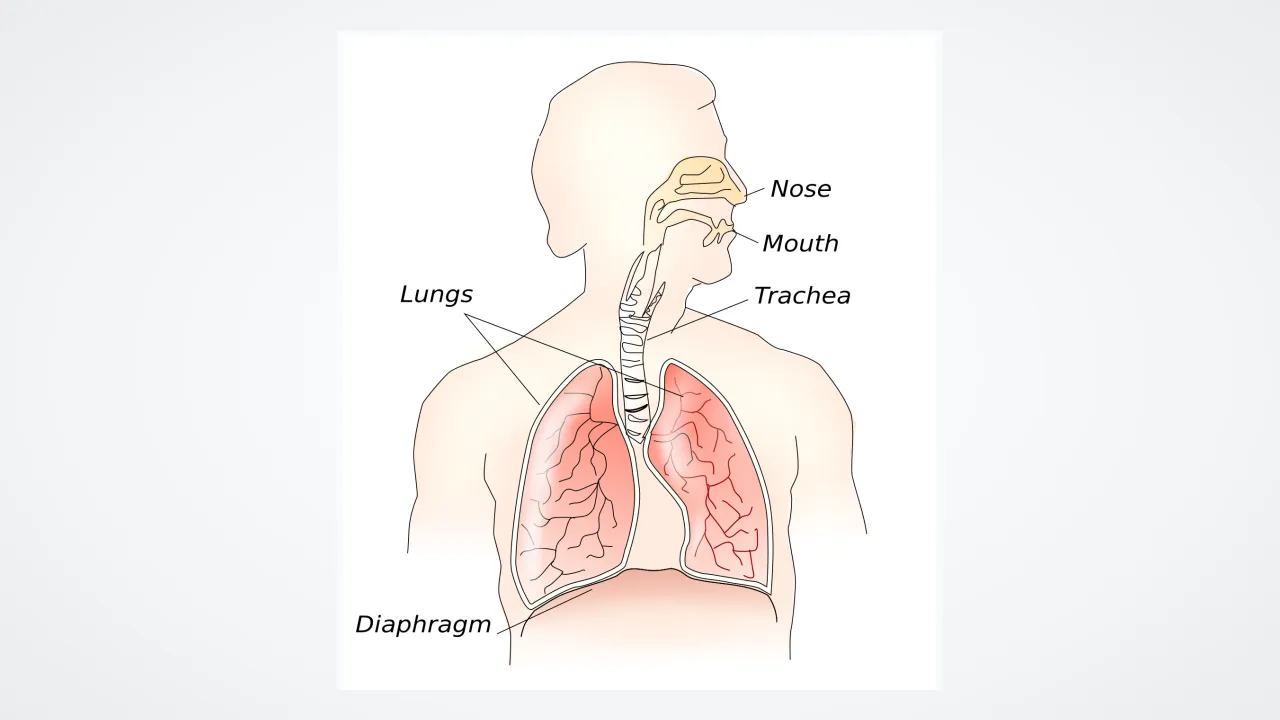
Diaphragm Muscle
The Parachute-Shaped Breathing Engine Under Your Lungs
Grade 2 • Developing • 96 words
🩺 Body System & LocationRespiratory & Muscular Systems • Dome sheet separating the chest from the belly
🔬 Size / Cell Count~2–4 mm thick muscular dome • Moves down 0.5–4 inches (1–10 cm) per breath
⚙️ Core JobFlattens downward to pull fresh air into lungs and domes upward to exhale
⚡ Body SuperpowerPowers every single breath automatically yet causes funny 'hic!' sounds whenever it spasms
🤯 Mind-Blowing Fact • Grade 1
Every single hiccup you have ever had came from a sudden little jump of your diaphragm muscle!
✨ Word Sparks (Grade 1 Glossary)
Tap 🔊 to hear
Diaphragm
Dome muscle under lungs that helps you breathe
Dome
A rounded shape curving up like an umbrella
Hiccup
A quick 'hic!' sound when your diaphragm jumps
🪝
Where do silly hiccups actually come from inside your body?
1
A Parachute Under Your Lungs
Rest one hand right above your belly button and take a big breath! Deep inside, a wide muscle shaped like a parachute sits right under your lungs. Its name is the !
2
Pulling Down to Breathe In
Your lungs have no muscles of their own. When your pulls downward, it makes extra room so fresh air rushes into your chest.
3
Hic! Goes the Muscle
Sometimes your jumps by surprise, pulling air in fast—and out pops a funny !
1. What shape does your resting diaphragm muscle look like inside your chest?
2. What funny sound happens when your diaphragm muscle jumps suddenly?
🤯 Mind-Blowing Fact • Grade 2
Your diaphragm contracts and relaxes about 20,000 times every single day without ever taking a vacation!
✨ Word Sparks (Grade 2 Glossary)
Tap 🔊 to hear
Contract
When a muscle squeezes tighter and pulls shorter
Inhale
To draw fresh air inward into your lungs
Relax
When a muscle lets go and rests gently
🪝
If your spongy lungs have zero muscles inside them, how do they puff up with air?
1
The Floor of Your Chest
Put your hands on your lower ribs and slowly! Separating your heart and lungs above from your stomach below is a thin, strong sheet of muscle called the diaphragm. It curves upward like an umbrella.
2
Down to Inhale, Up to Exhale
When it is time to breathe in, your diaphragm squeezes and flattens downward! That extra space inside your chest pulls fresh air right down your windpipe. When the diaphragm , it springs back up into its dome shape, pushing used air gently out.
3
Belly Breathing for Singers
Singers and trumpet players practice deep 'belly breathing' with their diaphragm to hold long, steady musical notes!
1. Which way does your diaphragm move when you breathe IN?
2. What divides your upper chest organs from your lower tummy organs?
🤯 Mind-Blowing Fact • Grade 3
Unlike almost any other muscle, your diaphragm works automatically while you sleep yet lets you take conscious control whenever you sing or hold your breath!
✨ Word Sparks (Grade 3 Glossary)
Tap 🔊 to hear
Cavity
A hollow space inside the body holding organs
Suction
Pulling force created when air space expands larger
Voluntary
Controlled on purpose whenever you choose to act
🪝
How can one muscle work on automatic pilot while you sleep AND obey you whenever you hold your breath?
1
Built Like a Syringe Plunger
Have you ever pulled back the plunger on a toy water syringe and watched liquid rush inside? Your diaphragm uses that exact trick with air! Anchored all around your lower rib cage, breastbone, and spine, this dome-shaped skeletal muscle seals the bottom of your chest .
2
Creating Gentle Suction
When brain signals tell your diaphragm to contract, its dome flattens downward by up to several inches, while rib muscles lift outward. Expanding the chest lowers air pressure inside your lungs, so outside air flows naturally down your airways to fill the space!
3
Automatic AND Voluntary
Most muscles are either strictly automatic, like your heart, or strictly controlled by choice, like your fingers. Your diaphragm does both! Your brainstem runs it automatically all night long, yet you can take control anytime to blow out birthday candles or swim underwater.
4
The Science of a Hiccup
Eating too fast can tickle the diaphragm's nerve, causing a sudden contraction that snaps your throat flap shut with a classic 'hic!'
1. How is your diaphragm similar to pulling back the plunger on a syringe?
2. What makes control of the diaphragm unusual compared with your heart muscle?
🤯 Mind-Blowing Fact • Grade 4
Three major body highways—your largest artery, your largest vein, and your food-carrying esophagus—pass through three custom-fitted doorways right through your diaphragm!
✨ Word Sparks (Grade 4 Glossary)
Tap 🔊 to hear
Thorax
The rib-protected chest section above your diaphragm
Tendon
Tough cord or sheet anchoring muscle fibers firmly
Spasm
A sudden, unplanned tightening of a muscle
🪝
Why does getting bumped in the stomach 'knock the wind out of you' even though your lungs are higher up?
1
Boyle's Law in Every Breath
Physics students learn Boyle's Law: at constant temperature, expanding the volume of a closed container drops the gas pressure inside it. Your thoracic cavity puts Boyle's Law to work sixteen times every minute! During quiet breathing, the diaphragm accounts for roughly 75 percent of your chest expansion. Contracting muscle fibers pull its tough central downward just one or two centimeters during rest—or up to ten centimeters when you gasp after a sprint—dropping lung pressure slightly below outside air so half a liter to three liters of fresh air pours inward.
2
Three Built-In Highway Tunnels
Because the diaphragm forms a complete wall between your (chest) and abdomen (belly), major pipelines traveling from upper to lower body need special doorways! Three reinforced openings pierce the diaphragm: one for the aorta carrying oxygen-rich blood downward, one for the vena cava returning venous blood upward, and the esophageal hiatus letting swallowed food enter the stomach.
3
Getting the Wind Knocked Out
Have you ever fallen flat on a soccer field and felt unable to inhale for a few scary seconds? A sudden bump to your upper belly temporarily stuns the nerve network behind the diaphragm, freezing the muscle in a brief until its rhythm resets!
4
Laughing, Sneezing, and Lifting
Beyond breathing, rhythmic bursts of your diaphragm power belly laughs, forceful sneezes, and core stability!
1. Roughly how much of quiet, restful chest expansion is powered by your diaphragm alone?
2. Why does a hard bump to the upper belly briefly 'knock the wind out of you'?
🤯 Mind-Blowing Fact • Grade 5
Among all backboned animals on Earth, only mammals possess a complete muscular diaphragm—and its phrenic nerves trace all the way up to neck vertebrae C3–C5!
✨ Word Sparks (Grade 5 Glossary)
Tap 🔊 to hear
Phrenic nerve
Neck-originating nerve cable commanding the diaphragm muscle
Pleura
Slippery double membrane wrapping smoothly around each lung
Recoil
Springing naturally back to resting shape after stretching
🪝
Why does the nerve controlling your diaphragm start high up in your neck instead of down near your lower ribs?
1
A Mammalian Evolutionary Innovation
Among all vertebrates on Earth, only mammals possess a complete muscular thoracic diaphragm! Reptiles and amphibians ventilate lungs differently, whereas warm-blooded mammals evolved this tireless musculotendinous partition—packed with fatigue-resistant, mitochondria-rich slow-twitch skeletal fibers—to sustain the high oxygen demands of endothermy and sustained running.
2
Intrapleural Pressure Mechanics
How does downward movement of the diaphragm stretch spongy lungs without being glued directly to lung tissue? Each lung sits inside a double-walled pleural sac lubricated by a microscopic film of pleural fluid. When radial muscle fibers pull the cloverleaf-shaped central tendon inferiorly, expanding thoracic volume drops intrapleural pressure from roughly -4 mmHg to -6 mmHg relative to atmospheric pressure. That negative suction couples the outer visceral of the lungs to the chest wall, inflating alveoli effortlessly; during quiet exhalation, passive elastic of lung elastin domes the relaxed diaphragm back upward without spending ATP!
3
C3, C4, C5 and Embryonic Migration
Curiously, the paired that fire every breath originate high in your cervical spinal cord at segments C3, C4, and C5—inspiring the classic medical rhyme, 'C3, 4, 5 keep the diaphragm alive!' Why so high? Early in embryonic development, future diaphragm muscle cells form up in the neck region before migrating downward below the growing heart and lungs, trailing their phrenic nerve cables behind them.
4
Anatomical Hiatus Levels (T8, T10, T12)
Its three major apertures pierce staggered vertebral levels so aortic pulsations or diaphragmatic contractions never pinch blood return: the caval opening at T8, the muscular esophageal hiatus (which acts as an extra pinch-valve against stomach reflux) at T10, and the aortic hiatus at T12.
5
Medullary Rhythm Generators
Pacemaker neurons in the brainstem's pre-Bötzinger complex monitor arterial carbon dioxide and blood pH second by second, adjusting firing frequency seamlessly from sleep to marathon running.