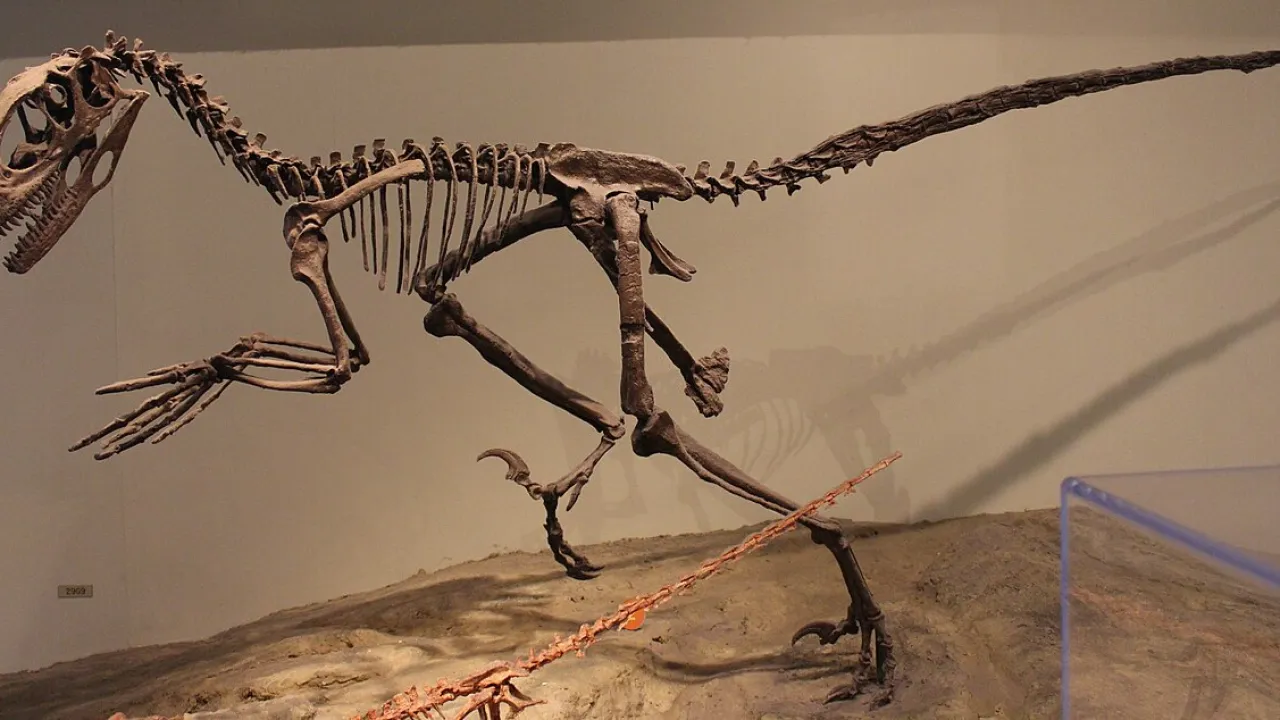
⚡ Survival SuperpowerFive-inch retractable sickle toe claws and bird-like skeleton that proved dinosaurs were active
🤯 Mind-Blowing Fact • Grade 1
Deinonychus means 'terrible claw' because the curved claw on each foot grew five inches long—twice as big as Velociraptor's!
✨ Word Sparks (Grade 1 Glossary)
Tap 🔊 to hear
Leap
Jump high and far through the air
Retract
Pull a sharp claw up off the ground
Plumage
Coat of warm feathers covering an animal
🪝
What wolf-sized feathered dinosaur changed everything we know about dinosaurs?
1
Leap Through the Ferns!
Spring, whoosh! Out of the shady green forest a sleek, feathered hunter! Long tail feathers stream straight behind it for balance. Meet swift and clever Deinonychus!
2
Five-Inch Curved Claw
Look down at its strong feet! Each second toe holds a curved five-inch claw lifted high off the dirt so it stays razor-sharp.
3
Quick Like a Giant Hawk
Warm feathers, bright eyes, and grasping three-fingered hands made this eleven-foot hunter look and move very much like a giant ground bird!
2. About how heavy and large was a grown-up Deinonychus?
🤯 Mind-Blowing Fact • Grade 2
John Ostrom's 1964 discovery of Deinonychus sparked the 'Dinosaur Renaissance,' proving modern birds are actually living feathered dinosaurs!
✨ Word Sparks (Grade 2 Glossary)
Tap 🔊 to hear
Renaissance
Exciting rebirth of new ideas and discoveries
Warm-Blooded
Making body heat inside to stay active anytime
Descended
Passed down through family generations over millions of years
🪝
Why did people once think all dinosaurs were slow, cold, swamp-dragging lizards—until Deinonychus was found?
1
Waking Up Dinosaur Science!
Imagine visiting a museum in 1960: every book described dinosaurs as sluggish, cold-blooded lizards dragging their tails! Then in 1964, paleontologist John Ostrom discovered Deinonychus in Montana. One look at its light hollow bones, stiff balancing tail, and leaping claws proved dinosaurs could be fast, , and energetic!
2
Birds Are Living Dinosaurs
Comparing Deinonychus wrist bones and hips with modern eagles and Archaeopteryx convinced scientists that birds directly from feathered theropod dinosaurs!
3
The Real Star Behind Movie Raptors
When storytellers wanted scary six-foot raptors, they actually modeled their creatures on Montana's wolf-sized Deinonychus while borrowing Velociraptor's name!
1. How did John Ostrom's 1964 discovery of Deinonychus change how scientists viewed dinosaurs?
2. Which dinosaur actually matched the wolf-like size of famous movie 'raptors'?
🤯 Mind-Blowing Fact • Grade 3
Because Deinonychus held its sickle-clawed second toe up in the air, fossil footprints of raptors show only two toe prints instead of three!
✨ Word Sparks (Grade 3 Glossary)
Tap 🔊 to hear
Counterbalance
Weight extending opposite to keep an animal steady
Didactyl
Walking with only two toes touching the ground
Quarry
Excavation site where fossil skeletons are dug up
🪝
How did Deinonychus keep its eleven-foot body balanced while leaping on a single foot?
1
Hunter of Early Cretaceous Floodplains
Travel back 112 million years to swampy floodplains across Montana, Wyoming, and Oklahoma. Trotting lightly on just two toes of each hind foot—keeping its giant curved inner claw lifted cleanly—comes Deinonychus antirrhopus.
2
Secret of the Counterbalancing Tail
Its species name antirrhopus means 'counterbalancing'! Bundles of hair-thin bony rods wrapped tightly around its tail vertebrae, locking most of the tail into a stiff rod while leaving the base flexible at the hips so it could swing like a tightrope walker's pole.
3
Clues Alongside Tenontosaurus
In multiple quarries, paleontologists unearthed shed Deinonychus teeth and skeletons right beside Tenontosaurus, a cow-sized plant-eater ten times heavier!
4
Folding Feathered Arms
Swiveling half-moon wrist bones folded its three-clawed hands neatly against its sides to protect long wing feathers whenever it sprinted and leaped through thick Early Cretaceous fern forests.
1. How many toe prints show up in fossilized footprints left by walking raptors like Deinonychus?
2. What does the species name antirrhopus describe about Deinonychus?
🤯 Mind-Blowing Fact • Grade 4
Chemical tests on tiny vs. adult Deinonychus teeth in 2020 showed youngsters hunted small lizards on their own in the trees rather than eating regurgitated pack meals!
✨ Word Sparks (Grade 4 Glossary)
Tap 🔊 to hear
Isotopes
Chemical atoms in tooth enamel recording ancient diets
Brooding
Sitting warmly over eggs to help embryos grow
Cooperative
Working together as an organized team toward goals
🪝
Did Deinonychus really hunt in organized wolf packs, or did tooth chemistry uncover a surprising twist?
1
Testing the Pack-Hunting Hypothesis
When John Ostrom found four Deinonychus skeletons alongside a one-ton herbivore called Tenontosaurus in Montana's Cloverly Formation, artists painted Deinonychus hunting in wolf-like packs! Yet scientists kept asking: did they cooperate peacefully like wolves, or mob carcasses competitively like Komodo dragons and crocodiles?
2
2020 Tooth Chemistry Breakthrough
In 2020, paleobiologist Joseph Frederickson analyzed carbon locked inside tiny juvenile and large adult Deinonychus teeth! In true pack-hunting wolves, parents bring big prey back to pups, so puppy teeth and adult teeth share the exact same chemical signature. Deinonychus teeth showed the opposite: juveniles ate small reptiles and insects, while adults ate big dinosaurs! Like modern Komodo dragons, youngsters likely fended for themselves—even scrambling up trees using curved claws and flapping wings.
3
Brooding Warm Eggs Like Birds
In 2006, paleontologists found a fossilized egg with crest-patterned shell texture tucked directly against the belly ribs of an adult Deinonychus skeleton, showing parents brooded warm ground nests much like living birds!
4
Powerful Bite for a Raptor
Tooth-marked Tenontosaurus bones prove adult Deinonychus jaws could generate surprisingly strong bites exceeding 4,000 newtons—roughly matching an adult American alligator—while curved three-fingered hands and sickle talons held quarry steady.
1. What did 2020 carbon-isotope tests on juvenile and adult Deinonychus teeth reveal?
2. What 2006 fossil discovery linked Deinonychus directly to bird-like nesting care?
🤯 Mind-Blowing Fact • Grade 5
Measurements of baby Deinonychus arm bones show youngsters had proportionally much longer wings than heavy adults—meaning juveniles may have fluttered up into trees for safety!
✨ Word Sparks (Grade 5 Glossary)
Tap 🔊 to hear
Synapomorphy
Shared evolutionary trait proving two groups are related
Endothermy
Internal metabolic heat generation keeping body temperatures steady
Monograph
Detailed scientific book examining one subject in depth
🪝
How did John Ostrom's 1969 anatomical monograph on Deinonychus overturn a century of evolutionary orthodoxy?
1
August 1964 at Bridger, Montana
On a sunny Montana hillside in August 1964, Yale paleontologist John Ostrom and colleague Grant Meyer spotted razor-sharp claws protruding from Aptian–Albian mudstones of the Cloverly Formation. Over three field seasons they recovered more than one thousand bones representing multiple individuals of a 3.4-meter (11-foot), eighty-kilogram predator. Ostrom's landmark 1969 naming `Deinonychus antirrhopus` shattered the Victorian paradigm of sluggish, ectothermic reptiles forever.
2
Synapomorphies Linking Maniraptorans to Birds
In the 1970s, Ostrom compared `Deinonychus` bone by bone against `Archaeopteryx` specimens in European collections, identifying dozens of shared derived traits (synapomorphies): a semilunate carpal wrist block enabling avian folding strokes, an elongated three-fingered manus, a retroverted pubis, a furcula, and hollow pneumatic vertebrae. Today, virtually every evolutionary biologist recognizes Aves (modern birds) as living maniraptoran theropods!
3
Ontogenetic Flight Potential in Juveniles
Allometric measurements by William Parsons and Kristi Parsons revealed juvenile `Deinonychus` possessed proportionally longer forelimbs, larger shoulder girdles, and lighter bodies than adults—suggesting hatchlings could flap-glide or scramble vertically up tree trunks to escape adult predators before transitioning to terrestrial ambush hunters.
4
Clutching Biomechanics Over Slashing
Robotic claw models tested by Phil Manning demonstrated the 13-centimeter strongly curved pedal ungual excelled as a climbing crampon and deep-puncturing grapple rather than a disemboweling blade, pinning prey securely on contact while serrated ziphodont jaws worked efficiently.
5
Enduring Legacy in Paleobiology
Few fossil species in history have catalyzed as many scientific breakthroughs—from dinosaur and feathered life restorations to stable-isotope behavioral ecology—as Montana's swift, sickle-clawed `Deinonychus`, bridging deep Mesozoic evolution with every soaring hawk and backyard songbird alive on Earth today.