2. What foods did Deinocheirus scoop up in the swamp?
🤯 Mind-Blowing Fact • Grade 2
Scientists found more than 1,400 smooth stomach stones inside a single Deinocheirus fossil to help mash up its food!
✨ Word Sparks (Grade 2 Glossary)
Tap 🔊 to hear
fossil
ancient bone or trace turned into stone
bill
a wide, flat beak like a duck's mouth
mystery
a puzzle that nobody has solved yet
🪝
How did two giant fossil arms stump dinosaur scientists for nearly fifty years?
1
The Mystery of the Giant Hands
Imagine digging in desert sand and uncovering two dinosaur arms bigger than a doorway! For almost fifty years, those huge arms and curved claws were the only bones scientists had. Everyone wondered if they belonged to a fierce monster.
2
Surprise! Meet the Whole Dinosaur
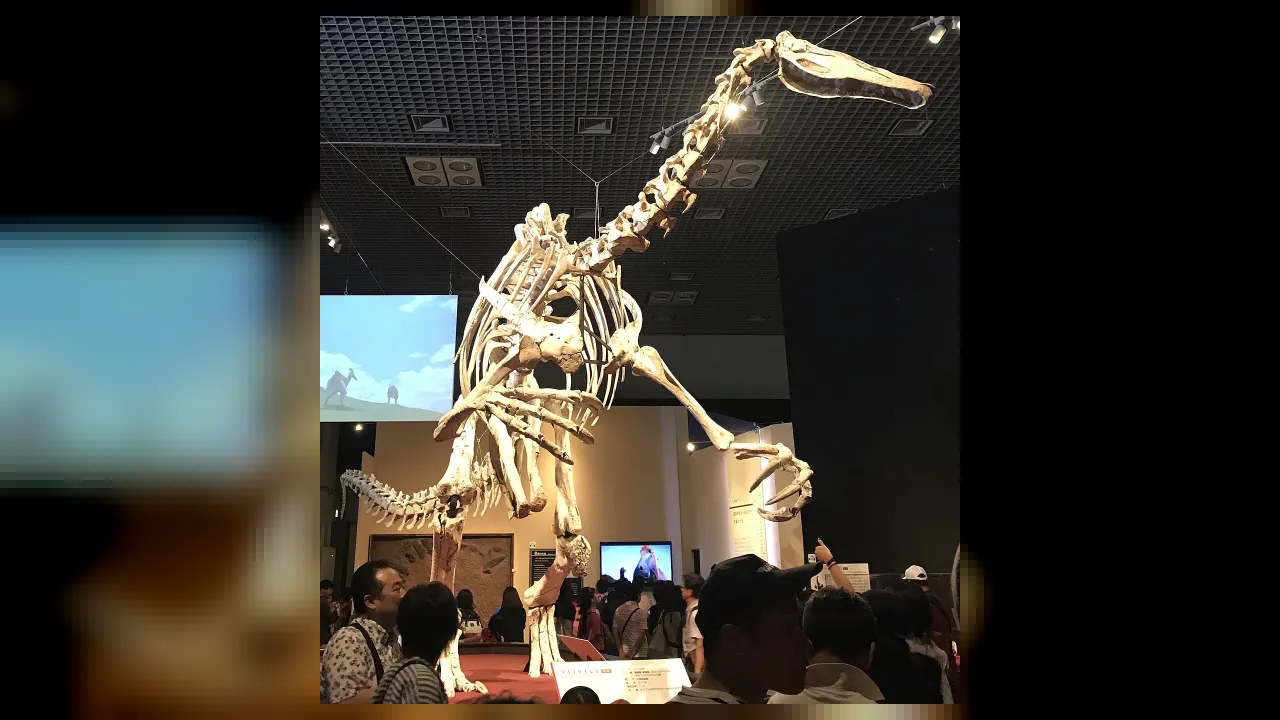
When full skeletons were finally found in Mongolia, scientists gasped and laughed! Deinocheirus was not a scary hunter at all. It had a wide duck-like , zero teeth, a pot belly, and a tall sail hump on its back.
3
Lunch by the River
Wide, blunt toes kept this heavy giant from sinking into soggy river mud. It used its long claws to rake up water weeds and slurped fish with its broad beak.
1. Why was Deinocheirus such a big mystery for nearly fifty years?
2. How did wide, blunt toes help Deinocheirus in its habitat?
🤯 Mind-Blowing Fact • Grade 3
The bones at the tip of Deinocheirus's tail were fused into a pygostyle—the exact structure modern birds use to hold a showy fan of tail feathers!
✨ Word Sparks (Grade 3 Glossary)
Tap 🔊 to hear
paleontologist
a scientist who studies ancient life through fossils
pygostyle
fused tail bones that support a feather fan
gizzard
a muscular stomach part that grinds up food
🪝
What happens when a family of speedy ostrich-mimic dinosaurs evolves a six-ton swamp giant?
1
Claws in the Gobi Sand
In 1965, Polish Zofia Kielan-Jaworowska brushed orange sand off an astonishing discovery in Mongolia's Gobi Desert. Lying in the rock were two colossal dinosaur arms measuring eight feet long, tipped with eight-inch curved claws! She named the creature Deinocheirus, meaning 'horrible hand.'
2
Solving a Half-Century Puzzle
For forty-nine years, artists drew Deinocheirus as a sleek predator ripping apart prey. Then in 2014, newly studied skeletons revealed the truth. This thirty-six-foot giant was actually the largest member of the usually slender ostrich-mimic dinosaur family!
3
Built Like Three Animals in One
Deinocheirus looked like nature's wildest mash-up. It combined a spoonbill's wide toothless beak, a camel-sized sail along its spine, sloth-like grappling arms, and fused tail-tip bones that held a colorful fan of feathers.
4
Evidence From Its Last Meal
Fossilized gut contents proved what this peaceful heavyweight ate. Alongside fish scales and fin bones lay over a thousand swallowed pebbles called gastroliths, which churned inside its to grind tough marsh plants.
2. Which fossil discovery directly proved that Deinocheirus ate fish as well as plants?
🤯 Mind-Blowing Fact • Grade 4
Unlike almost all other clawed theropod dinosaurs, Deinocheirus had blunt, flattened toe claws shaped almost like hooves so it wouldn't sink into soft river mud!
✨ Word Sparks (Grade 4 Glossary)
Tap 🔊 to hear
ornithomimosaur
a member of the ostrich-mimic dinosaur group
neural spines
upward bony projections along an animal's backbone
behemoth
an animal of truly enormous size and power
🪝
Why did paleontology's scariest pair of mystery arms turn out to belong to a slow-moving wetland browser?
1
Wading Through Ancient Nemegt Channels
Seventy million years ago, today's dry Gobi Desert pulsed with braided rivers, lily-choked ponds, and lush conifer forests. Wading chest-deep through the warm shallows came Deinocheirus mirificus—an eleven-meter, six-ton swaying on stout legs while sweeping its wide, duck-shaped bill back and forth through the murky water.
2
Anatomy of a Gentle Giant
Once paleontologists assembled two nearly complete skeletons in 2014, every bizarre piece of Deinocheirus made ecological sense. Inside its elongated snout, space for a massive muscular tongue created suction to slurp chopped pondweed, snails, and fish. Because its upper legs were longer than its shins, Deinocheirus traded the sprinting speed of smaller for stable, slow-paced wading on blunt, hoof-like claws.
3
Why Such Enormous Arms and Spines?
Despite measuring 2.4 meters long, its forelimbs were relatively slender for its body mass, making them far better suited for raking submerged roots and hooking shoreline branches than wrestling prey. Meanwhile, tall rising along its back anchored heavy ligaments that supported its bulky abdomen and cantilevered neck.
4
Too Big to Bully
Sharing its lush river valleys with Tarbosaurus—Asia's cousin to T. rex—meant danger lurked nearby. Bite marks found on some Deinocheirus ribs show predators attacked when they could, yet healthy adults relied on sheer six-ton bulk and sweeping eight-inch claws to deter most ambushes.
1. How do the leg proportions of Deinocheirus show it lived differently from smaller ostrich-mimic dinosaurs?
2. What mechanical job did the tall bony spines on Deinocheirus's back help perform?
🤯 Mind-Blowing Fact • Grade 5
Only after European paleontologists spotted its poached skull and strange hoof-toed feet in a private collection in 2014—and returned them to Mongolia—could scientists finally see the complete face of Deinocheirus!
✨ Word Sparks (Grade 5 Glossary)
Tap 🔊 to hear
repatriation
returning stolen treasures to their rightful home country
spatulate
broad and rounded at the tip like a spoon
piscivory
a feeding habit that includes eating fish
🪝
How did international fossil detective work reunite poached bones with newly excavated skeletons to solve a half-century dinosaur enigma?
1
An Icon Born From Two Giant Forelimbs
On July 9, 1965, during the Polish-Mongolian Palaeontological Expedition in the Nemegt Basin, Zofia Kielan-Jaworowska uncovered a pair of articulated forelimbs and shoulder girdles unlike anything science had ever recorded. Measuring 2.4 meters (nearly eight feet) long and armed with 20-centimeter recurved unguals, the specimen inspired the 1970 name Deinocheirus mirificus—'unusual horrible hand'—and sparked five decades of fierce debate over what kind of body lay behind those monstrous arms.
2
International Detective Work Completes the Skeleton
Breakthroughs arrived in 2006 and 2009 when expedition teams led by Yuong-Nam Lee located two additional Deinocheirus quarries in Mongolia—only to discover fossil poachers had already looted the skull, hands, and feet of the largest individual! Fortunately, European researchers recognized those exact missing bones in a private collection in 2014, enabling their to Mongolia and uniting virtually 100 percent of the creature's skeleton for science.
3
Extreme Megaherbivore-Omnivore Adaptations
Standing 4.4 meters tall, stretching 11 meters long, and weighing roughly 6.4 metric tons, Deinocheirus dwarfed every other ornithomimosaur. Its meter-long skull flared forward into a , duck-billed rostrum lined with vascular grooves that once nourished a broad keratinous beak, while deep lower jaws housed an oversized tongue for hydraulic suction feeding in freshwater channels.
4
Skeletal Engineering and Gut Evidence
Extensive skeletal pneumaticity lightened its towering neural spines—which reached 8.5 times the height of the vertebral centra—forming a stay-apparatus of ligaments that balanced its forward center of mass. Preserved within the ribcage of the adult specimen were 1,422 polished gastroliths ranging from 8 to 87 millimeters wide mixed with teleost fish vertebrae and ganoid scales, offering direct proof of durophagous gastric milling and .
5
A Lesson in Evolutionary Surprise
Complete down to a fused pygostyle at its tail tip that once anchored a decorative plume fan, Deinocheirus overturned every assumption built from fragmentary bones. Rather than a hyper-predator, it thrived in Late Cretaceous Mongolia as a specialized wetland omnivore protected from Tarbosaurus primarily by gigantism.