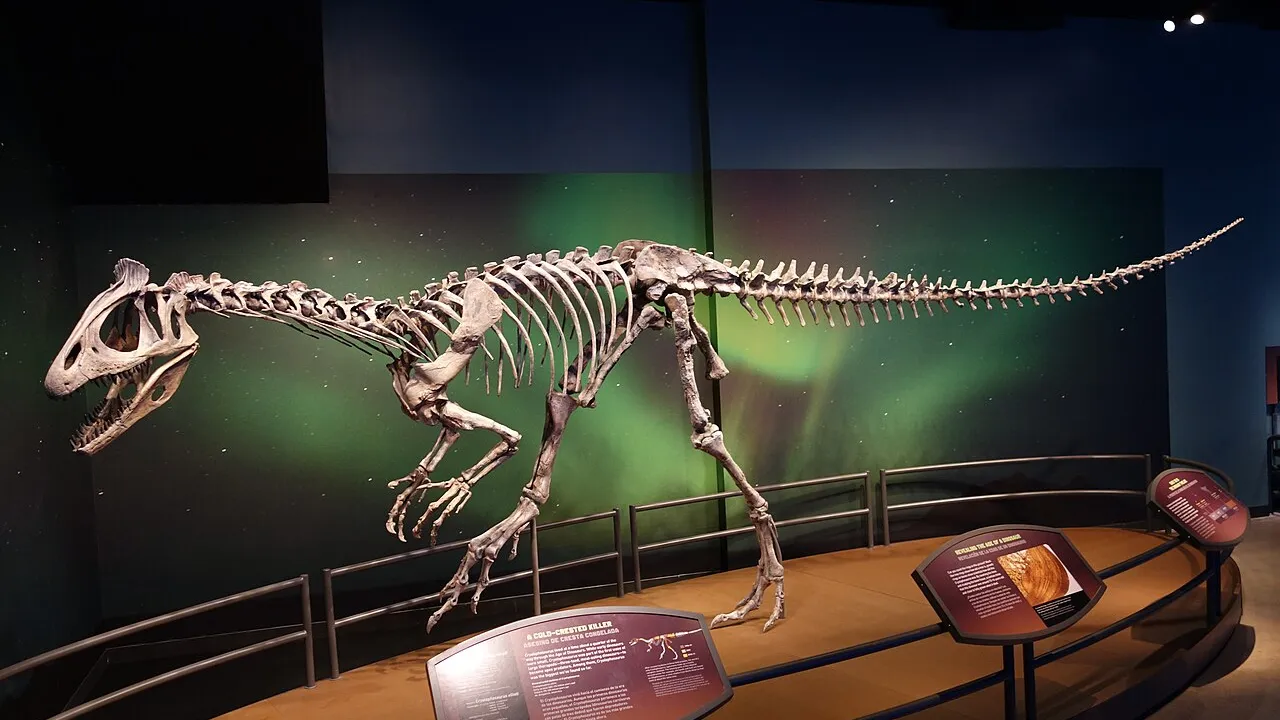
1. Why did scientists give Cryolophosaurus the funny nickname Elvisaurus?
2. What was Antarctica like when Cryolophosaurus lived there?
🤯 Mind-Blowing Fact • Grade 2
Temperatures dropped well below freezing while scientists used rock saws and helicopters to airlift Cryolophosaurus fossils off Mount Kirkpatrick!
✨ Word Sparks (Grade 2 Glossary)
Tap 🔊 to hear
jackhammer
a strong power tool that breaks rock
fragile
thin and delicate, breaking easily if bumped
airlift
to carry heavy cargo away by helicopter
🪝
How do paleontologists dig up a dinosaur skeleton at thirteen thousand feet on an icy Antarctic mountain?
1
Frozen Crest Lizard
Bundle up tight! In 1991, geologists exploring snowy Mount Kirkpatrick—just four hundred miles from the South Pole—spotted giant bones sticking out of frozen rock! Paleontologist William Hammer battled biting winds with to rescue the first meat-eating dinosaur ever found in Antarctica, naming it Cryolophosaurus, or frozen-crested lizard.
2
Built for Show, Not Crashing
Unlike most crested hunters whose ridges ran front to back along the nose, the thin grooved crest of Cryolophosaurus stretched sideways from eye to eye! Because the bone was wafer-thin, it was clearly meant for colorful display rather than head-butting.
3
Ruler of Cool Woods
Measuring over twenty-one feet long, Cryolophosaurus was one of the largest land predators of the Early Jurassic!
2. Why couldn't Cryolophosaurus use its head crest as a weapon for ramming?
🤯 Mind-Blowing Fact • Grade 3
Long-necked herbivore bones from Glacialisaurus were found in the exact same Antarctic mountain quarry as Cryolophosaurus!
✨ Word Sparks (Grade 3 Glossary)
Tap 🔊 to hear
furrowed
marked with neat parallel grooves or ridges
temperate
mild climate without extreme heat or ice
pterosaur
a winged flying reptile living alongside dinosaurs
🪝
What other ancient neighbors shared Antarctica's misty Early Jurassic forests with Cryolophosaurus?
1
A Lost Polar Ecosystem
Step back 190 million years to a time when Antarctica was still joined to South America, Africa, Australia, and India inside southern Gondwana. Sitting slightly farther north than today, its river valleys grew tall conifers, tree ferns, and cycads. Winters brought chilly darkness and frost, yet zero giant ice sheets covered the ground!
2
One-of-a-Kind Headgear
Stalking through those misty evergreens came twenty-two-foot Cryolophosaurus ellioti. Rising straight across its forehead between two small hornlets was a bony fan shaped like an ornate Spanish comb. Covered in bright keratin in life, that crest flashed vivid signals to other Cryolophosaurus.
3
Crowded Fossil Quarry
Alongside its skeleton in the Hanson Formation, scientists found teeth and bones of the long-necked plant-eater Glacialisaurus, flying , and mammal-like tritylodonts!
4
Early Giant Among Hunters
Weighing nearly half a ton, Cryolophosaurus proved theropod predators grew big very early in the Jurassic Period.
1. How was the crest of Cryolophosaurus positioned differently from almost all other theropod crests?
2. Which plant-eating neighbor shared ancient Antarctica with Cryolophosaurus?
🤯 Mind-Blowing Fact • Grade 4
Because Mount Kirkpatrick sits more than 12,500 feet above sea level in Antarctica, paleontologists can only excavate there during brief summer weeks when helicopters can fly!
✨ Word Sparks (Grade 4 Glossary)
Tap 🔊 to hear
transverse
extending crosswise from one side to another
lacrimal
skull bone right in front of eyes
courtship
displays used by animals to attract mates
🪝
Why did Early Jurassic predators suddenly sprout dramatic head crests right after a global extinction?
1
Rise of the First Giant Theropods
When volcanic eruptions triggered the end-Triassic extinction 201 million years ago, giant land-dwelling crocodile relatives vanished, leaving top predator jobs wide open across Earth. Within ten million years, theropod dinosaurs surged in body size! Near the southern edge of Gondwana, Cryolophosaurus ellioti reached nearly seven meters in length and close to half a metric ton, reigning as apex predator of Antarctica's Hanson Formation.
2
Anatomy of the Transverse Crest
Detailed preparation of the Mount Kirkpatrick skull revealed how its famous pompadour formed: upturned extensions of the bones fused across the forehead between two short brow horns, curling forward in fluted vertical grooves. In life, a colorful keratin sheath would have extended this fan even higher, creating unmistakable species-recognition and displays in dim forest light.
3
Fossil Clues to Ancient Meals
Inside the Cryolophosaurus quarry, paleontologists discovered long cervical ribs of a sauropodomorph lying beside shed theropod teeth, plus a mammal-cousin tritylodont tooth nearby—painting a vivid food-web portrait of polar scavengers and hunters sharing carcasses along cool forested riverbanks.
4
Bridge on the Family Tree
Combining primitive hip traits with advanced tetanuran-like skull windows, Cryolophosaurus captures the evolutionary step between early coelophysoids and later Jurassic giants that soon spread across every continent on Earth.
1. What major event opened the door for theropods like Cryolophosaurus to become giant apex predators?
2. Which skull bones grew upward and fused to build the sideways crest of Cryolophosaurus?
🤯 Mind-Blowing Fact • Grade 5
Unfused backbone sutures on the famous 21-foot Cryolophosaurus skeleton reveal it was still a subadult teenager when it died, meaning full-grown adults grew even larger!
✨ Word Sparks (Grade 5 Glossary)
Tap 🔊 to hear
parasagittal
running lengthwise parallel to the body midline
agonistic
relating to rival pushing or fighting behavior
austral
relating to Earth's southern polar hemisphere
🪝
How did excavating a 190-million-year-old predator at 4,000 meters in the Transantarctic Mountains reshape theropod evolution?
1
High-Altitude Paleontology Near the Pole
During the 1990–1991 summer, geologist David Elliot spotted fossilized bone protruding from Pliensbachian volcaniclastic siltstones high on Mount Kirkpatrick in Antarctica's Central Transantarctic Mountains. Summoned to the 4,000-meter outcrop, paleontologist William Hammer and his team braved minus-thirty-degree-Celsius windchills with rock saws and explosives to extract a skull, pelvis, femur, and vertebrae—formally naming Cryolophosaurus ellioti in 1994 as Antarctica's first non-avian theropod.
2
Unique Morphology of the Lacrimal Crest
Whereas Dilophosaurus and Monolophosaurus bore or midline crests aligned lengthwise down the snout, Cryolophosaurus evolved a transversely oriented, anteriorly curled cranial fan spanning the interorbital roof. Constructed from thin, fluted upward laminae of the lacrimals flanked by short postorbital-lacrimal horns, the structure lacked biomechanical strength for ramming, serving instead as a keratin-clad socio-sexual signaling ornament.
3
Phylogenetic Mosaic in Early Neotheropoda
Early descriptions grouped Cryolophosaurus among tetanurans because of its tall, shortened skull proportions. Subsequent comprehensive cladistic analyses by Nathan Smith, Hammer, and Philip Currie demonstrated that its skeleton blends derived averostran cranial traits with plesiomorphic dilophosaur-grade femoral and pelvic features—positioning Cryolophosaurus as a pivotal transitional neotheropod near the base of Averostra.
4
Subadult Holotype and Adult Scale
Neurocentral suture closure indicates the 6.5-meter, 465-kilogram holotype had not yet finished growing, implying fully mature individuals exceeded seven meters in length and rivaled later Middle Jurassic apex carnivores in stature.
5
Temperate Gondwanan Refugia
Situated near sixty to sixty-five degrees south paleolatitude during the Early Jurassic greenhouse climate, the Hanson Formation supported lush podocarp-fern woodlands inhabited by massopodan sauropodomorph Glacialisaurus, dimorphodontid pterosaurs, and synapsid tritylodontids across cool seasonal river valleys.