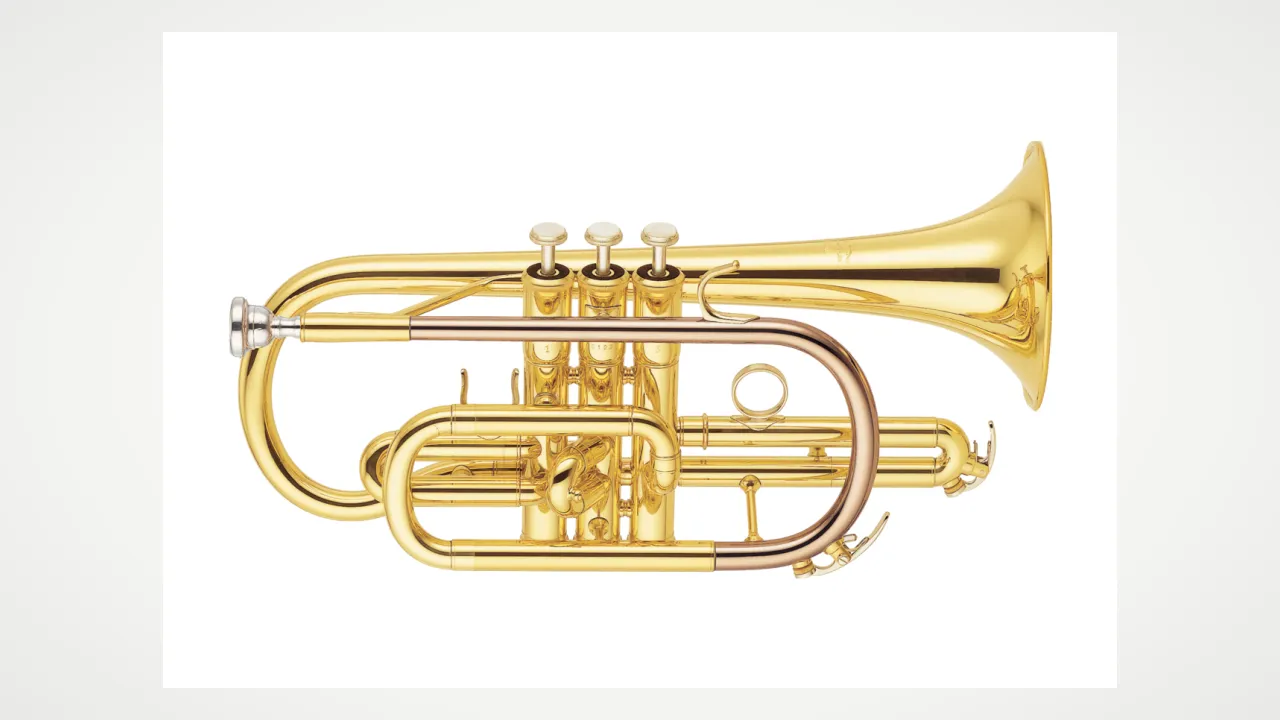
1. Why does a cornet look shorter than a trumpet even though it plays the exact same notes?
2. How does a cornet sound compared to a bright, blasting trumpet?
🤯 Mind-Blowing Fact • Grade 2
Jazz superstar Louis Armstrong actually played his earliest famous 1920s recordings on a cornet before switching to the louder trumpet!
✨ Word Sparks (Grade 2 Glossary)
Tap 🔊 to hear
posthorn
Small coiled brass horn carried on mailcoaches
shepherd's crook
Graceful S-bend in tubing beneath cornet bell
agile
Able to leap and move very quickly
🪝
How did a mail coach horn that announced arriving letters turn into the star of brass bands and early jazz?
1
Mail Call on Horseback!
Two hundred years ago in Europe, stagecoach guards blew a small coiled brass horn called a to shout that the mail had arrived! Around 1828 in Paris, clever makers added three piston valves to that little horn, inventing the cornet.
2
Spot the Shepherd's Crook
How can you recognize a classic British brass-band cornet from across the room? Peek right underneath the bell tail for a graceful S-shaped curve called a !
3
Widening Inside
While a trumpet's tube stays mostly straight and narrow, a cornet's tube widens bit by bit from a deeper mouthpiece all the way to the bell—making fast melodies smooth, nimble, and velvety.
1. Which everyday working horn did Parisian makers add valves to when inventing the cornet?
2. What curved shape underneath the bell helps you spot a classic British cornet?
🤯 Mind-Blowing Fact • Grade 3
Jean-Baptiste Arban's 1864 cornet method book was so thorough that trumpeters and brass players around the world still call it 'the brass player's bible' today!
✨ Word Sparks (Grade 3 Glossary)
Tap 🔊 to hear
triple-tonguing
Rapid 'tu-tu-ku' tongue motion for fast triplets
slur
Glide smoothly between notes without re-tonguing
taper
Gradual widening or narrowing along a tube
🪝
Why did nineteenth-century audiences gasp at cornet solos while orchestral trumpets played slow background chords?
1
Virtuoso Superstar of the 1800s
When valves were brand-new in the 1830s, many symphony trumpeters distrusted buttons and stuck to long, clumsy crooks. Meanwhile, daring soloists like Jean-Baptiste Arban grabbed the nimble new three-valve cornet and dazzled crowds with fireworks of triple-tongued notes!
2
Conical vs. Cylindrical Physics
Both B-flat trumpets and cornets measure roughly 148 centimeters unrolled and share identical fingerings. Yet a cornet starts with a deeper, V-leaning mouthpiece cup and expands conically along most of its length. That steady softens harsh upper harmonics and lets glide effortlessly between registers.
3
First Voice of New Orleans Jazz
On vibrant New Orleans parade streets around 1900, pioneers Buddy Bolden, Freddie Keppard, and King Oliver chose the agile cornet to weave bluesy, vocal improvisations above marching drums and clarinets.
4
Lead Violin of the Brass Band
In British-style championship brass bands—where zero violins, flutes, or clarinets appear—nine cornets carry the soaring, lightning-fast lead melodies just like an orchestral violin section!
1. What role does the cornet section play in a traditional British brass band?
2. Why is slurring smoothly up and down across intervals slightly easier on a cornet than on a trumpet?
🤯 Mind-Blowing Fact • Grade 4
Composer Igor Stravinsky loved the cornet's nimble bite so much that he made it one of just seven solo instruments in his famous chamber tale 'The Soldier's Tale'!
✨ Word Sparks (Grade 4 Glossary)
Tap 🔊 to hear
shank
Narrow tapered stem of a brass mouthpiece
cross-section
Slice showing width inside a hollow tube
soprano cornet
Higher E-flat cornet crowning brass band chords
🪝
Why did French Romantic composers write side-by-side parts for two trumpets AND two cornets in the very same symphony orchestra?
1
Two Distinct Voices in Paris
Open Hector Berlioz's Symphonie fantastique, Georges Bizet's Carmen, or Tchaikovsky's Swan Lake and check the brass staves: right beside two heroic trumpets sit two agile cornets a pistons! Nineteenth-century French, Russian, and Italian composers prized that contrast—pairing blazing cylindrical trumpet fanfares with lyrical, nimble conical cornet solos.
2
Anatomy of Bore Taper and Bends
Trace the air column from the receiver of an authentic shepherd's-crook cornet: after passing through a narrower and deep cup mouthpiece, the tubing expands continuously across four gentle 180-degree bows rather than two tight trumpet turns. Softer bends plus rising cross-sectional area dampen high partials above 2,500 hertz, wrapping every note in golden warmth.
3
Soprano E-Flat Crown and Concert Band Fame
Sitting beside nine B-flat cornets in championship British brass bands is a smaller jewel: the high E-flat , pitched a fourth higher to crown massive brass chords with crystalline silver shimmer, while American park bands cheered golden-age soloists like Herbert L. Clarke.
4
Poetic Jazz Stylists
Even after 1930s big bands adopted louder, more directional trumpets to project over full saxophone sections in cavernous ballrooms, poetic jazz stylists like Bix Beiderbecke, Rex Stewart, Ruby Braff, and Nat Adderley cherished the cornet's intimate, vocal smoky glow on timeless recordings.
1. Why did composers like Berlioz and Tchaikovsky score both cornets and trumpets together in the same orchestra?
2. Why did most 1930s big bands eventually switch from cornets to trumpets?
🤯 Mind-Blowing Fact • Grade 5
Forging a concert cornet bell from rose brass (85% copper, 15% zinc) instead of standard yellow brass (70% copper, 30% zinc) slightly softens wall stiffness to warm its lyrical singing tone even further!
✨ Word Sparks (Grade 5 Glossary)
Tap 🔊 to hear
attenuated
Reduced or softened in strength and intensity
rose brass
Warm reddish alloy rich in extra copper
input impedance
Acoustic pushback felt by buzzing lips
🪝
How do subtle differences in bore profile—within identical 148-centimeter B-flat tubing—separate the cornet, trumpet, and flugelhorn into three distinct acoustic worlds?
1
Middle Ground of the Soprano Labrosones
Float a single lyrical phrase into a Victorian concert hall and trained ears immediately distinguish the warm, vocal halo of a cornet from a trumpet's metallic edge. Assigned to Hornbostel-Sachs 423.232/233, the B-flat cornet—created around 1828 in Paris by Jean-Louis Antoine (Halary) by fitting Stolzel valves to the circular cornet de poste—occupies the exact acoustic midpoint between cylindrical trumpets and wide-bore flugelhorns.
2
Conical Percentage and Wave-Steepening Suppression
Although unrolled tube length (~148 centimeters, fundamental pedal B-flat1, practical range concert E3 at 164.8 hertz to C6 at 1,046.5 hertz) matches the B-flat trumpet millimeter for millimeter, internal geometry diverges sharply. Whereas a trumpet stays cylindrical for roughly seventy percent of its path, an authentic short-model cornet expands conically across more than fifty to sixty percent of its length—widening steadily from a small ~9.5-millimeter leadpipe throat through conical tuning slides into the bell. Because acoustic pressure drops rapidly as cross-sectional area expands, nonlinear shock-wave steepening is significantly , yielding softer high-frequency rolloff above 2.5 kilohertz.
3
Mouthpiece Physics and Slotting Flexibility
Authentic cornet mouthpieces pair a shorter, narrower backbore shank with a deep V-cup profile. That larger cup volume lowers the mouthpiece's Helmholtz resonance (~700–750 hertz), broadening peaks slightly so lip-slurs, rapid triple-tonguing, and wide interval leaps 'flex' cleanly without brittle cracking.
4
Trigger Compensation and Brass Band Symphonism
Modern championship cornets—frequently hand-hammered from warm containing eighty-five percent copper and fifteen percent zinc—incorporate spring-loaded first- and third-valve thumb and finger triggers to micro-correct sharp multi-valve combinations in real time across demanding British brass band test pieces by Edward Elgar, Gustav Holst, Ralph Vaughan Williams, and Philip Sparke.
5
Dual Heritage in Classical and Jazz
Immortalized in dazzling theme-and-variation showpieces by Jean-Baptiste Arban and John Philip Sousa's star soloist Herbert L. Clarke, Romantic orchestral scores from Bizet's Carmen to Stravinsky's Petrushka, and King Oliver's and Bix Beiderbecke's seminal jazz recordings, the cornet proves how profoundly millimeter tapers shape musical soul.