🌋 Where It FormsGlobal Atmosphere & Ocean Basins on Rotating Planets
💎 Key PropertiesCurves Right in Northern Hemisphere • Curves Left in Southern Hemisphere • Zero at Equator
⚡ Planet Earth SparkTurns straight-moving global winds and ocean currents into giant swirling storms and ocean gyres
🤯 Mind-Blowing Fact • Grade 1
Big hurricanes north of the equator spin opposite to cyclones south of the equator because of Earth's rotation!
✨ Word Sparks (Grade 1 Glossary)
Tap 🔊 to hear
rotate
Spin around an imaginary center line
curve
Bend smoothly away from a straight line
planet
Large round world orbiting a star
🪝
What happens if you roll a ball across a spinning merry-go-round?
1
Rolling on a Spinning Ride
Spin slowly on a playground merry-go-round and roll a ball to your friend! To your eyes, the ball away to the side. Earth spins too, and that curve is the Coriolis effect!
2
Curving the Wind
Long winds try to blow in a straight line across Earth. Because our turns underneath them, the winds gently instead!
3
Not in Your Sink!
Only giant storms like hurricanes feel this big spin. Tiny bathroom sinks are much too small for Earth's turn to steer!
2. Does the Coriolis effect decide which way water drains in your small bathroom sink?
🤯 Mind-Blowing Fact • Grade 2
Right on Earth's equator, the ground beneath your shoes spins eastward at more than 1,030 miles per hour—even though you cannot feel it!
✨ Word Sparks (Grade 2 Glossary)
Tap 🔊 to hear
hemisphere
Half of the round Earth globe
spiral
Winding curve circling around a center
globe
Round sphere model of planet Earth
🪝
Why does Earth's equator travel more than a thousand miles per hour while the North Pole barely moves sideways?
1
Different Speeds on One Round Ball
Hold a basketball and spin it once around on your finger! A sticker on its fat middle equator travels a huge circle fast, while a sticker near the top pole makes only a tiny slow circle. Earth spins once every twenty-four hours the exact same way.
2
Right in the North, Left in the South
When wind travels hundreds of miles over our spinning , the ground underneath moves at different eastward speeds. In the Northern , winds and currents curve to the right. In the Southern Hemisphere, they curve to the left!
3
Spinning Up Giant Storms
Without the Coriolis effect, winds would rush straight into low pressure and fill it up. Instead, curving winds around the center, creating swirling hurricanes!
1. Which way do long-distance winds curve in the Northern Hemisphere where the United States is located?
2. Where on Earth does the surface spin eastward at the fastest speed?
🤯 Mind-Blowing Fact • Grade 3
Even though warm tropical water covers the equator, zero hurricanes have ever formed or crossed right along the zero-degree equator line!
✨ Word Sparks (Grade 3 Glossary)
Tap 🔊 to hear
deflection
Sideways bending of a moving path
counterclockwise
Spinning opposite to clock hands' motion
mathematician
Scientist who solves problems using math
🪝
Why can hurricanes NEVER form right on top of the equator?
1
Named After a French Engineer
In 1835, French and engineer Gaspard-Gustave de Coriolis studied how objects move on spinning machines like waterwheels. Weather scientists soon realized his math explained why global winds and ocean currents curve across our rotating planet!
2
Why Opposite Hemispheres Spin Opposite Ways
Suppose a package of air starts near the equator—already moving east at 1,000 miles per hour with the ground—and heads north toward Virginia, where the ground moves east at only 800 miles per hour. Because the air keeps its extra eastward speed, it pulls ahead to the right! Air heading south in the Southern Hemisphere pulls ahead to the left.
3
Counterclockwise vs. Clockwise Storms
Surprisingly, Northern Hemisphere hurricanes spin even though individual winds curve right! As air rushes inward from all sides toward low pressure and curves right just before reaching the center, the whole ring ends up whirling counterclockwise.
4
Zero Spin at the Equator
Right along zero degrees latitude, horizontal Coriolis turning drops to zero, so hurricanes never form within about three hundred miles of the equator!
1. Why do hurricanes never form right on Earth's equator?
2. Which way does a hurricane spin in the Northern Hemisphere versus a cyclone in the Southern Hemisphere?
🤯 Mind-Blowing Fact • Grade 4
In science museums from Richmond, Virginia, to Paris, France, giant swinging Foucault pendulums slowly knock over a circle of pegs as Earth rotates underneath them!
✨ Word Sparks (Grade 4 Glossary)
Tap 🔊 to hear
apparent
Seeming to happen from viewer's viewpoint
gyre
Giant circular loop of ocean currents
pendulum
Weight swinging back and forth freely
🪝
Why do museum pendulums knock down pegs in a circle—and why did we bust the toilet-swirl myth?
1
An Apparent Force From Reference Frames
Stand outside a spinning playground carousel watching from the grass, and a tossed ball flies in a dead-straight line through the air. Only to riders sitting ON the turning carousel does the ball appear to curve! Physicists call the Coriolis effect an (or inertial) force because nothing physically shoves the wind sideways; instead, we observe the sky from a rotating planet whose tangential speed drops from 1,037 mph at the equator to 790 mph across Virginia and 0 mph at the poles.
2
What Controls Its Strength?
Two factors strengthen Coriolis deflection: higher latitude closer to the poles, and faster travel over long distances and hours. That explains why flushing toilets and kitchen sinks NEVER care which hemisphere they are in! Water crosses a sink basin in two seconds at one mile per hour—millions of times too brief for Earth's 24-hour rotation to overcome tiny tilts in the bowl or faucet jets.
3
Sculpting Ocean Gyres and Wind Belts
Over thousands of miles, however, Coriolis turning shapes our whole planet: curving trade winds westward, bending the Gulf Stream clockwise around the North Atlantic , and spinning low-pressure storms counterclockwise across North America.
4
Foucault's Famous Pendulum
In 1851, French physicist Léon Foucault hung a heavy iron bob on a long wire in Paris; as Earth rotated underneath its steady swing, it knocked down pegs around a ring—proving Earth's spin indoors!
1. Why do scientists call the Coriolis effect an 'apparent' force rather than a real push?
2. Where on Earth is horizontal Coriolis deflection strongest?
🤯 Mind-Blowing Fact • Grade 5
Scientists use a math ratio called the Rossby number to prove that local swirl inside a bathtub drain is roughly ten thousand times stronger than the Coriolis effect!
✨ Word Sparks (Grade 5 Glossary)
Tap 🔊 to hear
isobar
Map line connecting equal air pressures
inertial
Continuing straight motion unless pushed aside
synoptic
Continent-sized weather scale spanning hundreds of miles
🪝
How does one simple trigonometric formula—the Coriolis parameter—explain why Jupiter has twelve wind belts while Earth has three?
1
Mathematics of the Rotating Frame
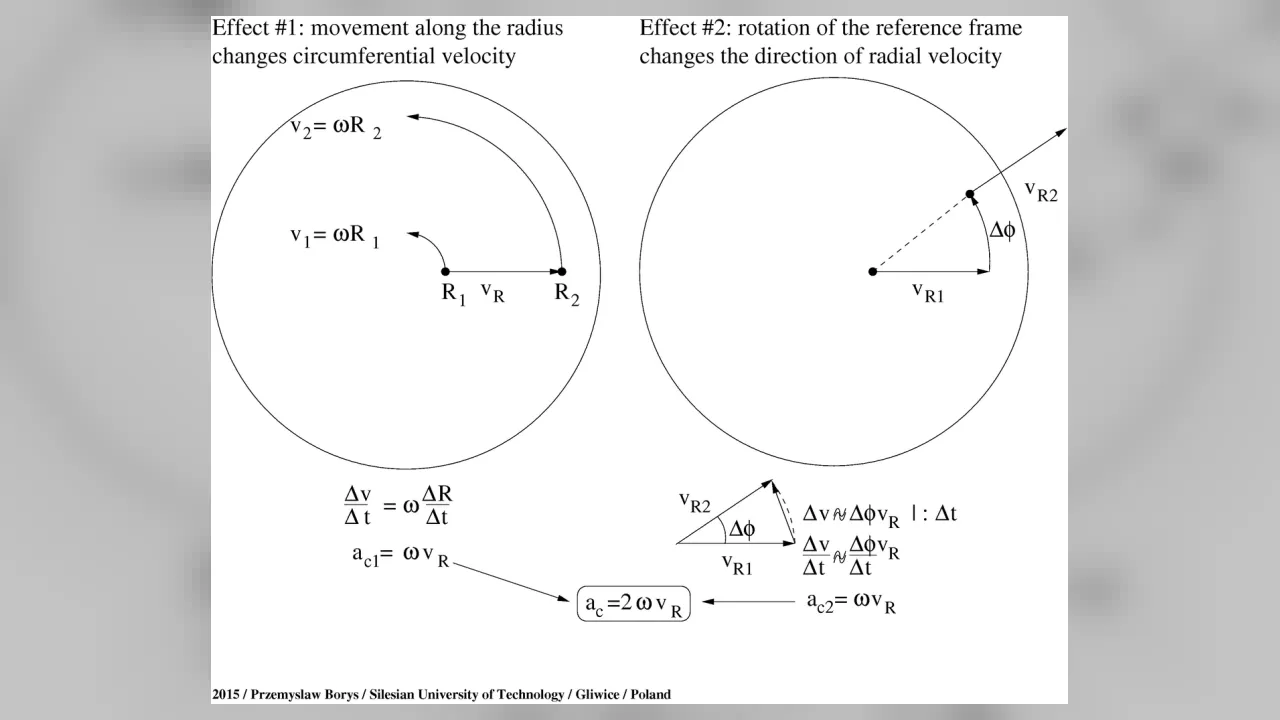
When Gaspard-Gustave de Coriolis published his 1835 equations for rotating machinery, he quantified the apparent acceleration experienced in a non- rotating frame: $a_c = -2\,\vec{\Omega} \times \vec{v}$. For horizontal atmospheric and oceanic motion at latitude $\phi$ on Earth (angular rotation rate $\Omega = 7.292 \times 10^{-5}$ radians per second), meteorologists isolate the Coriolis parameter $f = 2\Omega\sin\phi$. Because $\sin(0^\circ) = 0$ and $\sin(90^\circ) = 1$, horizontal Coriolis acceleration vanishes completely at the equator, increases toward maximum magnitude at the poles, and scales directly with wind or current velocity $v$.
2
The Rossby Number Test
How do fluid dynamicists prove mathematically whether a vortex feels Earth's rotation? They compute the dimensionless Rossby number, $Ro = U / (fL)$, comparing flow speed $U$ against length scale $L$ times $f$. For a low-pressure system ($U \approx 15\text{ m/s}$, $L \approx 1{,}000\text{ km}$), $Ro \approx 0.15$—meaning planetary rotation dominates! For a draining bathtub ($U \approx 0.5\text{ m/s}$, $L \approx 0.5\text{ m}$), $Ro \approx 10{,}000$, proving Earth's rotation is ten thousand times weaker than tiny basin asymmetries.
3
Geostrophic Balance and Isobars
Above surface friction (roughly 1 kilometer altitude), pressure gradient forces accelerating air from high toward low pressure balance Coriolis deflection exactly. Consequently, upper-level geostrophic winds blow parallel to rather than straight across them—explaining jet streams and spinning cyclones.
4
Ekman Spirals and Coastal Upwelling
In the ocean, surface winds plus Coriolis turning and water friction twist currents into an Ekman spiral, transporting net upper-layer water 90 degrees right of the wind off California and pulling cold, nutrient-rich water upward.
5
Planetary Rotation Across the Solar System
Slowly rotating Venus (one turn every 243 Earth days) experiences weak Coriolis deflection and just one giant hemispheric cell, whereas eleven-times-wider Jupiter spins in under ten hours, slicing its clouds into dozens of dazzling alternating bands!