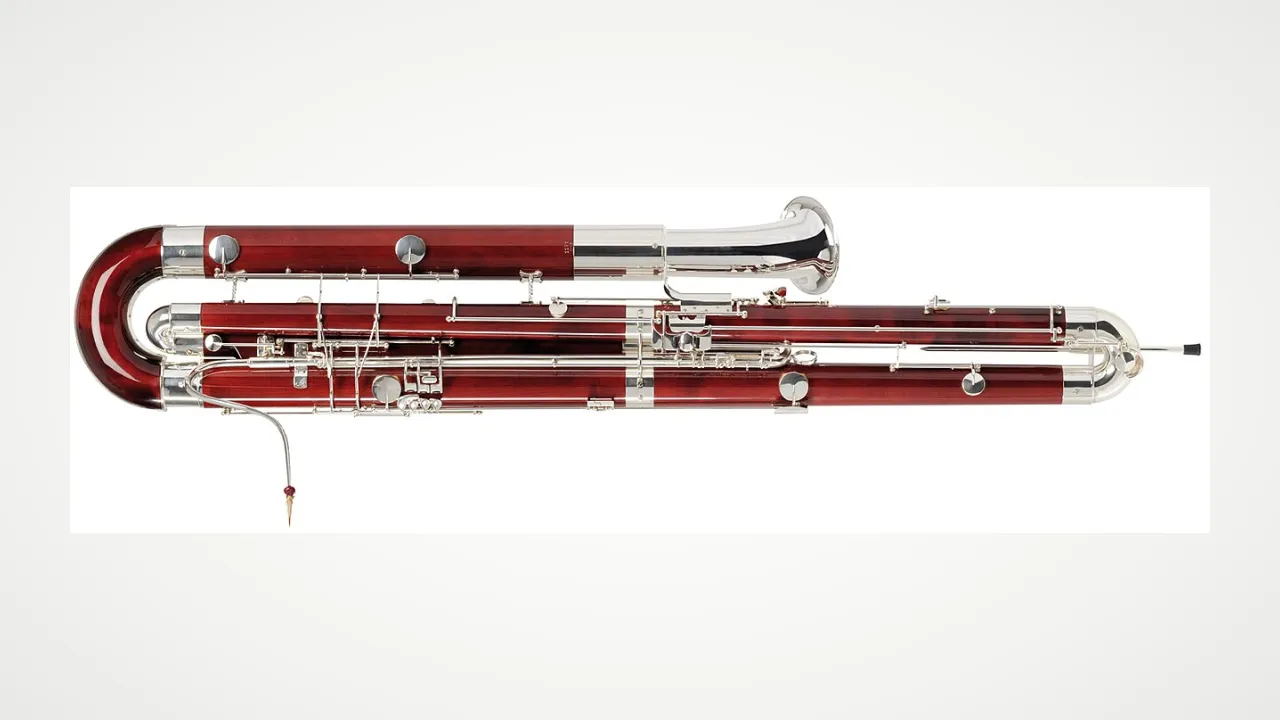
1. About how long would a contrabassoon's air tunnel stretch if you unfolded every bend?
2. How does the contrabassoon rank in pitch among standard orchestra woodwinds?
🤯 Mind-Blowing Fact • Grade 2
On the contrabassoon's lowest notes, the double reed flaps fewer than thirty times per second—slow enough to feel like a purring engine!
✨ Word Sparks (Grade 2 Glossary)
Tap 🔊 to hear
endpin
Sturdy floor rod holding heavy instruments upright
double bassoon
Another name for the octave-lower contrabassoon
sub-bass
Extra-deep pitches felt as physical vibrations
🪝
How do builders pack an eighteen-foot wooden tunnel into an instrument one seated musician can play?
1
The Friendly Beast of the Orchestra
Grrrr-hum! When French composer Maurice Ravel told the story of Beauty and the Beast in music, he chose one rumbling giant to play the gentle Beast: the contrabassoon, also called the .
2
Doubling the Bassoon's Tunnel
Because its maple and metal air pipe is twice as long as a regular bassoon's, every single note sounds a full octave lower! Clever brass U-bends fold those eighteen feet into nested vertical loops resting on a sturdy floor spike.
3
Giant Reed, Slow Waves
Its double reed is nearly twice as wide as an oboe's, flapping slowly enough that you can almost count the buzzes on its deepest piano-bottom notes!
1. Which fairy-tale character did Maurice Ravel give to the contrabassoon in his Mother Goose Suite?
2. Compared to a standard bassoon, how much lower does a contrabassoon sound?
🤯 Mind-Blowing Fact • Grade 3
A contrabassoon weighs around twenty pounds—about as heavy as a bowling ball—so players never hang it from their necks!
✨ Word Sparks (Grade 3 Glossary)
Tap 🔊 to hear
extension bell
Longer swap-on bell unlocking deeper bottom notes
water key
Little corked lever draining collected breath moisture
fundamental
Lowest main pitch of a vibrating air column
🪝
Why do some contrabassoons curl their metal bells toward the floor while others point toward the ceiling?
1
Subterranean Thunder
Close your eyes during Beethoven's Fifth Symphony and feel a gravelly vibration rolling beneath the cellos and double basses like distant tectonic plates. That floor-shaking foundation belongs to the contrabassoon—the towering elder of the double-reed family.
2
Four Parallel Tubes of Maple
Unwinding a contrabassoon's conical bore would stretch about 5.5 meters across the stage! To shrink that giant pipe to roughly 1.6 meters tall, builders fold seasoned maple tubes back and forth multiple times with gleaming brass U-joints and support its twenty-pound weight on a steel endpin.
3
Downward Bell or Tall Bell?
Standard contrabassoons reach down to concert B-flat0 through a curved metal bell that loops gracefully downward. When composers demand an even deeper low A0—matching the bottom key on a grand piano—players swap in a tall upward-pointing !
4
Heckel's Breakthrough
Early giant bassoons leaked air and wobbled out of tune until German makers Wilhelm Heckel and Friedrich Stritter perfected the tightly folded modern design in the late 1800s.
1. Why would a contrabassoonist attach a tall upward-pointing bell instead of the curved downward bell?
2. Which nineteenth-century German workshop perfected the folded modern contrabassoon?
🤯 Mind-Blowing Fact • Grade 4
Unlike smaller woodwinds that tune mainly by pulling joints slightly apart, the contrabassoon has a trombone-style metal tuning slide built right into its upper pipe!
✨ Word Sparks (Grade 4 Glossary)
Tap 🔊 to hear
tuning slide
Sliding metal U-pipe adjusting overall tube length
threshold
Boundary limit where ears first sense pitch
transposing
Sounding a different octave than written notes
🪝
What happens near the edge of human hearing when an eighteen-foot wooden cone vibrates fewer than thirty times a second?
1
At the Edge of Human Pitch
When a contrabassoonist presses down every key and breathes steadily into its wide cane blades, listeners experience something astonishing: individual pulses of air seem to throb in the chest at just twenty-seven to twenty-nine cycles per second! Sitting right near the lower of human pitch perception, this gentle titan anchors the entire orchestral spectrum.
2
Multi-Folded Conical Engineering
one octave below written bassoon notation, the contrabassoon requires a conical air column exceeding 5.5 meters—more than eighteen feet! Early eighteenth-century builders tried stacking straight wooden joints nearly three meters high—like the towering 1714 Stanesby contrabassoon in London—which swayed precariously and leaked through giant finger pads. Between 1877 and 1899, Wilhelm Heckel and foreman Friedrich Stritter solved the puzzle by folding maple and nickel-silver tubing into four compact parallel columns resting solidly on a floor endpin.
3
Tuning Slide, Water Keys, and Giant Reeds
Because five-plus meters of tubing warm up unevenly under stage lights, contrabassoons include a movable metal near the bocal—unusual among woodwinds—plus brass water keys at the bottom U-bends to drain condensed breath. Its massive double reed, roughly 70 millimeters long and 18–20 millimeters wide at the tip, demands steady, relaxed air volume rather than brute force.
4
From Royal Fireworks to Symphonic Triumphs
Handel called for an early contrabassoon in his 1749 Music for the Royal Fireworks, Beethoven unleashed its dark grandeur in the finales of his Fifth and Ninth Symphonies, Brahms wove it into his First Symphony, and Ravel gave it an unforgettable solo heart in Beauty and the Beast.
1. Why does a contrabassoon include brass water keys at its bottom U-bends and a metal tuning slide?
2. Approximately how many times per second does the air vibrate on the contrabassoon's lowest notes?
🤯 Mind-Blowing Fact • Grade 5
At concert A0 (27.5 Hz), a single sound wave leaving a contrabassoon stretches roughly 12.5 meters (41 feet)—wider than many orchestra stages!
✨ Word Sparks (Grade 5 Glossary)
Tap 🔊 to hear
auditory cortex
Brain region processing pitch and sound waves
Contraforte
Modern wide-bored redesign of the classic contrabassoon
subterranean
Deep rumbling quality sounding from underground depths
🪝
How do acoustic harmonic overtones trick your brain into hearing crystal-clear pitch from an eighteen-foot tube pulsing at 27.5 Hz?
1
Sub-Bass Architecture Beneath the Symphony
Beneath the double basses and bass tuba sits an acoustic phenomenon wrapped in flamed maple and silver-plated brass: the contrabassoon. Sounding one full octave below written notation, a modern extended contrabassoon descends to concert A0 (27.5 Hz)—matching the bottommost key of a concert grand piano and generating physical sound waves more than twelve meters (forty feet) long in concert-hall air!
2
Harmonic Richness and the 'Missing Fundamental' Advantage
At frequencies below 35 Hz, a pure sine wave sounds indistinct and muddy to human ears. How, then, does a contrabassoon articulate crisp bass lines with unmistakable pitch focus? Organologically a multi-folded conical double-reed aerophone, its 5.5-to-5.9-meter expanding bore—driven by two hand-scraped Arundo donax blades nearly 20 millimeters wide—generates a dense comb of integer harmonics (55 Hz, 82.5 Hz, 110 Hz, 137.5 Hz, and upward). Even in seats where room acoustics weaken the 27.5 Hz fundamental, the human locks onto that tight harmonic spacing and perceives a razor-sharp sub-bass pitch!
3
From Towering Dulcians to Stritter's Compact Folding
Renaissance makers built monstrous Octave-Dulcians like Hans Schreiber's 1620 Berlin Choristfagott, and Thomas Stanesby Junior crafted a straight 2.5-meter giant in 1739 London for Handel's spectacles. Yet unsealed leather pads and unwieldy reach plagued early models until Friedrich Stritter, working in Wilhelm Heckel's Biebrich factory in 1877–1899, engineered a four-fold maple chassis linked by smooth U-bends, plateau keys on long axles, a main tuning slide, and interchangeable bells—a downward metal bell for B-flat0 (29.14 Hz) or an upright flared bell reaching A0 (27.50 Hz).
4
Modern Innovations: Contraforte
Because traditional contrabassoons taper relatively narrowly above C3, German makers Guntram Wolf and Benedikt Eppelsheim unveiled the in 2001, widening the conical bore taper and resizing tone holes to unlock thunderous dynamic range without sacrificing pianissimo control.
5
Monumental Orchestral Footprints
Whether fortifying the blazing C-major triumph of Beethoven's Fifth Symphony, growling beneath the Ode to Joy march in Beethoven's Ninth, portraying the tender Beast in Ravel's Ma Mère l'Oye, or stalking dark shadows in Benjamin Britten's and Dmitri Shostakovich's symphonies, the contrabassoon grounds orchestral color on bedrock.