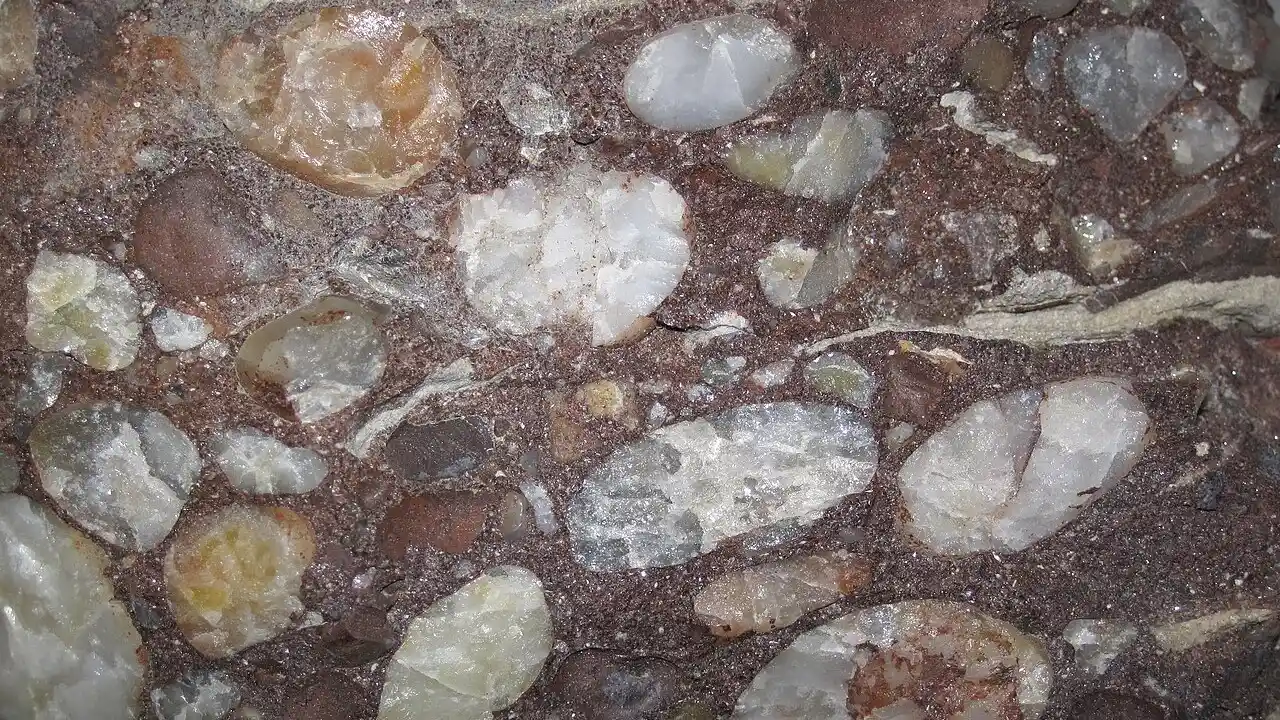
1. Why are the pebbles inside conglomerate rock smooth and round instead of sharp?
2. What human-made material does conglomerate rock look most like?
🤯 Mind-Blowing Fact • Grade 2
NASA's Curiosity rover discovered slabs of rounded-pebble conglomerate on Mars, proving knee-deep streams once flowed swiftly across the Red Planet!
✨ Word Sparks (Grade 2 Glossary)
Tap 🔊 to hear
clast
Individual broken rock piece or pebble inside stone
matrix
Finer sand or mud filling gaps between pebbles
breccia
Rock like conglomerate, but with sharp, jagged pieces
🪝
What secret about an ancient river's speed hides inside every piece of conglomerate?
1
Only Strong Water Can Carry Stones
Gentle pond water can barely move tiny bits of mud. It takes a roaring mountain stream or crashing ocean waves to roll heavy pebbles and cobbles! Whenever you spot conglomerate rock, you know strong, fast water once rushed right through that spot.
2
Pebbles, Matrix, and Cement
Every conglomerate has three parts. First come the big rounded pebbles, called . Second, finer sand or mud—called the —packs between them. Third, dissolved minerals like quartz or iron seep in and harden like glue!
3
Conglomerate's Sharp-Edged Cousin
If broken rocks get glued together BEFORE water can round their sharp corners, geologists call that jagged cousin instead.
1. What does finding a layer of conglomerate tell geologists about that place long ago?
2. How is conglomerate different from its cousin breccia?
🤯 Mind-Blowing Fact • Grade 3
South Africa's Witwatersrand conglomerate beds—ancient river gravels nearly three billion years old—have produced almost forty percent of all the gold ever mined by humanity!
✨ Word Sparks (Grade 3 Glossary)
Tap 🔊 to hear
cobble
Rounded water-worn stone larger than a pebble
alluvial fan
Cone-shaped gravel deposit where mountain streams reach valleys
gravel bar
Bank of pebbles and sand piled by river currents
🪝
Why did builders of the U.S. Capitol carve columns out of multicolored pebble stone?
1
The Two-Millimeter Rule
Pick up a fist-sized piece of conglomerate and measure its pebbles: geologists classify a clastic sedimentary rock as conglomerate when a large share of its rounded gravel clasts exceed two millimeters across—wider than coarse sand, ranging from pea-sized granules up to bowling-ball boulders!
2
A Rock Made of Older Rocks
Look closely at the pebbles inside a single slab, and you might spot milky white quartz, red jasper, gray limestone, and dark basalt all locked side by side. Each pebble eroded from an even older mountain upstream, tumbled miles down a braided river or , and became buried beneath new .
3
Calico Marble Along the Potomac
Along the border of Virginia and Maryland in the Culpeper and Frederick rift basins, 200-million-year-old streams washed limestone and quartz into reddish mud. Polished smooth, this colorful 'Potomac Marble' conglomerate forms famous columns inside Statuary Hall in the U.S. Capitol!
4
Tracking Ancient Gold
Because heavy gold nuggets settle in river gravel alongside pebbles, some ancient conglomerates hold rich buried gold deposits.
1. How wide must the rounded clasts be for geologists to classify a rock as conglomerate rather than sandstone?
2. Why can ancient river conglomerates sometimes contain rich deposits of gold?
🤯 Mind-Blowing Fact • Grade 4
At Cumberland Gap on Virginia's western tip, massive cliffs of 300-million-year-old white-pebble conglomerate stood guard over the historic trail used by Native Americans and pioneers!
✨ Word Sparks (Grade 4 Glossary)
Tap 🔊 to hear
imbrication
Shingle-like overlapping of flat pebbles showing current direction
clast-supported
Texture where pebbles touch each other directly
polymictic
Conglomerate containing pebbles of many different rock types
🪝
How can tilted pebbles inside a conglomerate cliff point like arrows toward a vanished mountain range?
1
Pebble Imbrication: Nature's Current Compass
Walk up to an Appalachian cliff of Pennsylvanian Pottsville or Lee Conglomerate, where dazzling white quartz pebbles stud tough gray sandstone. Notice how flatish pebbles overlap like roof shingles, tilting consistently in one direction! Geologists call this shingle-stacking : rushing river water tips flat cobbles so they lean upstream, letting scientists reconstruct the exact flow direction of rivers that vanished 310 million years ago.
2
Clast-Supported Versus Matrix-Supported Textures
How pebbles touch reveals how they arrived. When strong river currents or beach waves wash fine mud away so rounded pebbles rest directly against one another, the rock is conglomerate. When sudden debris flows or glacial meltwater slurries dump cobbles suspended inside abundant mud without touching, geologists call it matrix-supported paraconglomerate.
3
Polymictic Clues to Tectonic Uplift
A conglomerate packed with many fragile rock types—limestone, granite, shale, and volcanic clasts—is termed , signaling steep mountains eroding close by. By contrast, an oligomictic conglomerate holding almost 100 percent ultra-hard vein-quartz pebbles proves intense chemical weathering and long river transport destroyed every weaker stone.
4
Appalachian Plateau Rimrock
In southwestern Virginia and Kentucky—including Breaks Interstate Park and Cumberland Gap—thick, quartz-cemented Lee Conglomerate forms towering white cliffs resistant to erosion.
1. How does pebble imbrication help geologists reconstruct ancient landscapes?
2. What does a conglomerate containing almost 100% hard white quartz pebbles tell us compared to one full of fragile shale and limestone pebbles?
🤯 Mind-Blowing Fact • Grade 5
By measuring pebble sizes and roundness in the 'Hottah' conglomerate on Mars, NASA geologists calculated both the ankle-to-hip water depth and walking-pace current speed of a stream that dried up over three billion years ago!
✨ Word Sparks (Grade 5 Glossary)
Tap 🔊 to hear
rudite
Any coarse clastic sedimentary rock with gravel-sized fragments
unconformity
Buried erosion surface representing a gap in geologic time
bedload
Heavy sand and gravel rolled along a streambed
🪝
How did geologists calculate the exact depth and speed of a 3.5-billion-year-old Martian stream just by measuring pebbles in conglomerate?
1
Hydrodynamic Thresholds and Hjulström's Curve
Stand before a cliff of coarse cobble conglomerate, and fluid mechanics comes to life in solid stone. On the Wentworth scale, contain rounded granules (2–4 mm), pebbles (4–64 mm), cobbles (64–256 mm), and boulders (>256 mm). According to Hjulström's and Shields' sediment-transport equations, entraining a 5-centimeter pebble requires turbulent bottom shear velocities exceeding one meter per second—far beyond calm lakes or wind! Rounding sharp rock corners by abrasion further proves sustained fluvial or littoral transport over kilometers.
2
Syntectonic Molasse and Unconformity Markers
In basin stratigraphy, basal conglomerates frequently rest directly atop major erosional unconformities, marking where advancing seas or rejuvenated rivers swept across beveled bedrock. During continental collisions—such as the Alleghanian Orogeny that raised the Appalachians or Cenozoic uplift of the Alps and Himalayas—eroding thrust sheets shed kilometeters-thick wedges of braided-river conglomerate called molasse into adjacent foreland basins.
3
Provenance Fingerprinting via Detrital Clasts
Each cobble inside a conglomerate acts as a time capsule from an eroded mountain belt that may no longer exist. By radiometrically dating detrital zircons inside granitic clasts, geologists reconstruct vanished source terrains across drifted continents.
4
Paleoplacer Ore Concentration
Hydraulic sorting in high-energy braided channels concentrates high-density minerals—native gold, uraninite, cassiterite, and diamond—into basal conglomerate lags like South Africa's Archean Witwatersrand reef.
5
Curiosity's 'Hottah' Outcrop on Mars
In 2012, NASA's Curiosity rover imaged the 'Link' and 'Hottah' conglomerates on Mars: rounded basaltic pebbles 2 to 40 millimeters across cemented in coarse sand. Applying terrestrial Shields' shear-stress physics adjusted for Mars's one-third gravity, scientists proved water once flowed ankle- to hip-deep at roughly 0.2 to 0.75 meters per second across an ancient Martian alluvial fan!