🦴 PREHISTORIC
🦴 Concavenator corcovatus • Carcharodontosauridae
VA Science SOL 2.5, 3.4, 3.5, 5.8 (Fossils, Adaptations & Earth History)
Concavenator
Spain's Shark-Finned Hunter With Mysterious Arm Bumps
Grade 4 • Expanding • 199 words
🌋 Geologic Period & RegionEarly Cretaceous (130–125 MYA) • Cuenca, Central Spain
📏 Size & Weight19–20 ft (5.8–6 m) long • 700–880 lbs (320–400 kg)
🦴 Diet & FossilsCarnivore • La Huerguina Formation (Las Hoyas)
⚡ Survival SuperpowerPointed shark-fin-like lower back hump plus bird-style foot pads and forearm bumps
🤯 Mind-Blowing Fact • Grade 1
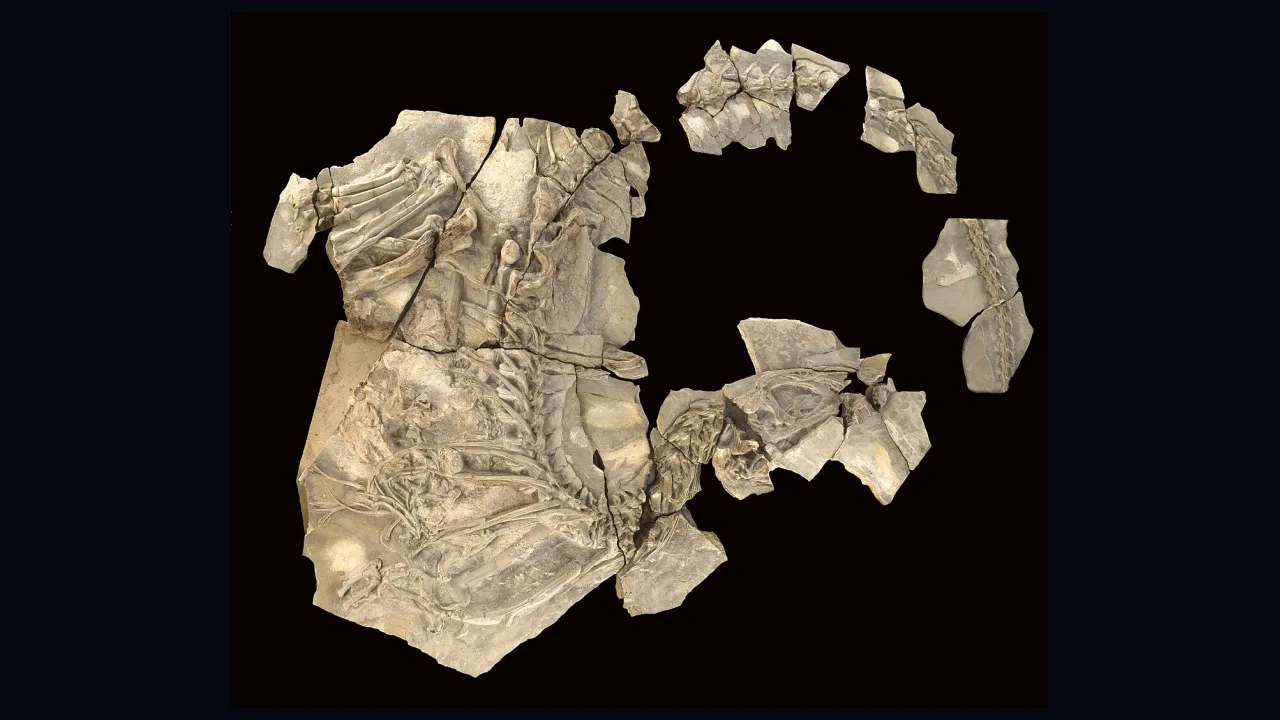
Fine mud in Spain preserved the actual scaly skin prints of Concavenator's tail and bumpy pads underneath its toes!
✨ Word Sparks (Grade 1 Glossary)
Tap 🔊 to hear
hump
a tall raised mound on an animal's back
quill
a stiff hollow shaft like a feather
pad
a tough cushion underneath a walking toe
🪝
Why did a meat-eating dinosaur in Spain have a pointy shark fin on its back?
1
Shark-Fin Back!
Whoa, look at that back! Most sailed dinosaurs had smooth long ridges. Concavenator grew two super-tall backbones right over its hips that stuck up like a triangle shark fin!
2
Bumps on Its Arms
Tiny bumps lined its lower arm bones. Some scientists think stiff poked out like fancy arm feathers!
3
Swamp Hunter
Splashing through warm Spanish marshes on bird-like padded feet, it hunted fish, crocs, and small dinosaurs.
1. What made the back of Concavenator look so unusual?
2. In which country was Concavenator discovered?
🤯 Mind-Blowing Fact • Grade 2
The fossilized foot pads on Concavenator match modern bird feet so closely that you could mistake its footprints for a giant ostrich's!
✨ Word Sparks (Grade 2 Glossary)
Tap 🔊 to hear
lagoon
a calm shallow pond near warm seas
ostrich
a giant flightless bird with fast legs
regulate
to keep temperature steady and balanced
🪝
What happens when a twenty-foot dinosaur sinks into mud so fine that even its toe pads turn to stone?
1
Humpbacked Hunter of Cuenca
Peek into quiet, sunlit in central Spain 127 million years ago! When one twenty-foot hunter died and sank onto soft limestone mud at Las Hoyas, almost every bone stayed connected. Named Concavenator corcovatus in 2010, its Latin name means humpbacked hunter from Cuenca.
2
Two Tall Spines
Right in front of its hips, the eleventh and twelfth backbones shot upward twice as tall as their neighbors! That triangular peak likely flashed bright colors to attract mates or help body heat.
3
Bird Feet and Scaly Tail
Stone impressions around its skeleton revealed broad rectangular belly scales like a crocodile AND cushioned foot pads almost identical to modern !
1. What does Concavenator corcovatus mean in English?
2. Which modern animal has toe cushions closely matching the fossilized foot pads of Concavenator?
🤯 Mind-Blowing Fact • Grade 3
Concavenator belonged to the shark-toothed dinosaur family Carcharodontosauridae, making it an older, sleeker European cousin of giant South American Giganotosaurus!
✨ Word Sparks (Grade 3 Glossary)
Tap 🔊 to hear
ulna
the outer lower bone of the forearm
quill knob
tiny bone bump anchoring a stiff feather
scavenger
an animal that feeds on dead remains
🪝
Why did a row of tiny bumps on Concavenator's arm bone spark a lively scientific debate?
1
Snapshot From a Spanish Wetland
Imagine dragonflies skimming across warm, lily-dotted marshes in Early Cretaceous Spain while early birds flutter through cypress trees. Stalking silently along the water's edge comes nineteen-foot Concavenator, an agile early cousin of giant shark-toothed predators like Giganotosaurus.
2
The Forearm Quill Mystery
When Spanish paleontologist Francisco Ortega and his team unveiled the skeleton in 2010, they pointed to a neat line of tiny raised bumps along its —the lower forearm bone. In modern birds and Velociraptor, similar anchor stiff wing feathers! Other researchers suggested the bumps anchored strong arm tendons instead, inspiring exciting follow-up scans.
3
Why Grow a Hip Crest?
Unlike Spinosaurus, whose sail stretched across its whole back, Concavenator concentrated its crest over just two tall vertebrae ahead of its hips—forming a striking display banner visible through tall marsh reeds.
4
Fossil Treasure Chest
Because oxygen-poor pond mud kept away, Las Hoyas preserved scales around its tail, throat, and feet alongside tiny prehistoric fish and frogs!
1. What two competing explanations did scientists test for the tiny bumps on Concavenator's forearm?
2. Which famous giant dinosaur family counts Concavenator as an early member?
🤯 Mind-Blowing Fact • Grade 4
Scientists affectionately nicknamed the famous Las Hoyas Concavenator skeleton 'Pepito,' and it even preserves impressions of the tough horny sheaths extending past its toe claws!
How did oxygen-free lake mud at Las Hoyas preserve one of Europe's sharpest meat-eating dinosaur fossils?
1
A Lagerstatte Masterpiece
Paleontologists reserve the German term Lagerstatte for rare fossil sites where fine sediments and low oxygen preserve soft tissues normally lost to decay. Excavated in 2003 from Barremian-age limestones at Las Hoyas in Cuenca, Spain, the holotype of Concavenator corcovatus—nicknamed Pepito—is the most complete medium-to-large theropod skeleton ever found in Europe, preserving articulated bones wrapped in ghostly skin impressions.
2
Anatomy of the Twin-Spined Hump
Measuring nearly six meters long and weighing roughly 360 kilograms, this early carcharodontosaurid sported hyper-elongated neural spines on just its eleventh and twelfth dorsal vertebrae, rising nearly forty centimeters high right ahead of the pelvis before dropping down on the sacrum. Likely framing a fleshy, brightly colored crest or energy-storing hump, this silhouette allowed rivals and mates to recognize each other instantly across subtropical wetlands.
3
Scales, Scutes, and Forearm Papillae
Around the tail and feet, limestone slabs captured small diamond body scales, wide rectangular tail-underside scutes resembling crocodilians, and bird-like foot pads capped with sharp keratin claws. Meanwhile, spaced bony along the ulna sparked intense study over whether primitive filament quills coexisted alongside scaly skin in basal tetanurans.
4
Subtropical Island Predator
Armed with blade-thin, serrated shark-like teeth, Concavenator topped food chains across Spain's Early Cretaceous island wetlands, preying on iguanodontians, juvenile sauropods, and freshwater vertebrates.
1. Why do paleontologists call the Las Hoyas quarry in Spain a Lagerstatte?
2. Exactly which backbones stretched extra tall to create Concavenator's shark-fin hump?
🤯 Mind-Blowing Fact • Grade 5
Laser-stimulated fluorescence imaging of the Concavenator slab lit up tiny invisible chemical traces of its foot pads and claw sheaths, proving modern bird feet inherited their exact cushion layout from theropod dinosaurs!
✨ Word Sparks (Grade 5 Glossary)
Tap 🔊 to hear
lacustrine
formed at the bottom of ancient lakes
podotheca
scaly skin covering bird and dinosaur feet
hypertrophy
pronounced enlargement of a bone or organ
🪝
What does Concavenator reveal about the surprising mix of bird-like and crocodile-like skin structures in predatory dinosaurs?
1
Taphonomic Perfection in Barremian Limestone
Uncovered in 2003 within 127-million-year-old Barremian limestones of the La Huerguina Formation at Las Hoyas, Cuenca, and formally named Concavenator corcovatus by Ortega, Escaso, and Sanz in 2010, holotype MCCM-LH 6666 stands among paleontology's crown jewels. Microbial mats sealing the alkaline wetland bottom halted decay and scavenging, preserving a six-meter basal carcharodontosaurid in full anatomical articulation complete with extensive integumentary impressions.
2
Localized Axial Hypertrophy
Whereas spinosaurids like Spinosaurus and iguanodontians like Ouranosaurus elongated neural spines across nearly the entire trunk, Concavenator restricted axial sharply to the eleventh and twelfth presacral vertebrae, forming a steep triangular crest immediately anterior to the ilium, followed by a dip and slight caudal rise. Lacking heavy vascular grooves typical of pure heat-radiators, the structure most plausibly supported an adipose-keratinous visual signaling crest.
3
Debating Ulnar Papillae and Composite Integument
Along the posterolateral shaft of the ulna runs a linear ridge punctuated by spaced bony bumps. Ortega and colleagues interpreted these as homologous to avian remigial quill knobs—implying stiff filamentous display quills in an allosauroid far outside Coelurosauria—while subsequent osteological critiques debated whether intermuscular Septa or tendon scars could explain them, prompting re-evaluations using laser-stimulated fluorescence.
4
Podotheca Shared With Modern Birds
Uncontroversial and equally thrilling are the hindlimb impressions: reticulate scales surrounding digital phalanges, arthral toe cushions, and rectangular ventral caudal scutes identical in developmental patterning to the of living ratites and crocodilians.
5
Iberian Archipelago Biogeography
Patrolling subtropical freshwater marshes of the European island archipelago alongside enantiornithine birds like Iberomesornis and ornithomimosaurs like Pelecanimimus, Concavenator demonstrates early Early Cretaceous diversification of carcharodontosaurids across Laurasia.