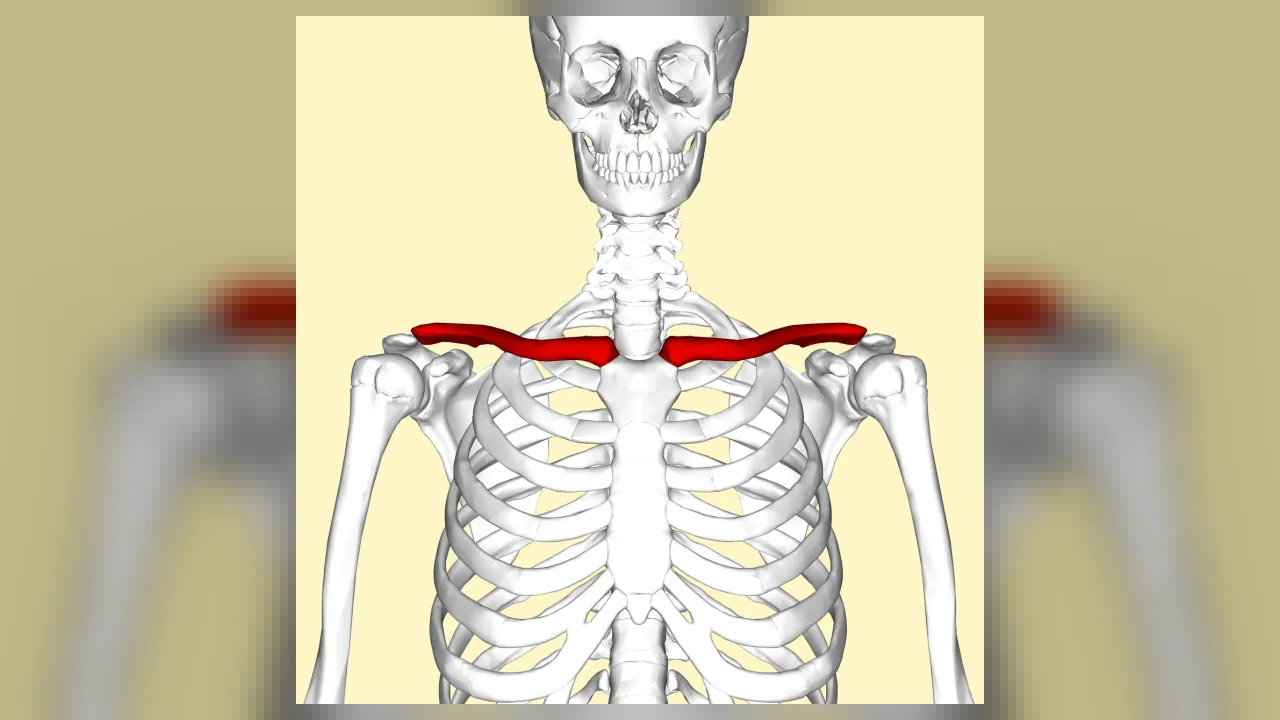
1. How is your collarbone positioned differently from all the other long bones in your body?
2. Why can humans climb monkey bars and hug wide while horses cannot?
🤯 Mind-Blowing Fact • Grade 2
Your clavicle starts hardening before you are even two inches long as a tiny developing baby, yet doesn't finish growing until your mid-twenties!
✨ Word Sparks (Grade 2 Glossary)
Tap 🔊 to hear
Strut
Support bar holding two parts apart firmly
Springy
Bending slightly under bumps without breaking easily
Connect
Join two separate body parts together
🪝
Which bone in your entire body is the VERY FIRST to start growing—and the VERY LAST to finish?
1
First to Start, Last to Finish!
Here is a wild riddle about your skeleton: long before you were born, your two collarbones were the very first bones in your whole body to begin hardening! Yet their inner ends keep growing slowly until you are about twenty-five years old—making them the very last bones to finish!
2
Shaped Like a Gentle Letter S
Look down at a collarbone from above, and you will see a smooth double curve like a stretched-out letter S. That gentle S-shape gives the bone extra springiness if you tumble on the grass.
3
The Only Bony Link
Amazingly, your collarbone is the ONLY bone connecting your entire arm and shoulder directly to your chest skeleton!
1. At about what age does your collarbone finally finish all of its bone growth?
2. What letter of the alphabet does a collarbone look like when viewed from above?
🤯 Mind-Blowing Fact • Grade 3
A bird's V-shaped 'wishbone'—originally evolved in meat-eating dinosaurs like Velociraptor—is actually its left and right collarbones fused into one spring!
Did you know birds have fused collarbones too—and you might know them by their holiday dinner nickname?
1
Little Key of the Shoulder
Ever wonder where the word 'clavicle' comes from? Ancient Romans noticed this slender S-curved bone rotates slightly like an old-fashioned key turning in a lock whenever you lift your arm high overhead—so they named it , Latin for 'little key'!
2
Bridging Two Busy Joints
Each clavicle links two important joints. Its rounded inner end plugs into the top of your breastbone at the sternoclavicular joint, while its flattened outer end meets the tip of your shoulder blade at the acromioclavicular (AC) joint. Underneath this bony run major blood vessels and nerves heading into your arm!
3
Built-In Safety Fuse
When kids trip and catch themselves on an outstretched hand, force zips up the arm to the clavicle. Like an electrical safety fuse, the collarbone absorbs impact so deeper nerves and ribs stay protected—and kid bone cells heal it super fast!
4
Bird Wishbones Are Clavicles!
In flying birds, the left and right clavicles fuse together at the center to form the springy V-shaped 'wishbone' () that powers wingbeats!
1. Why did ancient Roman anatomists name the clavicle 'little key'?
2. What animal structure is made from left and right collarbones fused into a V-shape?
🤯 Mind-Blowing Fact • Grade 4
Unlike your femur or humerus, your collarbone has no hollow marrow canal down the middle—its core is filled end-to-end with honeycomb spongy bone!
✨ Word Sparks (Grade 4 Glossary)
Tap 🔊 to hear
Subclavian
Major blood vessels running directly under collarbone
Axial
Central skeleton of skull, spine, and ribs
Primates
Mammal group including lemurs, monkeys, apes, humans
🪝
How can your entire arm and shoulder blade hang off your skeleton through just ONE thumb-sized joint at your breastbone?
1
A Crane Boom for Your Arm
Trace the bones of your upper limb inward looking for where they bolt onto your central spine or ribs—surprise! Your shoulder blade floats on muscle across your back ribs without a single bone-to-bone joint there. Instead, the entire bony connection between your arm and your skeleton runs through your slender clavicle into the thumb-sized sternoclavicular joint at the top of the sternum! Like the horizontal boom on a construction crane, the clavicle holds the shoulder socket away from the thorax.
2
Guarding the Costoclavicular Passage
Curve your fingers over your collarbone: its inner two-thirds bow forward over the top rib, creating a protected tunnel called the costoclavicular space. Safely beneath that arch travel the artery, subclavian vein, and brachial plexus nerve bundle supplying every muscle and fingertip in your arm!
3
No Marrow Tunnel Inside!
Although classified by shape as a long bone, the clavicle breaks two classic long-bone rules: it has no central medullary marrow cavity—consisting instead of honeycomb spongy bone wrapped in a dense compact shell—and it forms mostly without a cartilage blueprint first.
4
Why Climbers Keep Clavicles
Sprinting hooves like deer and horses lost their clavicles so their shoulder blades could stride farther forward and back, whereas tree-climbing , bats, and digging moles kept strong clavicles for 3D reach!
1. Which critical structures travel safely through the tunnel right underneath your collarbone?
2. Why did fast-running hoofed mammals like horses lose their collarbones over evolutionary time?
🤯 Mind-Blowing Fact • Grade 5
Forensic scientists can tell whether a young adult skeleton was 19 or 25 years old just by checking the inner end of the collarbone—the final growth plate in the entire human body to fuse!
✨ Word Sparks (Grade 5 Glossary)
Tap 🔊 to hear
Intramembranous
Forming bone directly without a cartilage model
Manubrium
Upper sternum bone meeting inner collarbone end
Brachiators
Animals swinging arm-over-arm through forest treetops
🪝
Why does the human clavicle break almost every rule of long-bone embryology—ossifying first in the embryo from membrane yet fusing its growth plate last in young adulthood?
1
Anatomical Outliers Among Long Bones
Spanning 13 to 15 centimeters horizontally across the root of the neck, the human clavicle (clavicula) functions as the sole osseous strut uniting the upper appendicular limb to the axial skeleton. Medially, its robust prism-shaped sternal end articulates via a fibrocartilaginous disc with the sterni at the saddle-shaped sternoclavicular joint; laterally, its flattened acromial end glides against the scapular acromion, anchored inferiorly to the coracoid process by the trapezoid and conoid coracoclavicular ligaments.
2
Hybrid Ossification: First to Begin, Last to Fuse
Embryologically, the clavicle is a fascinating paradox! Whereas every other long bone develops via endochondral ossification (replacing a hyaline cartilage model), the clavicular shaft begins ossifying directly from mesenchyme via ossification during the fifth to sixth gestational week—earlier than any other bone in the human fetus! Secondary cartilaginous growth caps appear later at the ends, and the medial sternal epiphysis does not fuse completely until ages 22 to 25, making it a prized landmark for forensic anthropologists estimating young-adult age.
3
Biomechanics of the Double S-Curve and Middle-Third Stress
Superiorly smooth yet roughened inferiorly by ligamentous attachments and the subclavius muscle groove, the clavicle bows anteriorly across its medial two-thirds (arching safely over the brachial plexus and subclavian vessels) and curves posteriorly across its lateral third. When an outstretched arm transmits compressive ground-reaction forces up the limb, mechanical stress concentrates right at the junction between these two curves—where bone cross-section is thinnest and unshielded by ligaments—functioning as a deformable crumple zone that spares the underlying neurovascular bundle!
4
Crankshaft Rotation in Overhead Reach
Raising your hand 180 degrees overhead requires ~40–50 degrees of upward axial rotation of the clavicle around its lengthwise axis—validating its ancient Latin name 'little key'!
5
Comparative Vertebrate Evolution
Descended from dermal armor plates of ancient lobe-finned fishes, mammalian clavicles persist strongly in arboreal , fossorial diggers, flying bats, and tool-making humans.