1. How loud is a clavichord compared to a big concert piano?
2. What touches the brass strings inside a clavichord when you press a key?
🤯 Mind-Blowing Fact • Grade 2
Young Wolfgang Amadeus Mozart composed parts of his famous opera The Magic Flute on his beloved personal travel clavichord!
✨ Word Sparks (Grade 2 Glossary)
Tap 🔊 to hear
tangent
Small upright brass blade mounted on keys
vibrato
Gentle, expressive waving up and down in pitch
seesaw
Lever balanced on a middle pivot point
🪝
How can one simple wooden lever let a keyboard player bend a note just like a violinist?
1
A Secret Treasure in a Wooden Box
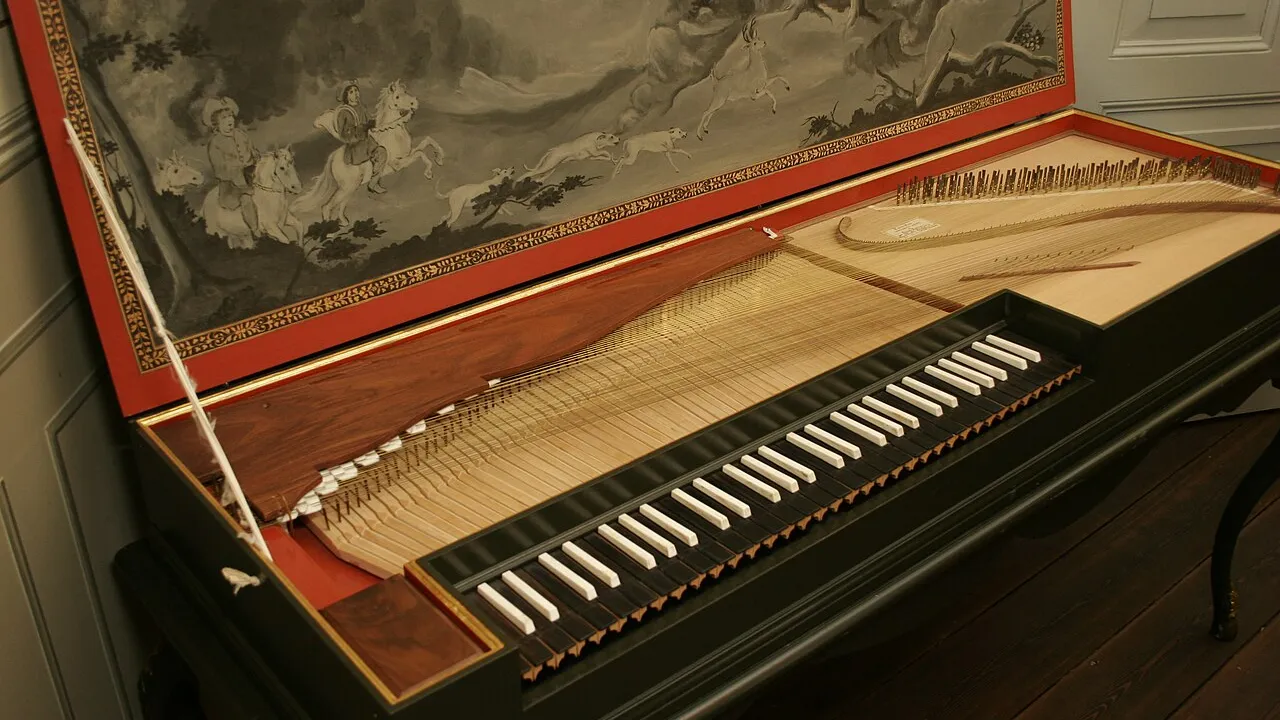
Ping-mmm-mmm! Step into a quiet study three hundred years ago after everyone else has gone to sleep. Sitting on a wooden desk is a slender rectangular keyboard called a clavichord, singing music soft enough not to wake the neighbors!
2
One Moving Part Per Key
Unlike pianos filled with thousands of springs and hinges, a clavichord is wonderfully simple. Each key is just a balanced wooden with a small upright brass strip—called a —standing at its far end. Press the key, and the brass tangent taps a pair of strings and stays pressed right against them!
3
Singing Finger Vibrato
Because the brass blade keeps touching the string as long as your finger holds the key, gently pulsing your finger stretches the wire to make a warm, wavering !
1. What is the small upright brass piece on the back of each clavichord key called?
2. Why can a clavichord play expressive pitch vibrato while an acoustic piano cannot?
🤯 Mind-Blowing Fact • Grade 3
Johann Sebastian Bach's son Carl Philipp Emanuel Bach wrote that anyone who mastered expressive playing on the delicate clavichord could play every other keyboard effortlessly!
✨ Word Sparks (Grade 3 Glossary)
Tap 🔊 to hear
Bebung
Gentle finger-pulsed pitch vibrato on a clavichord
fretted
Having several keys share one string pair
intimate
Close, quiet, and meant for small spaces
🪝
How could early clavichords play seventy different notes while having far fewer strings inside the box?
1
The Most Intimate Keyboard Ever Built
Ting-wah-wah! In a noisy concert hall, a clavichord would disappear beneath a single sneeze—yet up close, your ears adjust within seconds to discover a world of astonishing expressive color! Invented in Europe in the early 1300s, it served for five centuries as the favorite secret teacher of keyboard masters.
2
Two Jobs for Every Brass Tangent
When you press a key, its upright brass tangent rises to strike a pair of horizontal brass strings. Instead of bouncing off, the tangent stays pressed firmly against the wires, dividing them in two! The right half vibrates over a small spruce soundboard, while woven cloth ribbon laced through the left half silences unwanted ringing.
3
Sharing Strings on 'Fretted' Models
Because the tangent itself sets the vibrating length of the string—just like a guitarist's finger pressing a fret—early builders realized two or three neighboring keys could strike different spots along the exact same pair of strings! Only when you let go does the tangent drop and the cloth hush the note instantly.
4
Touch Sensitivity and Bebung
Unlike the harpsichord, pressing harder or softer changes loudness, and pulsing a held key creates a teardroplike pitch shimmer called .
1. Why is woven cloth ribbon laced through the left end of a clavichord's strings?
2. What could you NOT play at the exact same moment on a 'fretted' clavichord where C and C-sharp share one string?
🤯 Mind-Blowing Fact • Grade 4
Because medieval cathedral organs were unheated in winter and required paid helpers to pump the bellows, organists stacked two clavichords over a wooden pedal clavichord at home by the fireplace to practice!
✨ Word Sparks (Grade 4 Glossary)
Tap 🔊 to hear
monochord
Ancient one-stringed box for measuring musical intervals
Why did organists during the freezing European winters practice foot-and-hand music at home on stacked clavichords instead of inside churches?
1
Born From Pythagoras's Monochord
Pause in silence beside a hardwood clavichord and touch a single chord: at first its voice feels delicate as moonlight, yet within half a minute whisper-soft pianissimos and glowing accents seem to fill your entire imagination! Evolving in the fourteenth century directly from the medieval —a single-stringed scientific pitch ruler—the clavichord became Europe's earliest stringed keyboard with dynamic touch.
2
Bridge, Striker, and Damper System in One
Mechanically, the clavichord achieves genius through economy. When your finger depresses a key lever, the wedge-shaped brass tangent rises to strike a pair of low-tension yellow brass strings from underneath and remains locked in contact as the temporary termination bridge! Vibrations travel rightward from the tangent across the hardwood bridge into a compact diagonal soundboard, while woven wool woven through the hitchpin end instantly absorbs leftward energy. The moment your finger lifts, the tangent drops away, reconnecting the vibrating string to the wool listing so silence falls immediately.
3
Fretted vs. Unfretted—and Pedal Clavichords
Early Renaissance and Baroque 'fretted' (gebunden) clavichords saved weight and tuning time by angling two or three neighboring tangents to strike successive spots along one shared string pair. By the 1700s, large five-octave 'unfretted' (bundfrei) instruments gave every chromatic note its own choir so J.S. Bach could play any bold ! Organists even stacked two hand clavichords over a giant floor-pedal clavichord to practice warm at home without hiring bellows pumpers in icy cathedrals.
4
Expressive Soul of Empfindsamkeit
In eighteenth-century Germany's emotional Empfindsamkeit ('sensitive style') movement led by C.P.E. Bach, subtle key-pressure pitch shading and Bebung vibrato made the clavichord the ultimate confessional voice.
1. What two separate acoustic jobs does the brass tangent perform simultaneously while a key is held down?
2. Why did builders develop 'unfretted' (bundfrei) clavichords in the eighteenth century?
🤯 Mind-Blowing Fact • Grade 5
Stevie Wonder's funky hit 'Superstition' was recorded on a Hohner Clavinet—a twentieth-century electric descendant of the Renaissance clavichord that uses rubber-tipped tangents to strike strings over magnetic guitar pickups!
✨ Word Sparks (Grade 5 Glossary)
Tap 🔊 to hear
tactile
Experienced directly through physical sense of touch
intonation
Exactness of musical pitch in performance
cents
Tiny pitch units equal to hundredths of semitones
🪝
How does direct finger-to-string mechanical coupling give the clavichord microtonal pitch control that not even a nine-foot Steinway concert grand can imitate?
1
Unbroken Tactile Intimacy Between Finger and Wire
On a modern grand piano or Baroque harpsichord, an escapement mechanism severs the player's physical connection to the string the instant a hammer rebounds or a plectrum plucks—leaving the musician powerless to alter a sounding note until damping it. Alone among historical acoustic keyboards, the clavichord preserves continuous mechanical coupling from fingertip to vibrating wire throughout the entire life of every tone.
2
Tangent-Termination Physics and Micro-Tension Control
Classified in Hornbostel-Sachs organology as a struck box zither with keyboard (314.122-4), the clavichord stretches bi-choir courses of high-ductility brass (and occasionally iron or silver) wire horizontally from hitchpins at the left to tuning pins at the right across a compact rectangular case roughly 1.1 to 1.7 meters wide. Depressing a limewood or oak key lever pivots an upright brass blade—the tangent, ~1 to 1.5 millimeters thick at its crown—upward against a string pair. Because the tangent stays pressed against the wire without escapement, it serves simultaneously as exciter and movable left termination bridge! Vibrational waves propagate rightward between the tangent and the S-curved soundboard bridge, while woven wool damping cloth (listing) laced near the hitchpins deadens the left segment immediately—and quenches the entire string the instant the tangent drops. Operating between roughly 30 and 55 decibels (pppp to mp), the player must maintain precise downward finger weight: insufficient pressure lets the tangent chatter ('spitting'), excessive thrust stretches the wire sharp, and rhythmic vertical pulsing modulates tension by several to produce vocal Bebung vibrato.
3
Diatonic Fretting vs. Five-Octave Bundfrei Scaling
Descended from the Pythagorean monochord (sketched by Arnaut de Zwolle c. 1440), early double- and triple-fretted (gebunden) clavichords angled neighboring tangents—such as E-flat and D, or C, C-sharp, and D—onto a single string course. Late eighteenth-century North German masters like Christian Gottlob Hubert and Johann Adolph Hass built resonant five-octave FF–f3 or FF–g3 unfretted (bundfrei) instruments, sometimes adding octave '4-foot' bass strings for extra gravitas.
4
Pedagogy of Finger Independence
Because careless key impact instantly warps , centuries of pedagogues prized the clavichord for cultivating velvety legato weight transfer.
5
Empfindsamkeit Masterworks to Modern Revival
Immortalized in Carl Philipp Emanuel Bach's 1753 treatise Essay on the True Art of Playing Keyboard Instruments and deeply cherished by Haydn and Mozart, the clavichord was revived by Arnold Dolmetsch in the 1890s—even inspiring jazz pianist Keith Jarrett, Herbert Howells, and amplified funk cousin the Hohner Clavinet!