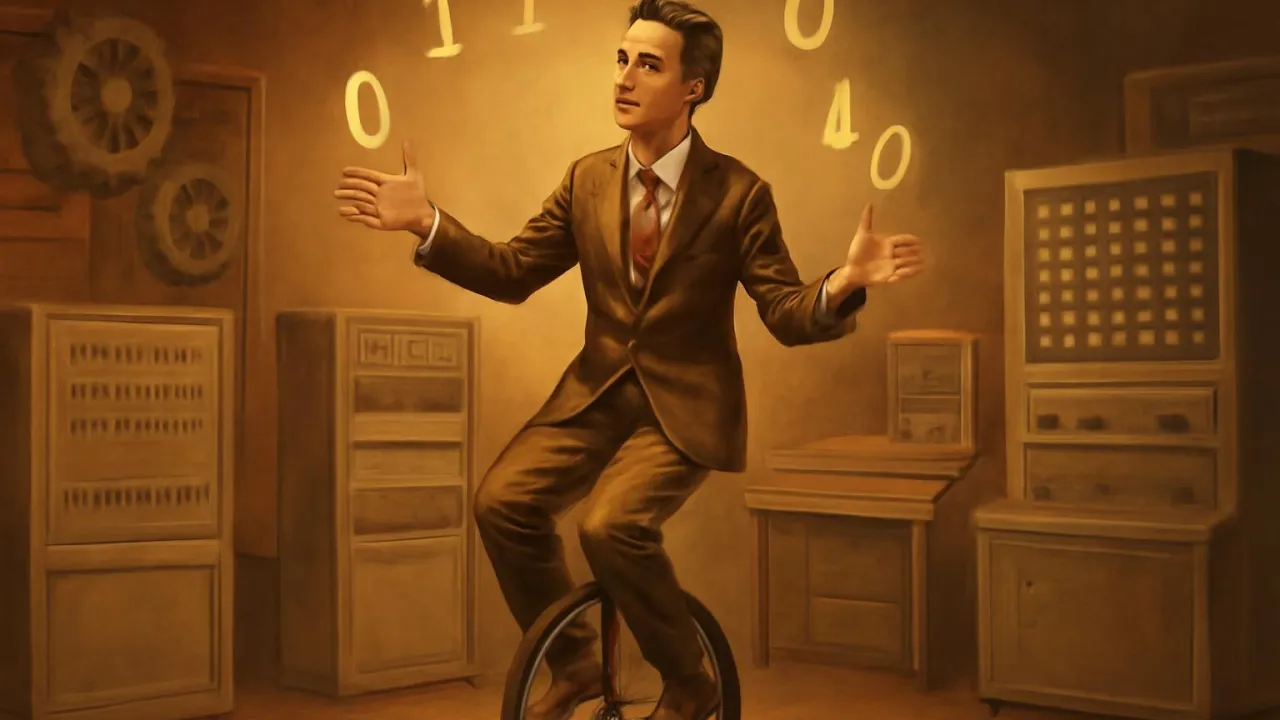
Claude once rode a unicycle down the hallway while juggling!
✨ Word Sparks (Grade 2 Glossary)
Tap 🔊 to hear
curiosity
Wanting to learn new things
message
A way to tell someone something
theory
A big idea that explains something
🪝
Have you ever wondered how computers understand messages?
1
Young Inventor
Claude loved to build things and solve puzzles as a boy. He made toy boats and even sent with wires. His made him want to learn more about how things work.
2
Learning and Trying
Claude studied math and science in school, working hard every day. He liked to use switches to make codes for sending . He kept trying new ideas, even when they were tough.
3
A Big Idea
Claude discovered that all could be sent with just yes or no. His idea helped invent computers and cell phones. People call him the 'father of information ' today.
Claude built a robot mouse named Theseus that could solve any maze it was placed in!
✨ Word Sparks (Grade 3 Glossary)
Tap 🔊 to hear
digital
Using numbers to show information
perseverance
Not giving up, even when it’s hard
theory
A smart idea that explains something big
🪝
Can you imagine turning every message into a secret code of just zeros and ones?
1
A Curious Mind
As a child, Claude Shannon loved taking apart radios and building gadgets from spare parts. He was always fascinated by how things worked and asked lots of questions. His favorite toys were puzzles and model airplanes. This curiosity led him to study math and science in school.
2
Inventing with Numbers
Claude discovered that switches could be used to show yes or no answers. He realized that these two choices could be written as numbers: one and zero. This idea became the basis for codes, which are used in computers today. He was excited to see how math could solve real problems.
3
Overcoming Challenges
Claude worked hard, even when his ideas seemed strange to others. He used to keep testing his theories and building new machines. Sometimes, his inventions failed, but he learned from every mistake. His hard work paid off when his ideas changed how people communicate.
4
A Lasting Impact
Claude’s information showed how to send messages quickly and safely. His work helped create computers, cell phones, and the internet. People around the world use his ideas every day. Claude proved that one person’s curiosity can change the world.
2. What did Claude’s information theory help create?
🤯 Mind-Blowing Fact • Grade 4
Claude once invented a machine that could juggle balls while he rode a unicycle!
✨ Word Sparks (Grade 4 Glossary)
Tap 🔊 to hear
binary
A code using only ones and zeros
digital
Information shown with numbers and codes
perseverance
Trying again and again, never giving up
🪝
What if every text, photo, or song could travel the world using only yes and no?
1
Inventing the Language of Machines
As a boy in Michigan during the 1920s, Claude Shannon tinkered with radios, telegraph lines, and model planes, always eager to discover how things worked. His fascination with gadgets and puzzles led him to study mathematics and electrical engineering at college. Even as a student, he built homemade inventions and sent coded messages to friends. This early curiosity sparked ideas that would change the world.
2
Turning Switches into Codes
Claude realized that electrical switches could represent yes or no, which he called . He used math to show that any message—letters, numbers, or pictures—could be turned into a code of just ones and zeros. This breakthrough became the foundation of technology. His famous 1948 paper explained how information could be measured, stored, and sent without mistakes.
3
Facing Doubts and Making History
At first, many people doubted Claude’s ideas because they sounded too simple or strange. But he kept experimenting, building machines like a maze-solving robot mouse and even juggling while riding a unicycle to show creative thinking. His inspired other scientists and engineers to explore communication. Claude’s work helped invent computers, cell phones, and the internet.
4
Changing How the World Connects
Today, Claude Shannon is called the 'father of information theory' because his discoveries made modern technology possible. His ideas allow us to send texts, emails, and videos across the globe in seconds. Claude’s playful spirit and love of puzzles remind us that big dreams and curiosity can shape the future for everyone.
1. What did Claude’s binary code use to send messages?
2. Why is Claude called the 'father of information theory'?
🤯 Mind-Blowing Fact • Grade 5
Claude once built a mechanical mouse named Theseus that could remember and solve any maze it entered—a true robot pioneer!
✨ Word Sparks (Grade 5 Glossary)
Tap 🔊 to hear
bit
A tiny piece of digital information: 1 or 0
Boolean algebra
Math that helps computers make decisions
error-correcting code
A way to fix mistakes in messages
🪝
How did one playful inventor’s simple math ideas build the foundation for our digital world?
1
A Childhood Fueled by Curiosity
Claude Shannon’s early years in rural Michigan were filled with invention and exploration. He spent hours building homemade telegraphs, repairing radios, and creating clever gadgets from whatever he could find. His love for puzzles and codes grew as he sent secret messages to friends and experimented with mechanical toys. This hands-on curiosity led him to excel in mathematics and engineering, setting the stage for his groundbreaking discoveries.
2
Revolutionizing Communication with Binary Logic
While studying at MIT, Claude realized that electrical switches could represent yes/no choices, which he mapped to the numbers one and zero. He demonstrated that any kind of information—words, numbers, or images—could be encoded using binary digits, or . His 1937 master’s thesis showed how could control electronic circuits, laying the groundwork for digital computers. This insight transformed communication, making it faster, more reliable, and easier to automate.
3
The Birth of Information Theory
In 1948, Claude published 'A Mathematical Theory of Communication,' introducing information theory to the world. He defined how to measure information in and explained how messages could be sent accurately, even with noise or errors. His formulas predicted the maximum speed for sending data and inspired the creation of . These ideas became essential for computers, satellites, cell phones, and the internet.
4
Playfulness and Perseverance
Claude’s creative spirit showed in everything he did, from building a maze-solving robot mouse to riding a unicycle through his laboratory. He believed that play and imagination were vital for solving tough problems. Even when his theories were doubted or misunderstood, Claude persisted, testing his inventions and encouraging others to think differently. His playful approach inspired generations of scientists and engineers.
5
A Legacy That Powers the Digital Age
Today, Claude Shannon is celebrated as the father of information theory, a field that underpins all digital technology. His work made possible everything from texting and streaming videos to exploring space with computer-guided rockets. Claude’s story shows how curiosity, creativity, and perseverance can change the world. Every time you send a message or use a computer, you’re using the codes and ideas he invented.