1. What wiggles on the clarinet's mouthpiece to start the sound?
2. How many main pieces twist together to build a standard clarinet?
🤯 Mind-Blowing Fact • Grade 2
In Prokofiev's musical tale Peter and the Wolf, a sneaky clarinet tiptoes on velvety low notes to play the Cat!
✨ Word Sparks (Grade 2 Glossary)
Tap 🔊 to hear
ligature
Clamp holding the reed onto the mouthpiece
barrel
Short neck piece used for fine tuning
glissando
Smooth sliding swoop from low to high
🪝
What secret trick lets one wooden tube sound like three different voices?
1
Slide Into the Spotlight
Wooo-eee! Picture a swooping musical laugh that starts as a deep rumble and glides smoothly up into a bright, sunny cry. Only the clarinet can slide between notes that playfully while keeping its tone warm and velvety.
2
Cane, Cork, and Hardwood
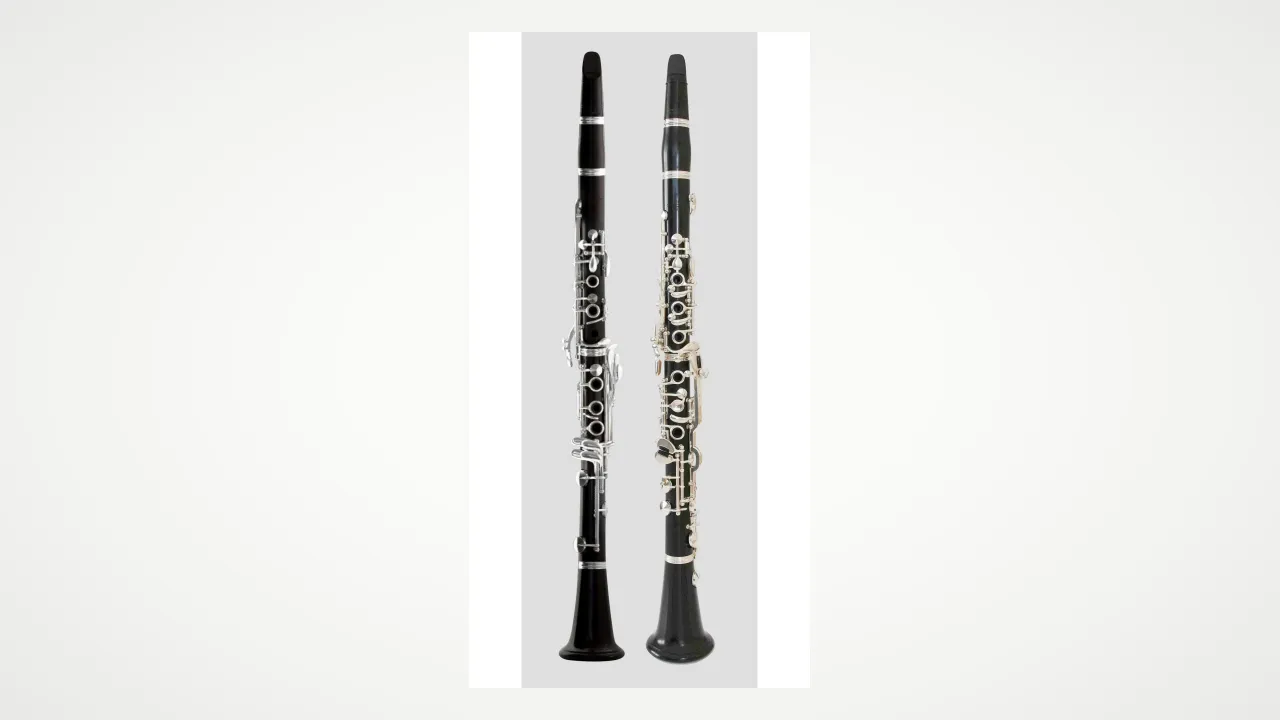
Before playing, a clarinetist clips a flat cane reed onto the mouthpiece with a metal band called a . Five sections of dense black wood join with snug cork rings, crowned by shiny silver keys and a flared bell.
3
The Magic Thumb Key
Pressing one special thumb key on the back makes every note jump twelve steps higher all at once! That clever leap gives the clarinet nearly four full octaves of smoky low notes and sparkling high melodies.
1. What holds the thin cane reed tightly against a clarinet mouthpiece?
2. Which animal does the clarinet portray in Peter and the Wolf?
🤯 Mind-Blowing Fact • Grade 3
The word clarinet comes from clarinetto, meaning little clarino trumpet, because its upper notes rang out like bright brass!
✨ Word Sparks (Grade 3 Glossary)
Tap 🔊 to hear
cylindrical
Shaped like a straight even-width tube
register key
Thumb key jumping pitches to higher range
chalumeau
Early folk reed pipe and lowest register
🪝
Why does a clarinet jump twelve scale steps instead of eight when you press its register key?
1
One Tube, Three Personalities
Listen closely to a solo clarinet and you might swear three different instruments are trading melodies onstage. Down low it murmurs like dark hot chocolate; in the middle it sings like a clear trumpet; up high it flashes with fiery brilliance.
2
The Closed-Pipe Secret
Most woodwinds have cone-shaped tubes, yet the clarinet has a straight bore from top to near the bell. Paired with a single vibrating reed at the mouthpiece, it acts like a pipe closed at one end. When the thumb opens the , the air column jumps not an octave, but a twelfth!
3
Born From the Chalumeau
Around 1700 in Nuremberg, Germany, instrument maker Johann Christoph Denner improved a simple folk pipe called the by adding that game-changing . People named the bright upper voice clarinetto—Italian for little trumpet!
4
Classical Grace and Jazz Swing
Because its tone holes sit right beneath the fingertips, a skilled player can slide seamlessly across pitches. From Mozart's glowing concerto to klezmer celebrations and Gershwin's Rhapsody in Blue, the clarinet shines everywhere.
1. Who invented the clarinet around 1700 by adding a register key to the chalumeau?
2. What interval does a clarinet jump when overblowing with its thumb register key?
🤯 Mind-Blowing Fact • Grade 4
Because a cylindrical stopped pipe stretches wavelengths to four times its tube length, a clarinet plays nearly an octave lower than an open flute of equal size!
✨ Word Sparks (Grade 4 Glossary)
Tap 🔊 to hear
harmonics
Higher overtone waves blending inside a note
clarion
Bright trumpet-like upper-middle register of a clarinet
altissimo
Extreme highest notes above the normal range
🪝
How does a straight wooden cylinder give the clarinet the widest range in the woodwind family?
1
A Wail Heard Around the World
On a snowy Manhattan afternoon in 1924, clarinetist Ross Gorman began George Gershwin's Rhapsody in Blue with a low trill that melted into an astonishing seventeen-note upward slide. Audiences gasped—how could a keyed wooden tube bend pitch like a human voice while spanning nearly four full octaves?
2
Odd Harmonics in a Cylindrical Bore
Unlike flutes, oboes, and saxophones, the clarinet pairs a single reed made of Arundo donax cane with a cylindrical bore drilled through dense African grenadilla wood. Acoustically, the reed-mouthpiece acts as a pressure node—like the sealed end of a stopped pipe—while the open tone holes form pressure antinodes. Stopped cylinders suppress even-numbered and reinforce odd harmonics, giving the clarinet its hollow, woody warmth and causing it to overblow at the third harmonic: a musical twelfth.
3
Named Registers of Color
Because overblowing skips an octave plus a fifth, clarinetists must bridge more fingered notes before venting the register key. That acoustic quirk creates distinct sonic zones: the dark, velvety chalumeau register at the bottom, hushed throat tones in the middle, the singing trumpet-like register above, and the blazing at the top.
4
From Denner to Boehm Rings
After Johann Christoph Denner added the speaker key around 1700, French virtuoso Hyacinthe Klosé teamed with maker Louis-Auguste Buffet in 1839 to add linked ring keys inspired by Boehm's flute. That nimble keywork empowered Mozart's successors, joyful Eastern European klezmer bands, and swing kings like Benny Goodman.
1. Why does the clarinet sound warmer and hollower in its low register than conical woodwinds?
2. Which 1924 piece opens with one of music history's most famous upward clarinet glissandos?
🤯 Mind-Blowing Fact • Grade 5
Mozart was so enchanted by Anton Stadler's clarinet playing in 1791 that he composed his final instrumental masterpiece—the Clarinet Concerto in A major—just weeks before his death!
✨ Word Sparks (Grade 5 Glossary)
Tap 🔊 to hear
antinode
Point of maximum wave motion in air
niente
Musical dynamic fading to or from nothing
klezmer
Expressive Eastern European Jewish celebratory musical tradition
🪝
Why does pairing a single reed with a cylindrical pipe break the octave rule followed by almost every other woodwind?
1
From Imperceptible Whisper to Clarion Cry
In the hushed stillness of a symphony hall, a clarinetist can initiate a note from sheer silence——letting a velvet murmur materialize before blooming into a radiant fortissimo that sails across the balconies. Spanning nearly four octaves and commanding unmatched dynamic control, the B-flat soprano clarinet stands as an acoustic maverick among orchestral woodwinds.
2
Quarter-Wave Physics and Odd Harmonics
Organologically classified as a single-reed cylindrical aerophone, the standard B-flat clarinet measures roughly 66 centimeters across five joints of seasoned Dalbergia melanoxylon (grenadilla). As breath accelerates through the narrow tip opening between the cane reed and curved mouthpiece facing, Bernoulli pressure drops pull the reed shut in rhythmic pulses. Coupled to a ~15-millimeter cylindrical bore, this pressure-controlled valve creates a quarter-wavelength standing wave—sounding down to concert D3 (about 146.8 Hz), nearly an octave below an open flute of comparable length. Because stopped cylinders sustain only odd multiples of the fundamental (1f, 3f, 5f), venting the register key forces the column to leap to the third harmonic: a twelfth rather than an octave.
3
Four Distinct Timbral Worlds
Spanning that twelfth requires extra tone holes and throat keys before the register break. Consequently, a single instrument encompasses four contrasting timbral regions: the rich odd-harmonic chalumeau (written E3–F4), delicate throat tones (F#4–B-flat4), luminous clarion (B4–C6), and incisive altissimo climbing beyond concert B-flat6 (over 1,865 Hz).
4
Keywork Evolution and Transposition
Evolving from Johann Christoph Denner's c. 1700 Nuremberg chalumeau, the clarinet gained seventeen keys and six movable rings when Hyacinthe Klosé and Louis-Auguste Buffet unveiled their Boehm-inspired system in Paris between 1839 and 1843, alongside the German Oehler system still prized in Vienna and Berlin. Orchestral players routinely alternate between the bright B-flat clarinet and the slightly longer, mellower A clarinet—the instrument immortalized in Mozart's sublime Clarinet Concerto, K. 622.
5
Across Continents and Genres
Whether weeping and laughing through flexible pitch bends in Eastern European , driving New Orleans polyphony and Benny Goodman's swing orchestras, or threading Brahms's autumnal chamber quintets, the clarinet bridges folkloric vocal inflection and classical precision like no other wind voice.