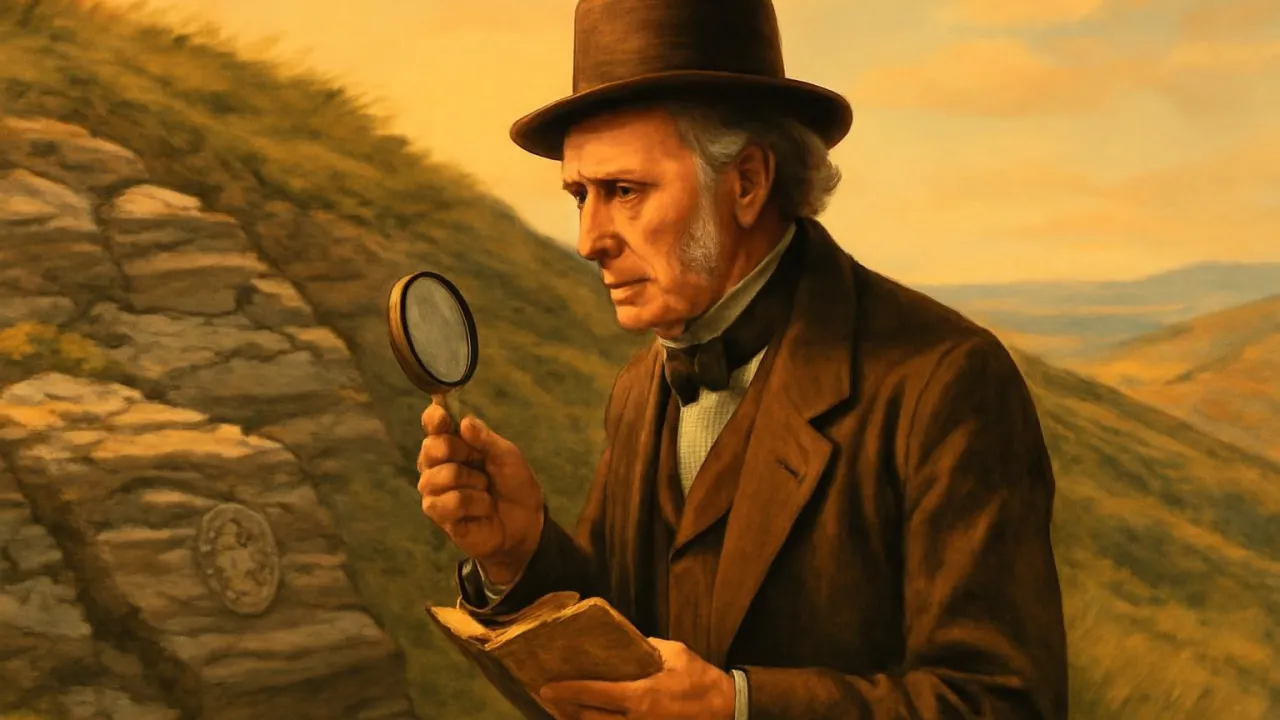
Charles Lyell’s books inspired Charles Darwin to study evolution!
✨ Word Sparks (Grade 2 Glossary)
Tap 🔊 to hear
notebook
A book for writing ideas and notes
volcano
A mountain that can erupt with lava
cliff
A steep rock face or edge
🪝
Have you ever wondered how mountains and rocks are made?
1
Curious About Rocks
Charles Lyell loved exploring the outdoors and collecting rocks as a boy. He wondered how rocks and mountains were made. He liked to look closely at rocks with his magnifying glass. He wanted to discover their secrets.
2
Hard Work and Discovery
Charles studied science and read many books about the Earth. He spent years traveling to see , , and fossils. He wrote down his ideas in and made careful drawings. His hard work helped him learn new things.
3
A Big Idea
Charles realized that Earth changes very slowly over time. He wrote a famous book called 'Principles of Geology.' His ideas helped other scientists understand how the world works.
1. What did Charles Lyell use for his rock studies?
2. What did Charles’s book help people understand?
🤯 Mind-Blowing Fact • Grade 3
Charles Lyell’s ideas helped prove that Earth is billions of years old!
✨ Word Sparks (Grade 3 Glossary)
Tap 🔊 to hear
uniformitarianism
Earth changes slowly in the same ways
geologist
A scientist who studies rocks and Earth
evidence
Clues that help prove an idea
🪝
Can rocks and fossils reveal the true age of our planet?
1
A Young Explorer
As a child, Charles Lyell wandered the Scottish countryside, searching for interesting rocks and fossils. He was fascinated by their shapes and layers, wondering how they formed. Charles carried a magnifying glass and notebook everywhere he went. His curiosity about the Earth only grew stronger as he got older.
2
Learning from Nature
Charles studied geology at school and read scientific books about Earth’s history. He traveled to see volcanoes, river valleys, and ancient cliffs in many countries. He carefully observed how rocks changed over time, making detailed notes and drawings. These adventures helped him develop new ideas about how the Earth works.
3
The Power of Slow Change
Charles Lyell believed that small changes, like rivers cutting through rock, could shape the land over millions of years. He called this idea ',' meaning the same natural processes always shape Earth. His famous book, 'Principles of Geology,' explained this theory to the world. Many scientists, including Charles Darwin, were inspired by Lyell’s work.
4
Changing Scientific Minds
Before Lyell, people thought Earth was only a few thousand years old. His careful studies showed that Earth must be much older, with rocks and fossils as the . Lyell’s ideas helped change how scientists understand our planet’s history. Today, still use his methods to study the Earth.
Charles Lyell’s books traveled with Charles Darwin on the Beagle’s famous voyage!
✨ Word Sparks (Grade 4 Glossary)
Tap 🔊 to hear
erosion
When wind or water slowly wears away rock
sedimentation
When sand and mud settle to form layers
legacy
Something important left behind for others
🪝
How did one scientist’s curiosity about rocks change our view of Earth forever?
1
Curiosity in the Countryside
Roaming the green hills of Scotland as a boy, Charles Lyell collected rocks and fossils, always eager to uncover their mysteries. He wondered how the layers in cliffs and riverbanks formed and what stories they could tell about Earth’s past. His early fascination with nature led him to study geology at university, where he learned to observe and record the world scientifically. Lyell’s passion for discovery only grew as he traveled to study volcanoes, earthquakes, and ancient landscapes.
2
A New Way to See Time
In the early 1800s, most people believed Earth was only a few thousand years old, shaped quickly by sudden events. Lyell challenged this idea by showing that slow, steady processes—like and —could create mountains, valleys, and fossils over millions of years. He called this theory 'uniformitarianism,' arguing that the same natural forces we see today have always shaped the planet. His careful observations and detailed notes provided strong evidence for this new way of thinking.
3
Writing the Principles of Geology
Lyell’s groundbreaking book, 'Principles of Geology,' was published in three volumes between 1830 and 1833, forever changing Earth science. He used real-world examples from his travels to explain his theories, making geology exciting and understandable. His writing inspired other scientists, including Charles Darwin, who took Lyell’s book on his famous voyage aboard the Beagle. Lyell’s work helped prove that Earth is much older than anyone had imagined.
4
A Lasting Legacy
Charles Lyell’s discoveries transformed geology from a hobby into a true science, based on careful observation and evidence. Today, geologists still use his methods to study how Earth’s surface changes over time. His ideas about slow change and ancient Earth continue to influence research about climate, fossils, and natural disasters. Lyell’s curiosity and careful work remind us that big discoveries can start with small questions and close observation.
1. What idea did Lyell introduce to explain Earth’s changes?
2. How did Lyell change geology?
🤯 Mind-Blowing Fact • Grade 5
Lyell’s 'Principles of Geology' changed how scientists measure Earth’s age and study its history.
✨ Word Sparks (Grade 5 Glossary)
Tap 🔊 to hear
paleontology
The science of studying fossils and ancient life
gradual
Happening slowly, little by little, over time
specimen
A sample or example collected for study
🪝
What if the rocks beneath our feet could reveal the true age and history of our planet?
1
Early Curiosity and Scientific Beginnings
As a boy exploring the Scottish countryside, Charles Lyell was captivated by the mysterious layers of rocks and fossils he found along riverbanks and cliffs. His fascination with the natural world led him to study geology at Oxford University, where he learned to observe, question, and record the world around him. Lyell’s early experiences collecting and making detailed notes shaped his future as a scientist. He was determined to understand how Earth’s landscapes and ancient creatures came to be.
2
Challenging Old Beliefs with Observation
In the early 1800s, most people believed that Earth was only a few thousand years old and that its features were shaped by sudden, dramatic events. Lyell questioned these ideas by carefully studying rock formations, fossils, and natural processes like erosion and sedimentation. He traveled across Europe, visiting volcanoes, river valleys, and coastal cliffs, gathering evidence that slow, changes could explain the planet’s history. His observations led him to propose that the same forces shaping Earth today have always been at work.
3
Uniformitarianism and the Principles of Geology
Lyell’s most influential idea—uniformitarianism—argued that Earth’s surface was shaped by continuous, processes over immense periods of time. He published his groundbreaking theory in 'Principles of Geology,' a three-volume work released between 1830 and 1833. Lyell’s book used real-world examples, detailed illustrations, and clear explanations to make geology accessible to both scientists and the public. His insistence on using evidence and observation helped transform geology into a modern science.
4
Influence on Charles Darwin and Scientific Progress
Lyell’s work had a profound impact on other scientists, most notably Charles Darwin, who carried 'Principles of Geology' during his voyage on the HMS Beagle. Darwin applied Lyell’s ideas about slow, change to his own theory of evolution by natural selection. Lyell’s emphasis on careful observation, evidence, and the immense age of Earth opened new possibilities for understanding fossils, climate change, and the history of life itself. His approach encouraged scientists to ask bold questions and seek evidence-based answers.
5
Legacy: Changing the Story of Earth
Charles Lyell’s discoveries revolutionized the way people think about our planet’s past and future. His methods and theories remain central to geology, , and environmental science today. By showing that even the smallest changes, repeated over millions of years, can create mountains and valleys, Lyell reminded us that patience and curiosity can unlock the greatest mysteries. His legacy continues to inspire scientists and students to explore, question, and discover the hidden stories written in stone.