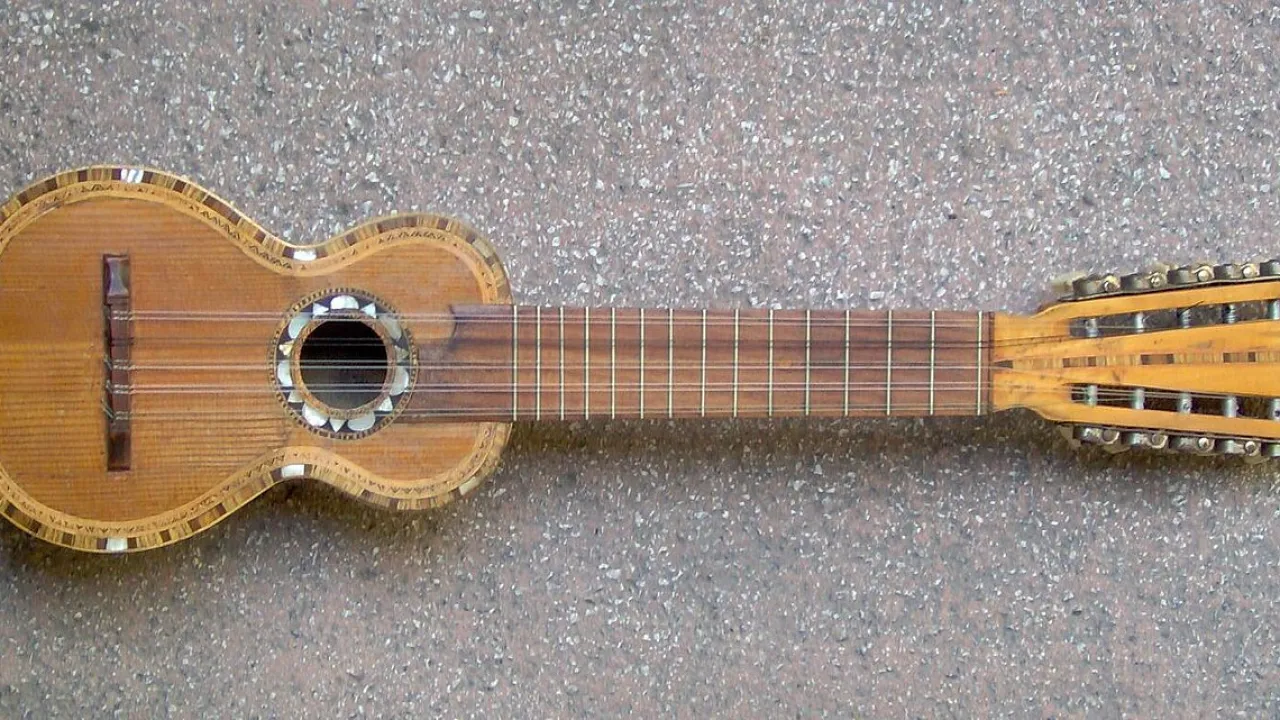
1. How many strings are packed onto a tiny charango?
2. How are modern charango backs built today?
🤯 Mind-Blowing Fact • Grade 2
Players cradle the tiny charango high against their chest without even needing a strap while marching and dancing through mountain parades!
✨ Word Sparks (Grade 2 Glossary)
Tap 🔊 to hear
artisan
A skilled craftsperson who makes things by hand.
sustainable
Caring for nature so wildlife stays safe.
nylon
Smooth, strong synthetic cord used for strings.
🪝
Why don't the strings on this mountain lute go from lowest to highest in a straight line?
1
Hummingbird Strums of the Andes
Trrr-ing, shimmer, chime! Up in the high villages of Bolivia and Peru, wind flutes soar over rapid, sparkling strums! That joyful pulse comes from the charango, a pint-sized lute born in the Andes Mountains.
2
Carved Bowls Protecting Wildlife
Long ago, builders sometimes shaped the round back from dried armadillo shells, which shrank and cracked over time. Today, carve one solid chunk of hardwood into a smooth, resonant bowl that protects wildlife and sounds much richer!
3
A Jumping Puzzle of Notes
Ten strings line up in five twin pairs. Instead of climbing neatly from low to high like guitar strings, charango pairs jump down and up—and its middle pair splits an octave apart!
1. Why do modern charango makers carve solid wood instead of using old-fashioned shells?
2. What is surprising about the middle pair of strings on a charango?
🤯 Mind-Blowing Fact • Grade 3
In Bolivia, giant bass cousins called the ronroco and khonkhota join tiny pocket-sized walaychos to form whole charango families!
✨ Word Sparks (Grade 3 Glossary)
Tap 🔊 to hear
re-entrant
String tuning that jumps up and down.
vihuela
Early Spanish guitar-like ancestor of the charango.
repique
A fluttering, rapid wrist-roll strum on charango.
🪝
How did Indigenous Andean musicians reinvent a Spanish lute into a shimmering harp-like pocket marvel?
1
Born High in the Clouds
Whirrr—glimmer—ring! A blur of fingernails sweeps across ten nylon strings, sounding like mountain hailstones dancing on a sunlit roof! In the eighteenth century around Potosi in present-day Bolivia, Indigenous Quechua and Aymara musicians encountered Spanish plucked and reimagined them into the compact charango.
2
Monoxyle Carved Bowl
Measuring just twenty-six inches from peghead to tail, a concert charango starts as one solid timber block of naranjillo or cedar. Luthiers chisel out the interior until thin curved walls resonate like a wooden bell beneath a spruce soundboard.
3
Re-Entrant Tuning Secrets
Look at its five double courses—G, C, E, A, E—and you will discover tuning! Instead of stepping steadily upward from bass to treble, pitches zig-zag inside a single tight octave while the middle E course pairs two strings an octave apart.
4
Repique Lightning
Because neighboring courses sit so close in pitch, alternating thumb and finger plucks weave cascading harp melodies, while fluttering wrist strums called roar with percussive energy!
1. What does 're-entrant tuning' mean on a charango?
2. Which Indigenous peoples of the Andes created the charango in the eighteenth century?
🤯 Mind-Blowing Fact • Grade 4
Stone mermaids carved right onto the 1744 doorway of the San Lorenzo Church in Potosi, Bolivia hold tiny charango-like lutes over two hundred eighty years old!
✨ Word Sparks (Grade 4 Glossary)
Tap 🔊 to hear
altiplano
High, windswept mountain plateau in the Andes.
campanella
Overlapping bell-like scale notes across alternating courses.
monoxyle
Carved completely out of one single wood block.
🪝
Why does squeezing ten strings into barely one octave make a tiny lute cut right through outdoor mountain festivals?
1
Cutting Through Thin Mountain Air
What would happen if you needed an instrument small enough to carry under a poncho up a thirteen-thousand-foot mountain pass, yet brilliant enough to be heard over booming bombo drums and soaring bamboo panpipes? Across the Andean , the ten-stringed charango answers that challenge with crystalline upper-register projection.
2
Eighteenth-Century Cultural Fusion in Potosi
Stone carvings added to churches in Potosi and Puno during the mid-1700s depict angels and mermaids strumming small lutes—visual proof of how Quechua and Aymara artisans transformed Renaissance Spanish vihuelas de mano into an unmistakably Andean voice. Over generations, rural towns developed distinct regional sizes, from shrill, pocket-sized walaychos to baritone ronrocos.
3
Single-Block Carving and Waist Geometry
Unlike European lutes glued from thin ribs, a concert charango is carved -style—hollowed from a single seasoned block of naranjillo, walnut, or jacaranda wood with a pinched figure-eight waist and narrow neck heel. Capped with a thin spruce or cedar soundboard reinforced against roughly forty kilograms of ten-string pull, the rigid wooden shell focuses acoustic energy into crisp treble frequencies.
4
Campanella Scales and Rasgueado Rhythm
Standard charango tuning—G4, C5, E5/E4, A4, E5—packs almost every open string between E4 and E5! That close-voiced re-entrant layout unlocks ('little bell') melodies, where consecutive notes of a scale ring simultaneously across alternating courses while percussive rasgueado strums drive huayno dances.
1. How does 'campanella' playing make a scale on the charango sound like ringing little bells?
2. Where can historians see 18th-century stone carvings proving the charango's early Andean history?
🤯 Mind-Blowing Fact • Grade 5
Remarkably, today's Andean charango preserves the five-course re-entrant tuning of 16th-century Renaissance vihuelas better than modern Spanish guitars do!
✨ Word Sparks (Grade 5 Glossary)
Tap 🔊 to hear
syncretism
Blending different cultural traditions into something new.
ronroco
Larger, deeper-voiced baritone cousin of the charango.
rasgueado
Rhythmic strumming using fanned-out right-hand fingers.
🪝
How do monoxyle shell stiffness, octave-clustered re-entrant tuning, and rasgueado kinetics turn a 37-centimetre scale into an acoustic powerhouse?
1
Treble Firepower from a Thirty-Seven-Centimetre Scale
Cradled unstrapped against the solar plexus, the Andean charango looks deceptively toy-like beside a classical guitar: its total length measures roughly sixty-six centimetres, and its vibrating string scale spans barely thirty-seven centimetres across seventeen metal frets. Yet one explosive flick of the right hand unleashes a shimmering cloud of upper partials capable of slicing cleanly across open-air plazas above three thousand five hundred metres.
2
Colonial Syncretism and Regional Organology
Classified under Hornbostel-Sachs 321.321 as a necked bowl lute carved from a solid block, the charango emerged in eighteenth-century Upper Peru—centered around the silver-mining metropolis of Potosi—as Quechua and Aymara musicians indigenized the five-course Spanish vihuela de mano, preserving its double-strung layout and re-entrant tuning long after Spain itself adopted six single guitar strings. Across Bolivia and Peru, this lineage branched into an entire consort, including the shrill steel-strung chillador and walaycho, the standard soprano charango, and the deep baritone popularized globally by Argentine composer Gustavo Santaolalla.
3
Monoxyle Bowl Physics and Ecological Craft
Whereas historical rural instruments occasionally used desiccated nine-banded armadillo carapaces, endangered-species laws and concert lutherie replaced shells with carved single-billet hardwood bowls of naranjillo (Citronella incarum), walnut, or mara. Gouged to graduated four-millimetre wall thicknesses and topped with quarter-sawn spruce or red cedar braced in fan patterns, the compact high-stiffness cavity places its primary air and plate resonances above three hundred fifty hertz—maximizing clarity while avoiding muddy low-frequency feedback.
4
Close-Voiced Re-Entrant Pitch Topology
Counting from bottom to top as held, the five paired nylon courses tune to E5/E5–A4/A4–E5/E4–C5/C5–G4/G4. Remarkably, every open pitch except the lower octave E4 clusters within a major sixth between G4 (392 hertz) and E5 (659.3 hertz)! This inverted pitch topology empowers harp-like campanella cross-stringing, dense cluster voicings, and shimmering octave reinforcement from the split third course.
5
Right-Hand Kinetics: Repique, Tremolo, and Melodic Polyphony
In traditional ensemble huaynos and solo concert works championed by Bolivian masters Mauro Nunez and Ernesto Cavour, players fuse percussive knuckle taps (golpes), lightning wrist-fluttering repiques, and continuous chordal tremolos with independent plucked melodies.