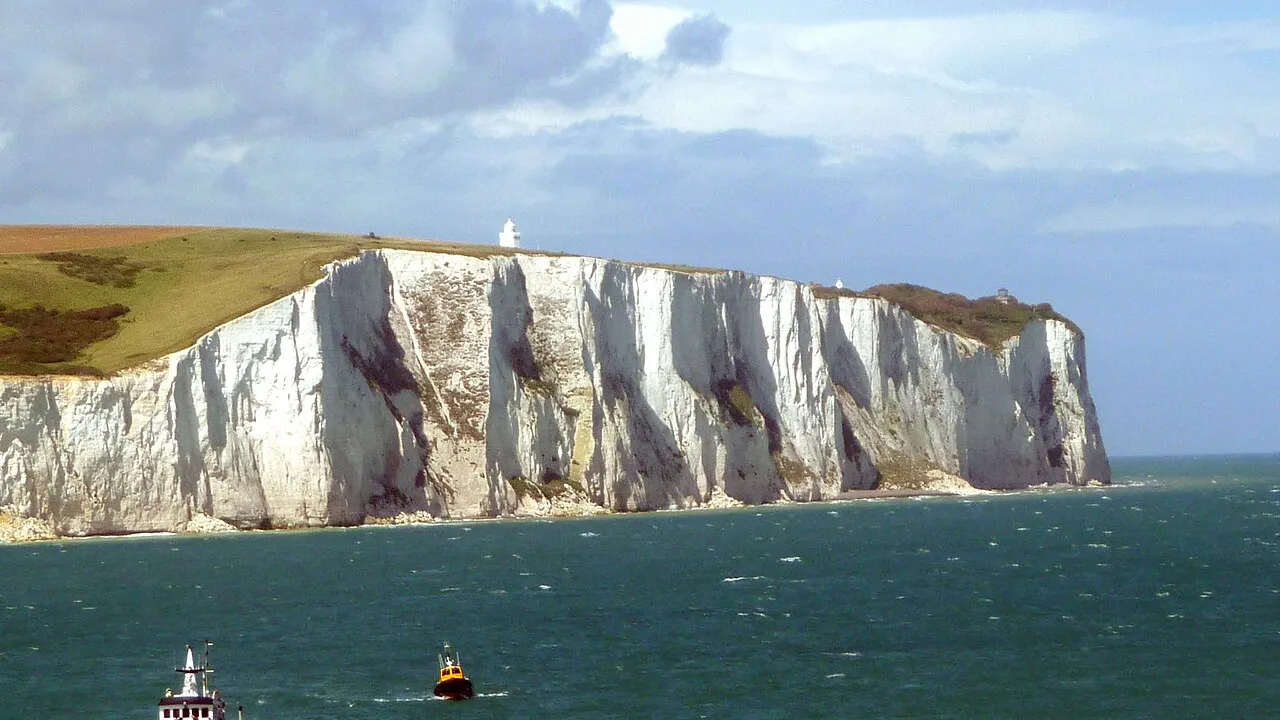
1. What tiny ocean things built giant white chalk cliffs?
2. What happens if you rub a piece of real cliff chalk across a dark sidewalk?
🤯 Mind-Blowing Fact • Grade 2
Today's classroom 'blackboard chalk' is usually pressed from a mineral called gypsum, whereas real ocean chalk is pure limestone made of ancient plankton!
✨ Word Sparks (Grade 2 Glossary)
Tap 🔊 to hear
algae
Simple plant-like organisms making food from sunlight
flint
Hard dark quartz nodules found inside chalk cliffs
nodule
A rounded lump of mineral inside rock
🪝
How could ocean creatures smaller than a speck of dust build cliffs 350 feet tall?
1
Snowfall Beneath the Waves
Imagine floating in a warm, crystal-clear sea while dinosaurs still walked on land! Single-celled called coccolithophores drifted near the sunny surface, covered in tiny round calcite shields. As those tiny shields sank, they dusted the seafloor like gentle snow.
2
One Inch Every Thousand Years
Because each little shield is microscopic, building thick chalk took extraordinary patience. Scientists estimate that chalk mud piled up only about half an inch to one inch every thousand years!
3
Dark Flint Surprises Inside
Streaking across the bright white cliffs are bands of hard, dark called . Prehistoric people dug flint out of soft chalk to chip sturdy tools and spark campfires.
1. About how fast did ancient plankton shells pile up on the ocean floor to form chalk?
2. What hard, dark lumps often form in neat bands inside soft white chalk cliffs?
🤯 Mind-Blowing Fact • Grade 3
The Latin word 'creta' means chalk—giving the entire Cretaceous Period its name because more chalk formed then than at any other time in Earth's history!
✨ Word Sparks (Grade 3 Glossary)
Tap 🔊 to hear
Cretaceous
Geologic period named for vast ancient chalk deposits
coccolith
Microscopic wheel-shaped calcite plate from ocean plankton
porous
Full of tiny spaces that soak up water
🪝
Why did geologists name an entire age of dinosaurs—the Cretaceous Period—after chalk?
1
The Age of Chalk Seas
In Latin, the word for chalk is creta. Between 100 and 66 million years ago during the Late Period, Earth had no polar ice caps and sea levels stood hundreds of feet higher than today. Warm, shallow seas flooded Europe and central North America, creating ideal sunlit nurseries for trillions of microscopic algae.
2
Microscopic Shields Called Coccoliths
Zoom in 5,000 times with an electron microscope, and a crumb of chalk transforms into a breathtaking pile of hubcap-shaped calcite rings called ! Because nearby continents lay low and flat, almost no muddy river clay washed out to stain the pure white carbonate ooze.
3
Soft Yet Standing Steep
Scoring barely 1 to 2 on the Mohs hardness scale, chalk crumbles under a fingernail, yet its , lightly cemented framework drains rainwater quickly instead of slumping into mud, allowing vertical sea cliffs to tower along coasts in England, France, Denmark, and Germany.
4
Chalk Towers in the American Heartland
You do not have to cross the Atlantic to see chalk—Monument Rocks in western Kansas rise out of prairie grasslands where an inland sea once swam with giant marine reptiles!
1. Why did Cretaceous chalk stay such a dazzling, pure snow-white color?
2. Why can you find tall chalk formations like Monument Rocks in the middle of dry Kansas?
🤯 Mind-Blowing Fact • Grade 4
Tunnel-boring machines digging the Channel Tunnel beneath the sea followed a single clay-rich layer of Lower Chalk for nearly thirty miles between England and France!
✨ Word Sparks (Grade 4 Glossary)
Tap 🔊 to hear
Chalk Marl
Clay-rich lower chalk layer blocking water flow
impermeable
Not allowing water or fluids to pass through
sea sponge
Simple ocean animal often having microscopic silica needles
🪝
How did soft white chalk help engineers dig the 31-mile Channel Tunnel under the sea between England and France?
1
One Chalk Blanket Split by the Sea
Look across the 21-mile Strait of Dover from England's White Cliffs to France's Cap Blanc-Nez, and you are viewing two halves of the exact same Cretaceous seafloor! Nearly half a million years ago, catastrophic spillover from a glacial lake carved out the strait, slicing through the continuous chalk arch that once connected Britain to mainland Europe.
2
Digging Through Chalk Marl
Upper white chalk is heavily fractured and acts as southern England's premier drinking-water aquifer. Yet near the base of the formation lies the —a gray-white layer mixed with about twenty-five percent clay. Soft enough for giant tunnel-boring machines to chew through smoothly, yet enough to keep the English Channel's seawater out, Chalk Marl proved the dream rock layer for carving the famous Eurostar 'Chunnel'!
3
Mystery of the Black Flint Bands
How did razor-hard black flint (Mohs 7) grow inside butter-soft calcite chalk? Ancient and radiolarians had skeletons made of glassy silica. After burial, alkaline pore water dissolved those sponge needles and re-precipitated microcrystalline quartz inside shrimp burrows along rhythmic chemical zones.
4
Wave-Cut Retreat Today
Storm waves hurling flint cobbles against cliff bases undercut Dover's chalk walls, causing dramatic rockfalls that keep the cliff faces gleaming fresh white rather than overgrown with grass.
1. Why did engineers steer the Channel Tunnel specifically through the Chalk Marl layer beneath the seafloor?
2. Where did the silica come from to build hard black flint nodules inside white chalk?
🤯 Mind-Blowing Fact • Grade 5
Living coccolithophore blooms—direct cousins of the plankton that built the White Cliffs of Dover—still turn ocean waters milky turquoise in swirls so vast astronauts photograph them from space!
✨ Word Sparks (Grade 5 Glossary)
Tap 🔊 to hear
aragonite
Less-stable crystal form of calcium carbonate in shells
eustatic
Relating to worldwide changes in ocean sea level
dual porosity
Rock storing water in tiny pores and flowing through cracks
🪝
Why didn't buried Cretaceous chalk harden into dense gray limestone like older carbonate rocks?
1
Low-Magnesium Calcite and Diagenetic Stability
Most tropical reef shells and ooids consist of or high-magnesium calcite—unstable crystal forms that readily dissolve during burial and re-precipitate as tight, interlocking cement, turning lime mud into hard, dense limestone. Cretaceous coccolithophores, however, constructed their 2-to-10-micrometer coccolith shields out of ultra-stable low-magnesium calcite! Because those platelets resisted chemical dissolution under shallow burial, very little mineral cement formed in the pore spaces, leaving chalk with remarkable 35 to 45 percent porosity even after 85 million years.
2
Greenhouse Oceans and Seawater Chemistry
Why did coccolithophore blooms peak so dramatically during the Late Cretaceous? Fast seafloor spreading along mid-ocean ridges altered the magnesium-to-calcium ratio of global oceans into what geochemists call a 'calcite sea,' while sea levels rose roughly 200 meters above modern shorelines, drowning continental interiors in warm, clear epicontinental shelf seas.
3
Redox Horizons and Nodular Chert Genesis
Rhythmic bands of dark flint (microcrystalline chert) track Milankovitch climate cycles across chalk cliffs. Along shallow sulfate-reduction redox boundaries inside ancient sea mud—especially inside branching Thalassinoides crustacean burrows—local pH shifts simultaneously dissolved calcite and precipitated biogenic opal from sponge spicules into dense quartz nodules.
4
Dual-Porosity Hydrogeology
Chalk aquifers exhibit classic : microscopic inter-coccolith pores store enormous volumes of water tightly via capillary tension, while tectonic joints and solution-widened fractures transmit water rapidly to crystal-clear English chalk streams—rare, spring-fed river ecosystems famous for steady year-round temperatures near 10 degrees Celsius and lush aquatic plant life.
5
Modern Blooms Visible From Space
Even today, living coccolithophore descendants such as Emiliania huxleyi bloom across sunlit subpolar and temperate oceans in milky turquoise swirls hundreds of kilometers wide. Captured by NASA Earth-observing satellites, these modern blooms reflect sunlight back toward space, export biogenic calcium carbonate to the deep seafloor, and connect living marine plankton directly to Dover's ancient cliffs!