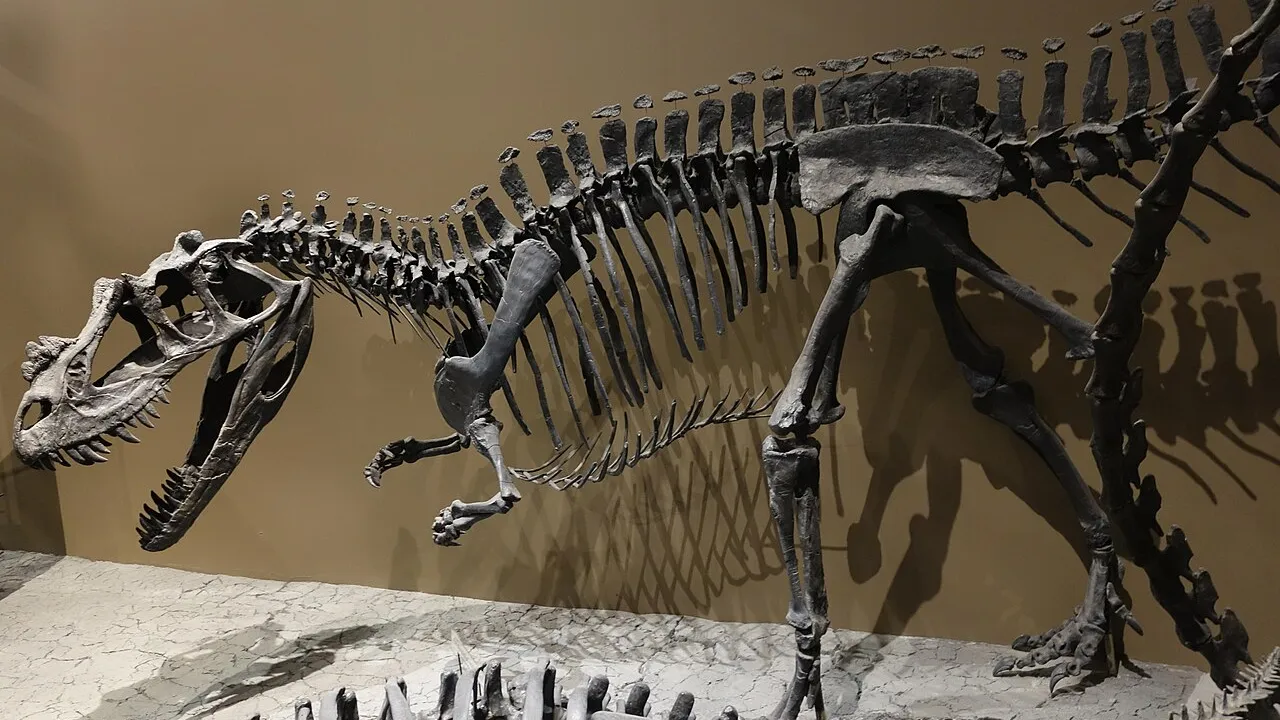
2. How did Ceratosaurus's deep tail help it near Late Jurassic rivers?
🤯 Mind-Blowing Fact • Grade 2
Fossil hunter Marshall Felch excavated the first nearly complete Ceratosaurus skeleton in Colorado in 1883, still encased in rock so hard it took months to chip free!
✨ Word Sparks (Grade 2 Glossary)
Tap 🔊 to hear
hornlet
A small horn or bony ridge above the eye
flexible
Able to bend easily without stiffly locking
lungfish
A freshwater fish able to breathe air
🪝
How did Ceratosaurus share the same Jurassic neighborhood with giant Allosaurus?
1
Crowned With Three Horns
Imagine standing beside a winding river in Colorado 150 million years ago. Out of the horsetail reeds strides Ceratosaurus, sporting a blade-shaped horn on its nose and two smaller above its eyes! Scientists think bright keratin covered these horns so rivals could show off peacefully without getting hurt.
2
Super-Long Upper Teeth
When Ceratosaurus closed its mouth, its upper teeth were so extra long that their sharp tips reached nearly to the bottom edge of its lower jaw!
3
Master of the Riverbanks
While bigger Allosaurus hunted giant land dinosaurs on open plains, Ceratosaurus used its , alligator-like tail to hunt , turtles, and smaller dinosaurs along waterways.
1. Why did Ceratosaurus hunt along rivers and swamps so often?
2. What was unusual about the upper teeth of Ceratosaurus?
🤯 Mind-Blowing Fact • Grade 3
Unlike most advanced meat-eating dinosaurs whose tails were stiffened for balance on land, Ceratosaurus kept a remarkably bendy tail built like a modern caiman's!
✨ Word Sparks (Grade 3 Glossary)
Tap 🔊 to hear
osteoderm
A bony plate embedded right inside the skin
chevron
A V-shaped bone hanging beneath a tail vertebra
supple
Bending and moving smoothly with graceful ease
🪝
Why did Ceratosaurus have four fingers, back armor, and a crocodile paddle tail?
1
An Ancient Design That Worked
Ripples part in a shaded Late Jurassic channel 150 million years ago as a six-meter predator glides effortlessly toward shore. Meet Ceratosaurus nasicornis, whose full scientific name means 'horned lizard with a horned nose.' Named by paleontologist Othniel Charles Marsh in 1884, this distinctive hunter roamed both western North America and ancient Portugal.
2
Display Horns and Back Osteoderms
Ceratosaurus stood out instantly thanks to a thin, upright nasal horn core paired with rugged brow ridges in front of each eye. Because the nasal bone was thin rather than thick, scientists conclude it served as a bold visual display crest rather than a battering weapon. Even stranger for a theropod, a single row of small bony ran down the center of its back and tail!
3
Four Fingers and Giant Fangs
While Allosaurus had three-fingered hands, Ceratosaurus kept an ancient body plan with four short fingers on each hand. Meanwhile, its wide jaws held enormous, flat-sided upper teeth shaped like curved daggers.
4
Swimming Specialist of the Morrison
Tall spines above and bones below its tail vertebrae created a deep, paddle ideal for snagging freshwater turtles, crocodilians, and lungfish.
1. Why do paleontologists think Ceratosaurus did NOT use its nose horn for ramming prey?
2. On which two continents have Ceratosaurus fossils been discovered?
🤯 Mind-Blowing Fact • Grade 4
Braincase CT scans of Ceratosaurus revealed that its brain and inner ear closely resembled early Jurassic relatives, while later southern cousins evolved into short-snouted abelisaurids!
✨ Word Sparks (Grade 4 Glossary)
Tap 🔊 to hear
riparian
Relating to wetlands and wooded banks beside rivers
haemal arch
Bone beneath tail vertebrae protecting blood vessels and anchoring muscle
maxillary
Belonging to the main tooth-bearing upper jawbone
🪝
How could the Morrison Formation support Ceratosaurus, Allosaurus, and Torvosaurus all in the same river valleys?
1
Three Giants in One Ecosystem
Picture the seasonal savannas and gallery forests of the Morrison Formation 150 million years ago across Colorado and Utah. Sharing this Late Jurassic landscape were three formidable large carnivores: abundant Allosaurus, massive Torvosaurus, and horn-snouted Ceratosaurus nasicornis. For over a century, paleontologists wondered why Ceratosaurus fossils appeared rarer than Allosaurus skeletons yet persisted across millions of years.
2
Isotope Clues and Riparian Hunting
Biomechanical and chemical clues solved the mystery. Paleontologist Robert Bakker and colleagues highlighted how Ceratosaurus possessed unusually tall neural spines and elongated along its tail, forming a vertically deep, laterally flexible sculling organ similar to modern crocodilians. Rather than chasing Stegosaurus herds across open floodplains like Allosaurus, Ceratosaurus patrolled densely wooded river channels for giant lungfish, aquatic reptiles, and smaller ornithopods.
3
Exaggerated Saber-Like Dentition
Relative to its sixty-centimeter skull length, Ceratosaurus carried exceptionally long, blade-like teeth whose tips extended nearly to the ventral margin of the lower jaw when closed, delivering deep, decisive punctures into slippery prey.
4
Mosaic of Ancient and Specialized Traits
Fused pelvic bones, four-digit hands, midline dorsal osteoderms, and keratin-sheathed nasal and lacrimal horns made Ceratosaurus one of the Jurassic Period's most anatomically distinctive predators.
1. How did tail anatomy help Ceratosaurus occupy a different ecological role than Allosaurus?
2. Which skeletal traits showed Ceratosaurus belonged to a more ancient theropod branch than Allosaurus?
🤯 Mind-Blowing Fact • Grade 5
The fused hip and foot bones of Marshall Felch's 1883 Ceratosaurus holotype seemed so bird-like that Othniel Charles Marsh immediately noted vivid anatomical parallels between dinosaurs and living birds!
✨ Word Sparks (Grade 5 Glossary)
Tap 🔊 to hear
ziphodont
Having laterally flattened, curved, serrated blade-like teeth
ossification
The natural biological process of forming hard bone tissue
prezygapophysis
Forward-pointing vertebral prong that interlocks backbone joints
🪝
What makes Ceratosaurus nasicornis a crucial evolutionary benchmark for understanding non-tetanuran theropod diversity?
1
Marsh's Classic Morrison Discovery
Between 1883 and 1884, collector Marshall Parker Felch painstakingly extracted an articulated Late Jurassic theropod skeleton from dense sandstone at Garden Park near Cañon City, Colorado. Studying the specimen at Yale, Othniel Charles Marsh named Ceratosaurus nasicornis in 1884, marveling at its fused pelvic girdle, prominent nasal horn core, and midline row of dermal . Measuring six to seven meters long and weighing up to 900 kilograms, Ceratosaurus thrived from Kimmeridgian to Tithonian times (153–148 MYA) across North America's Morrison Formation and Portugal's Lourinhã Formation.
2
Cranial Ornamentation and Bite Geometry
The holotype skull displays an elongated, laterally compressed prominence formed by fused rugose nasals, complemented by paired triangular lacrimal horns anterior to the orbits. Pit-and-groove vascular textures confirm these bony cores supported enlarged keratinous sheaths used for intraspecific visual recognition. Below, the maxillae hold twelve to fifteen extraordinarily elongated, recurved crowns capable of deep slicing bites.
3
Axial Flexibility and Semiaquatic Foraging
Whereas tetanuran theropods like Allosaurus stiffened the posterior tail with elongated prezygapophyses to act as a dynamic terrestrial counterbalance, Ceratosaurus retained supple caudal articulations paired with tall neural spines and deep, grooved haemal arches, facilitating undulatory aquatic propulsion when ambushing ceratodontid lungfish, freshwater turtles, and goniopholidid crocodyliforms along wooded Morrison waterways and oxbow lakes.
4
Endocranial Anatomy and Lineage Legacy
Computed-tomography endocasts published by R. Kent Sanders and David K. Smith demonstrated large olfactory bulbs, well-developed floccular recesses coordinating gaze stabilization, and inner-ear semicircular canals tuned to agile lateral head strikes. Simultaneously, retained ancestral characters—including four functional manual digits with shortened metacarpals, co-ossified pelvic elements, and a continuous midline row of sculpted dermal osteoderms—set Ceratosaurus sharply apart from contemporaneous allosauroids and megalosauroids.
5
Gateway to Gondwanan Abelisauroids
Though Ceratosaurus vanished from northern Laurasian continents near the Jurassic's close after millions of years of niche partitioning alongside Allosaurus and Torvosaurus, its sister clade—the abelisauroids—radiated explosively across southern Gondwana to rule Late Cretaceous ecosystems from Patagonia to Madagascar and India.