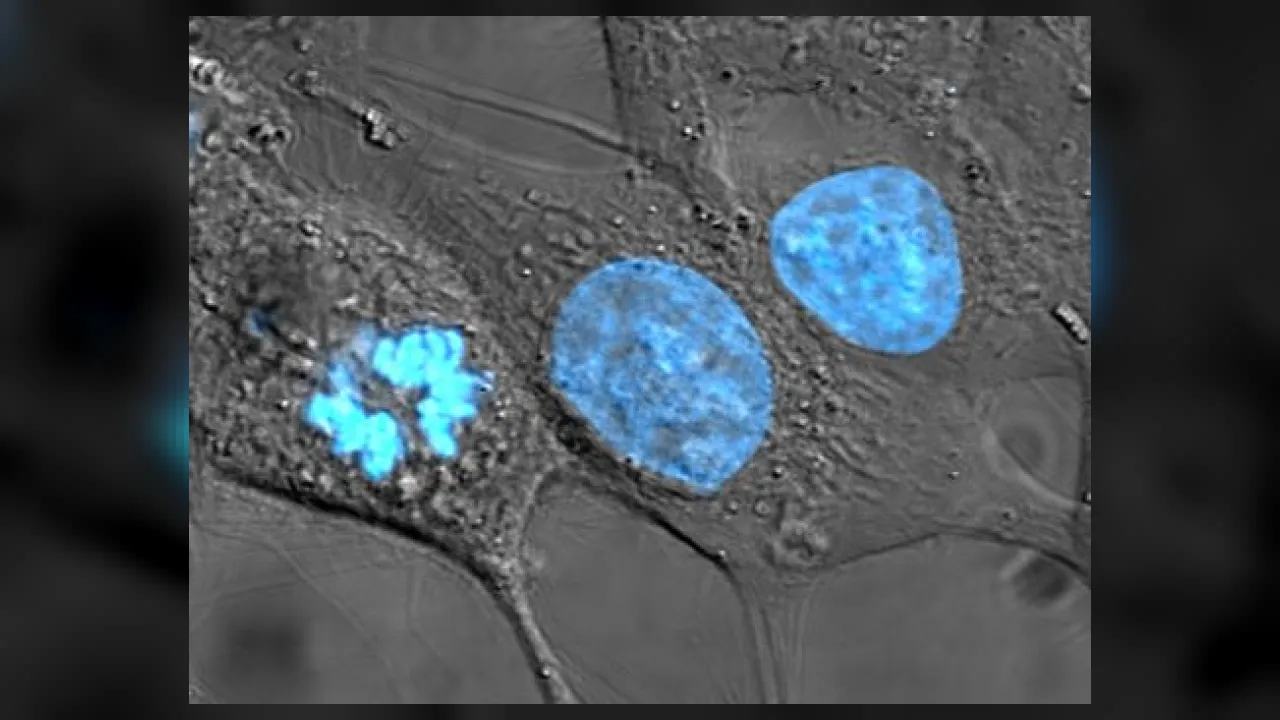
1. What precious instruction book stays safely locked inside the cell nucleus?
2. Why do mature red blood cells let go of their nucleus before traveling in your veins?
🤯 Mind-Blowing Fact • Grade 2
Every single cell nucleus is studded with about three thousand to four thousand microscopic nuclear pore doorways!
✨ Word Sparks (Grade 2 Glossary)
Tap 🔊 to hear
Nuclear Envelope
Double membrane wall wrapping around the nucleus
Messenger RNA
Copied single recipe sent outside the nucleus
Nucleolus
Dark inner spot building cell ribosome parts
🪝
How does a cell read instructions from its master library without ever risking torn or lost pages?
1
Double-Walled Protection
Imagine a precious reference library surrounded by two sturdy walls! That double wrapper is called the , and it shields your cell's master DNA blueprints from busy chemical reactions swirling outside in the cytoplasm.
2
Copying Single Recipes
Instead of lending out the whole giant DNA book, the nucleus copies just one needed recipe onto a short ribbon called . Thousands of tiny round doorways called nuclear pores check that ribbon and let it exit into the cell!
3
A Busy Workshop Inside
Look closely inside the nucleus and you will spot an even darker little sphere called the , which builds the tiny protein-making machines every cell needs.
1. How do instructions get from DNA inside the nucleus out to the rest of the cell?
2. What does the dark inner spot called the nucleolus manufacture?
🤯 Mind-Blowing Fact • Grade 3
Long muscle cells in your thighs are so big that a single muscle fiber can contain hundreds of nuclei working side by side!
✨ Word Sparks (Grade 3 Glossary)
Tap 🔊 to hear
Eukaryote
Organism whose cells contain a true nucleus
Chromatin
DNA neatly wound around spool-like helper proteins
Nuclear Pore
Protein doorway checking cargo entering the nucleus
🪝
Why do skeletal muscle fibers pack hundreds of nuclei into one long cell while skin cells have just one?
1
What Makes Eukaryotes Special
Simple bacteria let their DNA float loose inside the cell, yet plants, fungi, animals, and humans belong to a group called —Greek for 'true kernel' or 'true nucleus'! About ten percent of a typical human cell's volume belongs to this central command sphere.
2
Guarded by Basket-Shaped Pores
Wrapping the nucleus is a double-layered nuclear envelope reinforced inside by a tough protein meshwork called the nuclear lamina. Studded across that envelope sit thousands of basket-like complexes that check molecular passports before letting enzymes in or messenger RNA out.
3
Chromatin Spools and the Nucleolus
Inside the jelly-like nucleoplasm, two meters of thin DNA thread wind neatly around spool proteins into fluffy fibers called so nothing tangles! Right in the center, the nucleolus churns out fresh ribosome pieces nonstop.
4
Zero, One, or Hundreds!
Most cells hold one nucleus, mature red blood cells hold zero, and long skeletal muscle fibers fuse together during growth so hundreds of nuclei can supply recipes along their whole length!
1. Why do long skeletal muscle cells in your arms and legs contain hundreds of nuclei?
2. What does the scientific word 'eukaryote' literally mean?
🤯 Mind-Blowing Fact • Grade 4
A single nuclear pore complex can inspect and ferry nearly one thousand molecules per second in both directions simultaneously without a single collision!
✨ Word Sparks (Grade 4 Glossary)
Tap 🔊 to hear
Nuclear Lamina
Sturdy protein mesh supporting the nuclear envelope
Euchromatin
Loosely packed DNA open for reading recipes
Transcription Factor
Protein switch turning specific genes on or off
🪝
How does a cell pack six and a half feet of DNA into a microscopic nucleus and still find one exact recipe in seconds?
1
Color-Coded Neighborhoods Inside the Vault
Imagine packing forty kilometers of ultra-fine kite string into a tennis ball without creating a single knot—and still pulling out any centimeter you want! Your five-micrometer nucleus pulls off that feat by winding DNA around histone spools into chromatin. Active recipes stay loosely unspooled as open in easy-to-read neighborhoods, while unused chapters pack tightly as dense heterochromatin along the rim.
2
Selective Gene Expression
Here is one of biology's coolest surprises: a heart cell nucleus and an eye retina nucleus hold the exact same twenty thousand human genes! What makes them different is gene regulation— enter the nucleus and switch on light-sensing genes in eye cells while opening contraction-protein genes in heart cells.
3
Smart Nuclear Pore Security
Each nuclear pore complex is a giant octagon built from over five hundred individual proteins called nucleoporins! Proteins made in the cytoplasm can only enter if they wear a special amino-acid zip code called a nuclear localization signal, escorted across by importin shuttles.
4
Temporary Disassembly During Mitosis
Whenever a growing skin or bone-marrow cell divides during mitosis, the temporarily unzips its double envelope so duplicated chromosomes can separate evenly, then reassembles two pristine daughter nuclei within minutes!
1. If a skin cell nucleus and a brain neuron nucleus contain the exact same DNA book, why do those cells look and act so differently?
2. What special molecular 'passport' must a protein wear to be escorted inward through a nuclear pore?
🤯 Mind-Blowing Fact • Grade 5
By keeping DNA separated inside a nucleus, human cells can edit and remix RNA copies via alternative splicing—turning ~20,000 genes into over 100,000 different functional proteins!
✨ Word Sparks (Grade 5 Glossary)
Tap 🔊 to hear
Alternative Splicing
Editing one RNA transcript into varied protein recipes
Nucleoporin
Protein building block forming nuclear pore gateways
Karyopherin
Shuttle protein escorting cargo across nuclear pores
🪝
Why did separating DNA transcription inside a membrane-bound nucleus spark the evolution of every complex plant, fungus, and animal on Earth?
1
Architectural Mastery of the Nuclear Envelope
Spanning roughly five to ten micrometers in diameter, the eukaryotic nucleus is bounded by two concentric phospholipid bilayers separated by a perinuclear space—with its outer membrane continuous directly with the rough endoplasmic reticulum! Underlying the inner membrane sits a fibrous mesh of intermediate filaments called nuclear lamins, which anchor chromosome territories and lend mechanical resilience against physical compression.
2
Why Compartmentalization Changed Evolution
In bacteria, ribosomes jump onto messenger RNA and begin translating proteins before RNA polymerase even finishes copying the gene! Enclosing DNA inside a eukaryotic nucleus created a vital pause between transcription (inside the nucleus) and translation (out in the cytoplasm). During that protected window, spliceosomes snip out non-coding introns and stitch coding exons together in varied combinations—allowing twenty thousand human genes to generate well over one hundred thousand distinct proteins!
3
Ran-GTP Transport Through Nuclear Pore Complexes
Perforating both bilayers are roughly three thousand octagonal Nuclear Pore Complexes (NPCs), each weighing over one hundred megadaltons and lined with disordered phenylalanine-glycine protein webs that repel unauthorized macromolecules. Cargo bearing nuclear localization or export signals binds chaperones (importins and exportins), powered directionally by a steep concentration gradient of Ran-GTP inside the nucleoplasm.
4
Liquid-Droplet Nucleoli and Epigenetic Maps
Even without an internal membrane of its own, the nucleolus self-organizes through liquid-liquid phase separation—like a glistening oil droplet in water—around ribosomal RNA genes to assemble 40S and 60S ribosomal subunits. Surrounding chromatin organizes into topologically associating domains where histone acetylation opens euchromatin for RNA polymerase II.
5
Orchids, Microscopes, and Discovery
Dutch lensmaker Antonie van Leeuwenhoek glimpsed bright central cores inside salmon red blood cells in 1700, and Scottish botanist Robert Brown formally named the 'nucleus'—Latin for little nut or kernel—in 1831 while studying orchid leaf epidermis, inspiring Matthias Schleiden and Theodor Schwann to formulate foundational cell theory.