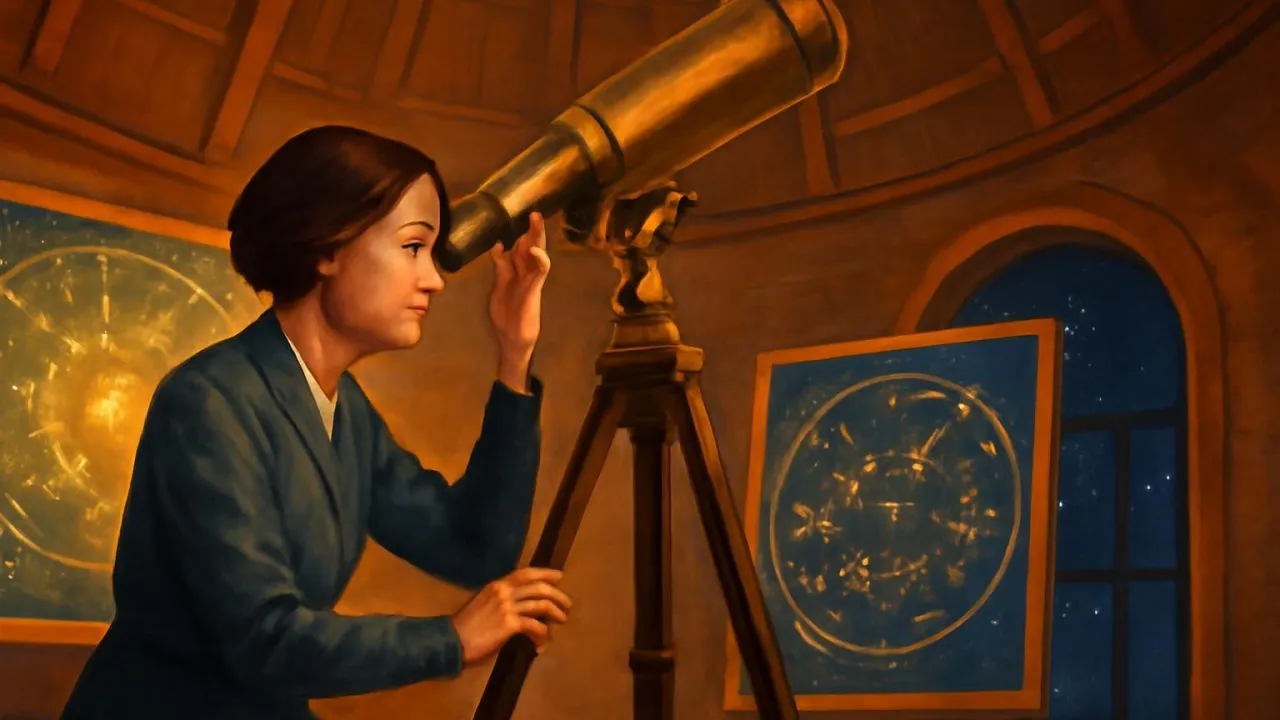
Cecilia’s discovery helped scientists understand every star in the sky!
✨ Word Sparks (Grade 2 Glossary)
Tap 🔊 to hear
scientist
A person who studies and learns
helium
A light gas found in stars
discovery
Finding something new or important
🪝
Have you ever wondered what stars are made of?
1
Curious About the Sky
Cecilia gazed at the stars with wide eyes and big questions. She wanted to know what made them shine. She read many books and dreamed of being a .
2
Learning with Light
Cecilia learned that starlight could tell secrets about space. She used a telescope to study the colors in starlight. Each color showed something special about the star.
3
A Big Discovery
After lots of hard work, Cecilia made a huge . She found out stars are mostly hydrogen and . Her idea changed how people think about the universe.
Cecilia Payne-Gaposchkin was the first person to earn a PhD in astronomy from Radcliffe College!
✨ Word Sparks (Grade 3 Glossary)
Tap 🔊 to hear
spectrum
A rainbow of colors from light
elements
Tiny parts that make up everything
spectroscopy
Studying light to learn about stars
🪝
What if you could solve a space mystery just by studying light?
1
A Young Stargazer
As a child, Cecilia Payne-Gaposchkin loved exploring the night sky and asking questions. She wondered why stars twinkled and what made them shine so brightly. Books about astronomy filled her room and sparked her curiosity. Her dream was to unlock the secrets hidden in starlight.
2
Learning the Language of Stars
Cecilia studied hard and moved to America to learn more about astronomy. She discovered that each star’s light could be split into a rainbow of colors called a . By studying these colors, she could figure out what were inside the stars. This process is called , and it became her favorite scientific tool.
3
A Groundbreaking Discovery
While working at Harvard, Cecilia made a bold discovery that surprised everyone. She showed that stars are mostly made of hydrogen and helium, not the same as Earth. Many scientists did not believe her at first, but her evidence was strong. Her discovery changed how people understood the universe.
4
Changing the Universe
Cecilia’s work inspired other scientists to study stars in new ways. She became a leader in astrophysics and helped many students follow their dreams. Today, we know much more about stars because of her discoveries. Cecilia proved that asking questions and working hard can change science forever.
2. What did Cecilia’s discovery teach us about stars?
🤯 Mind-Blowing Fact • Grade 4
Cecilia’s PhD thesis was called 'the most brilliant ever written in astronomy.'
✨ Word Sparks (Grade 4 Glossary)
Tap 🔊 to hear
astrophysics
The science of stars and space
composition
What something is made of
calculations
Careful math to solve problems
🪝
How did one scientist change what we know about every star in the sky?
1
A Curious Mind Under the Stars
Cecilia Payne-Gaposchkin’s fascination with the night sky began when she was a young girl in England, gazing up at the twinkling stars and wondering about their secrets. Her curiosity led her to study science, even though few women were encouraged to do so in the early 1900s. She read every astronomy book she could find, determined to learn how the universe worked. This passion set her on a path that would change astronomy forever.
2
Unlocking Starlight’s Code
After moving to the United States to study at Harvard, Cecilia learned to use spectroscopy, a technique that breaks starlight into a spectrum of colors. She realized that each element leaves a unique pattern in the spectrum, like a fingerprint. By carefully analyzing these patterns, Cecilia could tell what stars were made of, even though they were light-years away. This method allowed her to investigate questions no one had answered before.
3
A Discovery That Shook Astronomy
In her groundbreaking research, Cecilia discovered that stars are made mostly of hydrogen and helium, not the same elements that make up Earth. At first, many scientists doubted her results because they were so different from what people believed. However, Cecilia’s careful and evidence convinced others over time. Her discovery transformed our understanding of the universe’s .
4
A Lasting Legacy
Cecilia Payne-Gaposchkin became a respected leader in , mentoring students and making new discoveries about stars and galaxies. Her work opened doors for women in science and inspired future astronomers to keep asking big questions. Today, her findings remain fundamental to how we study stars and space. Cecilia’s legacy is a shining example of how curiosity and perseverance can change the world.
1. What technique did Cecilia use to learn about stars?
2. Why was Cecilia’s discovery surprising?
🤯 Mind-Blowing Fact • Grade 5
Cecilia Payne-Gaposchkin’s research proved that hydrogen is the most abundant element in the universe.
✨ Word Sparks (Grade 5 Glossary)
Tap 🔊 to hear
spectral lines
Colored marks that show what stars are made of
variable stars
Stars that change how bright they look
abundant
Something found in very large amounts
🪝
Can you imagine changing the way scientists understand every star in the universe?
1
A Childhood Spark Under English Skies
One chilly evening, young Cecilia Payne-Gaposchkin stared up at the stars, her mind swirling with questions about the universe. Despite growing up in early 1900s England, where few girls were encouraged to study science, Cecilia’s curiosity only deepened as she devoured every astronomy book she could find. She excelled in school, fueled by her determination to understand what made the stars shine. Her relentless passion for learning would soon set her on a groundbreaking path in astrophysics.
2
Crossing Oceans for Science
After earning a scholarship to Cambridge University, Cecilia realized that opportunities for women scientists were limited in England, so she bravely moved to the United States in 1923. At Harvard College Observatory, she worked with some of the world’s leading astronomers, learning to use spectroscopy—a powerful technique that splits starlight into its component colors. By analyzing these , Cecilia could identify the chemical elements present in distant stars, even though she could never touch them.
3
A Thesis That Changed Astronomy
While working on her doctoral thesis at Radcliffe College, Cecilia made a revolutionary discovery: stars are composed primarily of hydrogen and helium, not the heavier elements found on Earth. Her detailed calculations and analysis of stellar spectra challenged the scientific beliefs of her time. Although her findings were initially doubted by many established astronomers, her evidence was so convincing that her thesis was later called 'the most brilliant PhD thesis ever written in astronomy.'
4
Leadership, Mentorship, and Legacy
Cecilia Payne-Gaposchkin went on to become the first woman to be promoted to full professor at Harvard’s Faculty of Arts and Sciences. She mentored many students, published hundreds of scientific papers, and continued researching and the structure of the Milky Way galaxy. Her perseverance opened doors for women in science, inspiring generations to pursue careers in astronomy and physics.
5
A Star’s Enduring Light
Today, Cecilia’s discoveries remain fundamental to our understanding of the universe’s composition. Her work showed that scientific progress often requires challenging old ideas and trusting evidence, even when it’s unpopular. By turning starlight into scientific knowledge, Cecilia Payne-Gaposchkin forever changed how we see the cosmos. Her story reminds us that curiosity, courage, and hard work can illuminate mysteries as vast as the stars themselves.