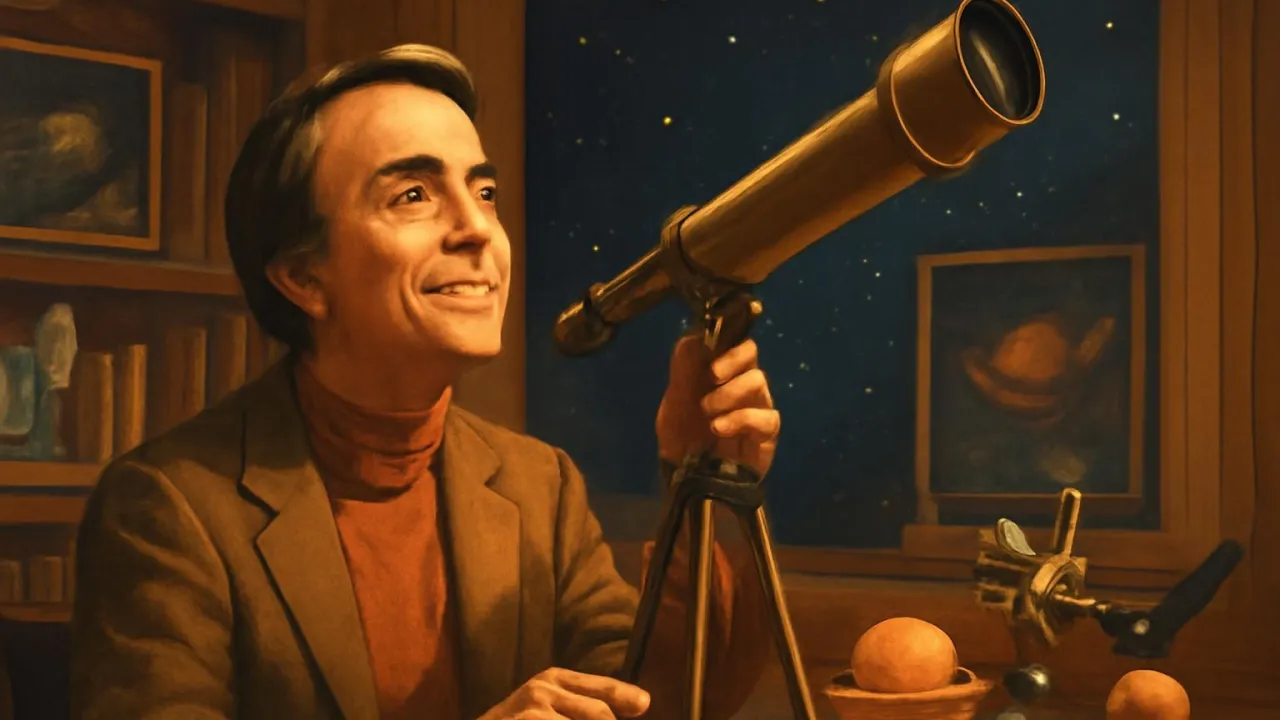
Carl’s TV show “Cosmos” helped millions of people love science.
✨ Word Sparks (Grade 2 Glossary)
Tap 🔊 to hear
universe
Everything in space, even us
spacecraft
A machine that travels in space
curiosity
Wanting to learn and ask questions
🪝
What would you say to someone from another planet?
1
Starry Wonder
As a young boy, Carl stared at the night sky and dreamed about space. He wanted to know what stars were made of. He read every space book he could find. His grew bigger every year.
2
Learning and Sharing
Carl asked questions and listened to science teachers. He used a telescope to see planets and moons. He worked hard to understand how the works. He loved to share his discoveries with others.
3
A Message for Space
Carl helped create a golden record for a space mission. The record held music and greetings from Earth. It was sent on the Voyager . Carl hoped someone far away might one day find it.
Carl Sagan’s books and shows are still used in science classes today.
✨ Word Sparks (Grade 3 Glossary)
Tap 🔊 to hear
spectrometer
A tool that studies light from stars
solar system
The sun and all its planets
perseverance
Not giving up, even when it’s hard
🪝
Imagine building a message for aliens—what would you send?
1
Eyes on the Cosmos
Carl Sagan’s fascination with the night sky began as a child in Brooklyn. He spent hours gazing through his small telescope, wondering about the mysteries of distant planets. His curiosity led him to read every astronomy book at the library. Carl dreamed of exploring the universe and unlocking its secrets.
2
Learning to Explore
Carl studied science in school and asked questions about stars, planets, and life beyond Earth. He learned how to use scientific tools like telescopes and to collect data. His helped him become an expert astronomer and teacher. Carl believed that everyone could understand science if it was explained clearly.
3
The Voyager Golden Record
One of Carl’s most famous projects was the Voyager Golden Record. He helped choose music, sounds, and greetings from Earth to send on the Voyager spacecraft. The record traveled beyond our , hoping to reach intelligent life. Carl wanted to show that humans are curious and friendly explorers.
4
Sharing the Wonders
Carl Sagan became famous for explaining science on TV and in books. His show “Cosmos” inspired millions to look up at the stars. He used words like 'starstuff' to help people feel connected to the universe. Carl’s passion made science exciting for people of all ages.
2. What word did Carl use to connect people to the universe?
🤯 Mind-Blowing Fact • Grade 4
The Voyager spacecraft carrying Sagan’s Golden Record is now over 14 billion miles from Earth.
✨ Word Sparks (Grade 4 Glossary)
Tap 🔊 to hear
astrobiology
The study of life in space
legacy
What someone leaves behind for others
atoms
Tiny building blocks of everything
🪝
How does sharing science change the way we see the universe?
1
A Childhood Spark
One night in Brooklyn, young Carl Sagan stared up at the stars with endless wonder, asking his parents questions about the glowing dots above. This curiosity drove him to read every astronomy book he could find, and soon he was building model rockets in his bedroom. As he grew, Carl’s fascination with the cosmos only deepened, inspiring him to study planetary science and physics in college. His early questions set him on a path to become a leading voice in astronomy.
2
Exploring the Unknown
Carl Sagan’s scientific journey was marked by perseverance and creativity, as he used telescopes and spectrometers to study planets like Venus and Mars. He discovered that Venus’s thick clouds hid a super-hot surface, and he helped explain why Mars has giant dust storms. Sagan’s research into fueled the search for life beyond Earth, and he encouraged scientists to keep asking big questions. His work helped shape NASA’s missions to explore the solar system.
3
The Golden Record and Voyager
Perhaps Sagan’s most famous achievement was leading the creation of the Voyager Golden Record, a time capsule with music, greetings, and sounds from Earth. This record was attached to the Voyager spacecraft, launched in 1977 to travel beyond our solar system. Sagan hoped that, someday, intelligent life might find the record and learn about humanity. The project showed his belief that science could connect people across space and time.
4
Making Science for Everyone
Carl Sagan became a household name by writing bestselling books and hosting the TV series 'Cosmos,' which made complex science easy to understand. He introduced ideas like 'starstuff,' explaining that everything on Earth is made from born in stars. Sagan’s dedication to science education inspired millions to look up at the night sky with curiosity and awe. His lives on in classrooms, space missions, and the imaginations of future explorers.
2. How did Carl Sagan help people feel connected to the universe?
🤯 Mind-Blowing Fact • Grade 5
Voyager 1, carrying Sagan’s Golden Record, is the farthest human-made object from Earth—over 14.8 billion miles away.
✨ Word Sparks (Grade 5 Glossary)
Tap 🔊 to hear
extraterrestrial
Something or someone from outside Earth
skepticism
Carefully questioning if something is true
cosmos
All of space, stars, and planets
🪝
If you could send a message across the galaxy, what story of Earth would you share?
1
A Universe of Questions
On a chilly Brooklyn night, young Carl Sagan pressed his nose to the window, mesmerized by the sparkling sky. That childhood awe never faded—instead, it fueled a lifelong quest to understand the universe. Sagan devoured library books on astronomy, built model rockets, and filled notebooks with sketches of planets and spacecraft. His early curiosity blossomed into a passion for science, leading him to study physics at the University of Chicago, where he began to ask deeper questions about life, the , and humanity’s place among the stars.
2
Scientific Breakthroughs and Perseverance
Carl Sagan’s career was defined by groundbreaking research and relentless perseverance in the face of . He used telescopes and spectrometers to analyze the atmospheres of Venus and Mars, discovering that Venus’s clouds hid a surface hot enough to melt lead and that Mars’s reddish color came from iron-rich dust. Sagan pioneered the field of astrobiology, investigating the potential for life on other planets and championing the search for intelligence. His scientific papers and collaborations with NASA shaped missions like Mariner, Viking, and Voyager, expanding humanity’s understanding of the solar system.
3
The Voyager Golden Record: Earth’s Message in a Bottle
One of Sagan’s most visionary projects was the Voyager Golden Record, a gold-plated phonograph containing music, greetings, and natural sounds from Earth. As chair of the committee, Sagan coordinated scientists, artists, and linguists to select content that would represent all of humanity. Launched aboard the Voyager 1 and 2 spacecraft in 1977, the record now travels beyond our solar system at over 38,000 miles per hour. Sagan hoped that, even if aliens never found it, the project would inspire humans to see themselves as part of a single, global family.
4
Science for the People: Cosmos and Beyond
Carl Sagan believed that science belonged to everyone, not just experts in laboratories. Through bestselling books like '' and his Emmy-winning television series of the same name, Sagan made complex scientific ideas accessible and thrilling. He coined the term 'starstuff' to explain that the atoms in our bodies were forged in ancient stars, connecting every person on Earth to the wider universe. Sagan’s poetic storytelling, clear explanations, and infectious enthusiasm inspired millions to explore science and cherish our pale blue planet.
5
Legacy: Wonder, Skepticism, and the Stars
Carl Sagan’s legacy endures in classrooms, observatories, and space missions around the world. He published over 600 scientific papers and 20 books, received the Pulitzer Prize, and mentored a new generation of astronomers and science communicators. Sagan championed scientific , urging people to question evidence and think critically about the world. His vision of a connected, curious humanity continues to shape how we explore space and care for our planet. As Sagan once said, 'Somewhere, something incredible is waiting to be known.'